

What if your most critical growth lever is actually leaking capital through the cracks of a spreadsheet? For many finance and operations teams, managing volume incentive rebates has become a defensive struggle against fragmented data and human error. Relying on legacy manual processes often results in costly overpayments and a total lack of real-time visibility into how partners are performing against their tiers. Implementing modern vir management software is no longer a luxury for global enterprises; it’s a technical necessity to maintain financial integrity and operational control.
You likely recognize that manual tracking is a primary obstacle to scaling your channel relationships. We understand the frustration of reconciling conflicting data sets while attempting to maintain trust with your partners. This guide provides a clear path toward stability by demonstrating how to automate complex rebate calculations and deploy real-time partner dashboards. You’ll discover how a systematic approach to incentive management eliminates financial disputes and transforms rebates into a predictable engine for growth. It’s time to move beyond the limitations of manual administration and embrace a data-driven strategy that prioritizes performance and precision.
Key Takeaways
- Replace manual spreadsheets with automated systems that can handle the complexity of multi-tiered rebate structures across global networks.
- Implementing dedicated vir management software allows your team to reduce administrative hours and achieve high-precision calculations.
- Leverage dynamic tier management to adjust partner goals in real-time, ensuring your incentive programs remain relevant to current market conditions.
- Eliminate financial disputes and overpayments by transitioning to automated claim processing and validation workflows.
- Learn how PartnerPortal™ centralizes all volume incentive rebate operations to provide a single, authoritative source of truth for partner performance.
The High Cost of Manual Volume Incentive Rebate Management
Volume Incentive Rebates (VIR) are essential for driving bulk purchases and long-term loyalty, yet their multi-tiered structures create significant administrative overhead. Managing these incentives manually often leads to a cycle of reactive accounting rather than proactive growth. A Rebate (marketing) strategy is only effective if the execution is precise. When manufacturers rely on manual tracking, they often face significant financial leaks that are difficult to plug without modern infrastructure.
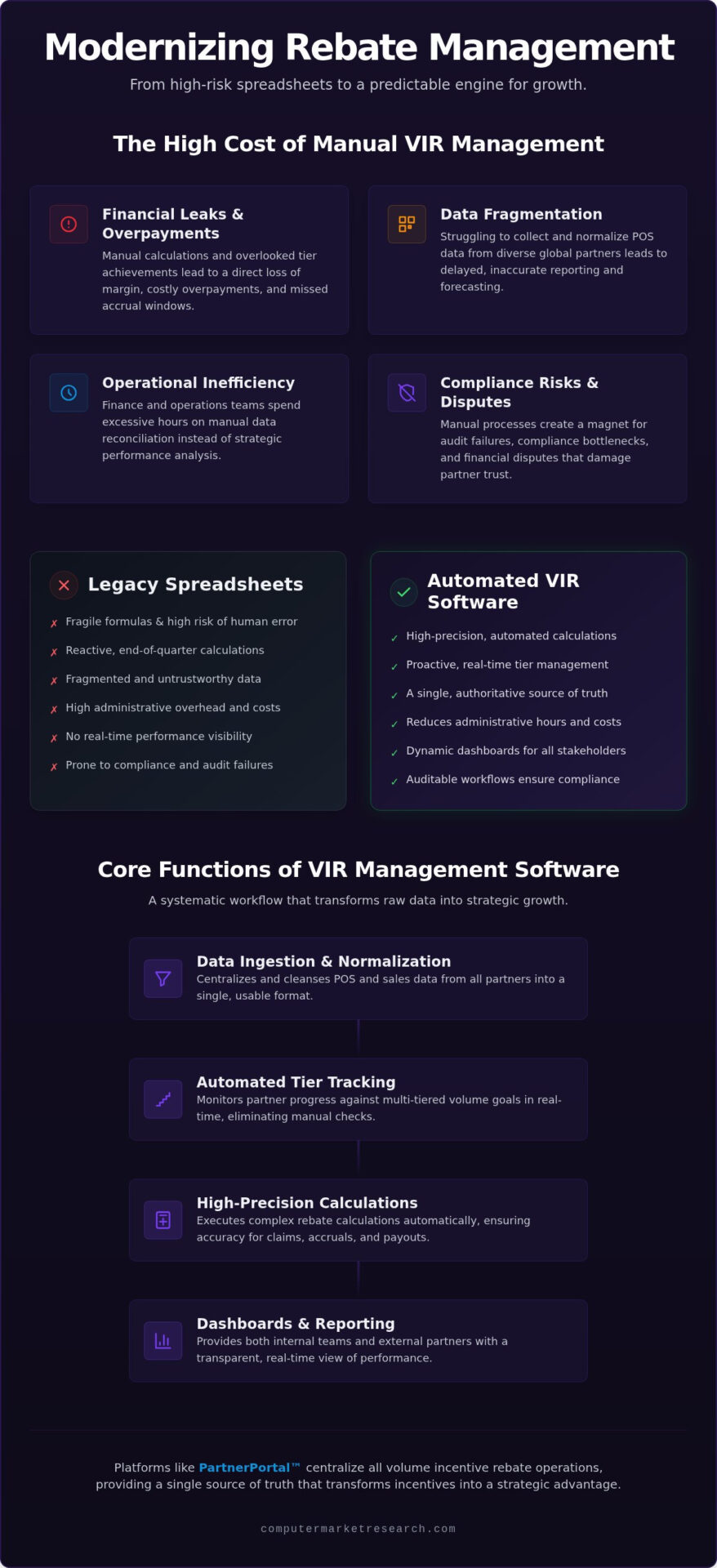
In 2026, spreadsheets simply can’t scale with the speed of global commerce. Fragile formulas and version control issues introduce risks that modern enterprises shouldn’t ignore. Without specialized vir management software, finance teams spend more time hunting for data than analyzing performance. This manual approach creates a hidden financial drain through missed accrual windows and the high cost of correcting historical errors after the books have closed. It’s common for organizations to lose revenue because they lack the tools to track every tier transition accurately across thousands of SKUs and territories.
The Escalation of Channel Data Fragmentation
Collecting Point of Sale (POS) data from a diverse network of global distributors remains a primary challenge for operations leaders. Legacy systems struggle to normalize this information, leading to delayed reporting that compromises financial forecasting accuracy. Dynamic incentive tiers require near-instant data processing to be effective. If your reporting lags by weeks, you lose the ability to influence partner behavior in real-time. Implementing channel data management systems is often the first step toward regaining control over this fragmented landscape and ensuring that your rebate programs are based on clean, verified information.
Financial Risks and Compliance Bottlenecks
Manual rebate calculations are a magnet for audit risks and compliance failures. During end-of-quarter reconciliations, the administrative burden on finance and operations teams becomes overwhelming, often leading to rushed approvals that hide inaccuracies. The ‘rebate gap’ represents the specific point where manual processing errors and overlooked tier achievements lead to a direct loss of margin that is rarely recovered. These errors don’t just impact the bottom line; they damage the foundational trust between manufacturers and their indirect partners. When a partner disputes a payout based on their internal records, the lack of a single source of truth turns a performance incentive into a point of friction. Transitioning to a dedicated vir management software solution ensures that every calculation is auditable and transparent. This shift provides the quiet confidence that your financial records are accurate and your partner relationships are secure.
What Is VIR Management Software? Core Functions Defined
At its core, vir management software is a centralized SaaS platform designed to automate the lifecycle of volume-based incentive programs. It serves as the primary engine for normalizing disparate channel data and executing rebate payouts based on verified performance metrics. Within the broader Partner Relationship Management (PRM) ecosystem, this software acts as a critical bridge. It ensures that the momentum generated by the sales team translates accurately into financial execution. By providing a transparent layer between these two departments, the system removes the friction typically associated with incentive administration.
The software functions by ingesting raw data from various partners and applying pre-defined rules to determine eligibility. This automation replaces the fragmented, error-prone spreadsheets discussed earlier with a systematic workflow. It’s about establishing a single source of truth that both the manufacturer and the partner can trust without reservation. When these systems are deployed correctly, they transform rebates from a back-office burden into a strategic asset.
Automated Tier Tracking and Calculations
One of the most valuable aspects of a modern system is the real-time monitoring of partner progress toward specific volume milestones. Instead of waiting until the end of a quarter to manually calculate achievements, the software provides continuous visibility into current standings. It automatically handles complex percentage-based or flat-fee calculations, even across multi-product bundles or regional variations. This proactive approach effectively eliminates the need for manual ‘look-back’ reconciliations, which are often the source of significant financial discrepancies. When partners can see their progress in real-time, they’re more likely to push for that next tier, directly driving higher sales volumes.
Data Normalization and POS Integration
Effective rebate management depends entirely on the quality of the incoming data. High-performance vir management software includes robust tools for cleaning and standardizing data from multiple partner formats into a uniform structure. This process is deeply connected to Channel Data Management (CDM), which ensures that every transaction is validated before it triggers a payout. By integrating directly with existing ERP and CRM systems, the platform maintains a consistent data flow across the entire organization. This integration ensures that finance teams have the decision-grade insights they need to manage accruals and payouts with total precision. To see how these core functions operate in a live environment, you can explore our platform’s capabilities through a guided experience.
Automated VIR Systems vs. Legacy Spreadsheet Tracking
Transitioning from legacy spreadsheets to automated systems is often the difference between a stagnant channel and a high-performance network. Deciding when to switch depends on whether your current manual workflows can still support your growth targets without compromising accuracy. While manual tracking is prone to an estimated 3-5% error rate, modern vir management software delivers 99.9% precision. This shift doesn’t just save money; it reclaims time. Industry benchmarks suggest that automation can reduce administrative hours by up to 80%, allowing your operations team to focus on strategy rather than reconciliation.
Scalability is the second major factor in this comparison. Spreadsheets are inherently limited by the number of rows a human can audit. When your product catalog grows to thousands of SKUs, manual systems require more headcount just to maintain the status quo. Automated platforms handle this volume effortlessly, ensuring that every transaction is tracked against the correct tier without adding a single person to your payroll.
The Shift to Real-Time Partner Transparency
One of the greatest weaknesses of spreadsheet tracking is the lack of visibility for the channel partner. When incentives are managed via email and offline files, partners often engage in ‘shadow accounting’ to protect their own margins. This creates a defensive relationship where every payout is met with skepticism. Self-service dashboards eliminate this friction by providing real-time progress bars and tier-attainment notifications. Partners who see exactly how close they are to the next volume milestone are naturally more motivated to increase their order frequency.
ROI: Calculating the Value of VIR Automation
The financial impact of automation is measurable and significant. A July 2026 Forrester Total Economic Impact™ study found that a leading rebate management platform provided a 225% return on investment (ROI) for a composite B2B organization, with a payback period of under six months. This ROI stems from the total elimination of overpayments and the reduction of the administrative burden that plagues finance teams. Investing in vir management software ensures that your financial data is both accurate and actionable. By replacing manual uncertainty with algorithmic precision, automation transforms rebates from a static accounting liability into a dynamic competitive advantage that accelerates market share.
5 Essential Features of a High-Performance VIR Platform
Selecting the right vir management software requires a focus on specific technical capabilities that transform raw data into actionable performance. A high-performance platform doesn’t just calculate numbers; it provides a structured environment where incentives are managed with surgical precision. To move beyond the limitations of legacy systems, look for these five foundational features:
- Dynamic Tier Management: The ability to adjust volume goals based on shifting market conditions ensures your programs remain competitive throughout the fiscal year.
- Automated Claim Processing: Streamlining the validation and payout workflow removes the manual bottlenecks that often delay partner compensation.
- Robust Reporting & Analytics: Real-time ROI tracking allows operations leaders to see the exact impact of every incentive dollar spent within their vir management software ecosystem.
- Seamless Integration: The platform must connect directly with your existing partner portal software to maintain a unified user experience.
- Audit Trail & Compliance: Maintaining a permanent digital record of every transaction and approval ensures financial transparency and simplifies end-of-year audits.
These features work together to create a reliable infrastructure for your indirect sales channel. When these elements are integrated into a single dashboard, the administrative burden on your finance team drops significantly. It’s about establishing a framework that supports growth without sacrificing the accuracy of your financial records.
Multi-Currency and Global Support
For global enterprises, managing rebates across different regions and tax jurisdictions is a primary operational hurdle. A sophisticated system must handle localized incentive programs while maintaining a consistent global framework. This includes automatic currency conversion and adherence to international financial reporting standards, ensuring that payouts are both accurate and compliant regardless of where your partners are located. This global visibility is essential for maintaining a standardized approach to channel growth.
Configurable Incentive Rules
Modern channel incentive programs require flexible ‘if-then’ logic to address diverse partner types and product groups. High-performance software allows you to set modular rules based on specific timeframes or promotional windows. This modularity ensures that as your strategy evolves, your system can adapt without requiring custom code or expensive re-implementation. If you’re ready to see how these features can stabilize your operations, you can start your 90-day free trial today to experience the precision of automated management.
Scaling Incentives with PartnerPortal™ VIR Solutions
Scaling a global channel requires more than just software; it needs a unified ecosystem where every incentive aligns with your broader business objectives. Computer Market Research (CMR) provides this infrastructure through PartnerPortal™, a centralized platform designed to handle the rigorous demands of Global 2000 enterprises. By consolidating all volume incentive rebate operations within a single interface, you eliminate the fragmented data silos that typically lead to financial leakage. This centralization ensures that your vir management software isn’t just a tool for calculation, but a strategic asset for channel governance.
One of the most significant advantages of the CMR approach is the ability to combine VIR with Market Development Funds (MDF). When these two programs operate in tandem, you create a more powerful incentive structure that rewards both high-volume purchasing and strategic market activities. PartnerPortal™ also leverages Managed Data Services to offload the heavy lifting of data cleansing. This service ensures that your POS and inventory data are normalized before they ever reach the rebate engine, guaranteeing the accuracy of every payout. You no longer need to worry about the inconsistencies of diverse global distributor formats. Our team handles the normalization, so your finance department receives decision-grade information every time.
A Holistic Approach to Channel Management
True efficiency comes from integrating VIR with other critical workflows like deal registration and lead management. PartnerPortal™ offers a single sign-on (SSO) experience, allowing your partners to access everything they need without navigating multiple disconnected systems. This streamlined approach improves the partner experience and ensures long-term scalability. As your organization grows, the system adapts to handle increasing complexity across thousands of global partners. It’s a pragmatic solution built for professionals who value order and performance above all else. You can customize the portal to reflect your brand and specific partner workflows, ensuring the interface feels like a natural extension of your company.
Getting Started with CMR Automation
The transition to a modernized system is a methodical process. Our implementation journey begins with a comprehensive data audit to identify existing gaps in your reporting. From there, we work closely with your team to ensure seamless technical integration with your current CRM and ERP systems. This structured path ensures that by the time you launch your portal, every workflow is optimized for precision. You don’t have to settle for the limitations of legacy tracking any longer. It’s time to optimize your rebate programs with CMR and experience the stability of a truly automated channel.
Future-Proofing Your Channel Incentive Strategy
Transitioning from manual tracking to a systematic infrastructure is the only logical step for organizations aiming to scale in 2026. By centralizing your workflows, you replace the uncertainty of fragmented spreadsheets with the precision of automated calculations. This shift doesn’t just protect your margins; it builds a foundation of trust with your partners through total transparency and real-time performance tracking. Implementing robust vir management software ensures that your incentive programs remain a dynamic driver of growth rather than an administrative burden.
Since 1984, Computer Market Research has provided the technical depth required by Global 2000 companies to manage complex channel relationships. Our platform combines comprehensive Managed Data Services with seamless ERP and CRM integration to deliver a single source of truth for your financial operations. You can eliminate the friction of manual errors and start focusing on high-impact strategic initiatives that move the needle for your business. We invite you to Schedule a PartnerPortal™ Demo to Automate Your Rebates and see the difference that technical competence makes. It’s time to reclaim control over your data and drive your channel performance to new heights.
Frequently Asked Questions
What is VIR in channel management?
VIR stands for Volume Incentive Rebate, a strategy where manufacturers reward partners for reaching specific purchase volume milestones. Unlike a simple discount, VIR is paid after the purchase, ensuring that partners meet their performance commitments before receiving the incentive. This approach encourages bulk purchasing and long-term loyalty by creating a tiered system where higher volumes unlock greater financial rewards. It’s a fundamental component of strategic channel management.
How does VIR management software reduce rebate overpayments?
Automated vir management software eliminates the manual spreadsheet errors that often lead to overpayments. By using standardized rules and real-time data validation, the system ensures that payouts are only triggered when verified performance milestones are met. This precision prevents “double-dipping” or claims based on incorrect tier logic. Centralizing all rebate calculations within a single platform provides an auditable trail that protects company margins and ensures financial accuracy across the network.
Can VIR software integrate with my existing CRM or Oracle ERP?
Yes, modern platforms like PartnerPortal™ are built to integrate seamlessly with leading CRM and ERP systems. These integrations ensure a consistent flow of data between your financial records and your channel management workflows. Technical integration fees typically cover the initial setup to synchronize partner profiles, transaction history, and payout authorizations. This connectivity creates a single source of truth, reducing the need for manual data entry and preventing information silos.
What is the difference between a rebate and a discount in channel sales?
A discount is applied at the time of purchase, reducing the upfront cost, whereas a rebate is a retrospective payment made after specific conditions are met. Rebates are more effective for driving behavior because they require the partner to achieve a volume milestone before receiving the value. This structure allows manufacturers to maintain higher list prices while rewarding their most productive partners. It also provides better control over channel pricing and prevents immediate margin erosion.
How long does it take to implement a VIR management system?
Implementation timelines vary based on the complexity of your incentive structures and the quality of your existing data. A typical deployment involves a structured process from an initial data audit to the final portal launch. While the exact duration depends on the depth of ERP or CRM integrations required, a phased approach often allows for core functionality to be active within a few months. Professional service teams work closely with you to ensure a smooth transition.
Does VIR management software support global multi-currency programs?
High-performance vir management software is designed to handle the complexities of global commerce, including multi-currency support and regional tax compliance. The system automatically converts localized transaction data into a primary reporting currency while ensuring that partner payouts are made in their local currency. This capability is essential for Global 2000 enterprises that manage diverse partner networks across multiple jurisdictions. It ensures that your global incentive strategy remains consistent and compliant worldwide.
How does automation improve partner trust and performance?
Automation provides partners with real-time visibility into their progress through self-service dashboards. When partners can see exactly how close they are to reaching the next volume tier, they’re more likely to increase their purchasing activity to unlock the higher reward. Clear, automated communication eliminates the “shadow accounting” and disputes that often arise from opaque manual tracking. This transparency fosters a collaborative relationship built on performance rather than administrative friction.
What data is required to start an automated volume incentive program?
To launch an automated program, you need clean Point of Sale (POS) data, inventory reports, and partner purchase history. Many organizations utilize Managed Data Services to handle the collection and normalization of this information from various distributor formats. Standardizing this data is critical for ensuring that the incentive rules are applied accurately. Once the foundational data is normalized, the system can begin calculating tier achievements and processing payouts with high precision.

Article by
Del Heles
Del Heles is the founder and CEO of Computer Market Research (CMR), a channel management software company he launched in 1984. With more than 40 years of experience, he’s known for helping manufacturers and distributors simplify complex partner programs through practical, customer-focused technology solutions.