

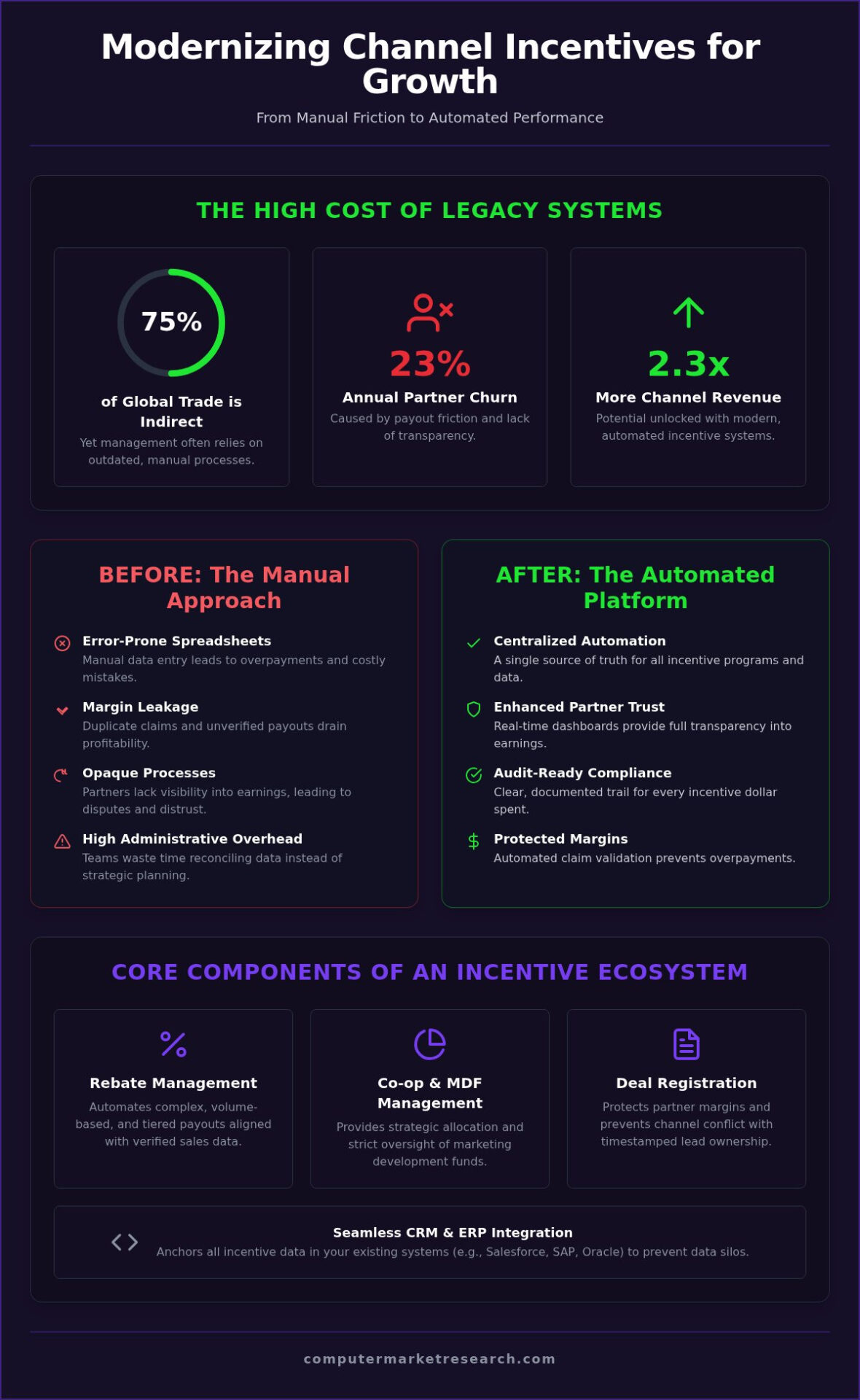
Did you know that indirect sales account for approximately 75% of global trade, yet the average B2B company loses 23% of its channel partners every year? It’s a staggering loss of potential that often stems from the friction of manual administrative errors and opaque payout processes. You likely recognize the frustration of reconciling fragmented POS data against complex rebate structures while your partners wait for earned incentives. Implementing robust channel incentive software is no longer optional if you want to eliminate these bottlenecks and stop legacy processes from obstructing your growth.
This guide provides a strategic roadmap to reclaiming control through automation and data transparency. We’ll show you how to automate complex rebate, MDF, and ship-and-debit programs to eliminate margin leakage and build partner trust. You’ll learn how to transition from fragmented inventory reports to a centralized PartnerPortal™ that delivers decision-grade insights into channel performance. We’ll explore how to leverage modern infrastructure to drive up to 2.3x more revenue from your channel and turn your incentive programs into a measurable engine for sustainable growth.
Key Takeaways
- Shift your channel strategy from manual, reactive payouts to a centralized model that prioritizes long-term partner engagement and strategic growth.
- Deploy advanced channel incentive software to automate complex claim processing, effectively eliminating the manual errors that lead to partner friction and margin leakage.
- Learn why accurate POS and inventory data normalization is the essential foundation for any audit-ready incentive or ship-and-debit program.
- Measure the tangible ROI of modernized systems by tracking reductions in administrative overhead and the elimination of costly incentive overpayments.
- Follow a structured, phased implementation plan for PartnerPortal™ to ensure your global incentive programs are scalable and reflect your specific brand requirements.
What is Channel Incentive Software and Why is it Critical?
Channel incentive software is a centralized SaaS platform designed to manage the financial complexities inherent in a marketing channel. It streamlines the administration of rebates, Market Development Funds (MDF), and SPIFFs, moving these critical functions away from the error-prone world of manual spreadsheets. In 2026, the industry’s focus has moved beyond tactical payouts. Today, successful organizations use these funds as precision levers for strategic partner engagement and long term loyalty.
While Partner Relationship Management (PRM) systems handle communication and recruitment, specialized channel incentive software provides the technical engine required for financial scale. It bridges the gap between high-level strategy and granular transaction verification. For many organizations, legacy manual tracking isn’t just slow; it’s a primary obstacle to growth. Relying on fragmented data creates a lack of transparency that eventually erodes partner trust and slows down sales cycles.
To better understand how these platforms function in a real-world enterprise environment, watch this helpful overview:
The Core Components of an Incentive Ecosystem
A robust ecosystem relies on three primary pillars to maintain order and drive performance across a diverse partner base:
- Rebate management: This module handles volume-based and performance-based goals, ensuring that payouts align with actual sales data rather than unverified partner claims.
- Co-op and MDF Management: These tools allow for the strategic allocation of marketing funds while maintaining strict oversight of how they’re utilized in the field.
- Deal registration: This protects partner margins and prevents channel conflict by providing a clear, timestamped record of lead ownership.
Why Fortune 500 Companies are Automating Now
Global enterprises are moving toward automation to solve three critical business challenges. First, they must stop margin leakage. When companies rely on manual verification, they often suffer from overpayments and duplicate claims that quietly drain profitability. Second, they’re focused on improving the partner experience. Partners expect real-time visibility into their earnings and predictable payout schedules. Finally, centralized systems like PartnerPortal™ ensure that companies meet strict compliance and audit requirements for global financial reporting, providing a clear, documented trail for every incentive dollar spent.
Key Features of Enterprise Channel Incentive Platforms
Modern channel incentive software acts as a specialized layer that sits between your commercial strategy and your financial execution. It isn’t just a ledger; it’s a dynamic environment that automates claim processing to eliminate the manual data entry errors that plague legacy systems. By integrating seamlessly with existing CRM platforms like Salesforce and ERP systems such as SAP or Oracle, these platforms ensure that every incentive payout is anchored in verified sales data. This level of technical cohesion prevents the data silos that often lead to conflicting reports and frustrated partners.
Real-time performance dashboards provide a single source of truth for both manufacturers and their partners. This transparency is vital for global channel operations, where multi-currency and multi-language support are required to maintain consistency across diverse regions. When partners can see their progress and potential earnings in their local currency, it removes a significant layer of friction from the relationship and fosters a sense of professional stability.
Rebates & Incentives: Beyond Simple Payouts
Enterprise platforms must handle more than just flat percentage payouts. They support complex structures like tiered rebates and ship-and-debit agreements that respond to specific market conditions. According to research on using incentives to drive pipeline, targeted programs are significantly more effective at accelerating sales than generic rewards. To maintain momentum, instant notification systems alert partners the moment they achieve a milestone. You can automate your rebates and incentives to ensure these payments are always accurate and audit-ready.
Co-op and MDF Management Modules
Managing Market Development Funds often feels like a logistical hurdle rather than a growth driver. Modern modules solve this by providing streamlined fund request and approval workflows directly within a centralized portal. This eliminates back-and-forth emails and ensures funds are allocated where they’ll have the most impact. For a deeper look at these strategies, consult The Strategic Guide to Market Development Funds (MDF).
Verification is the other side of the MDF coin. Integrated tools for Proof-of-Performance (PoP) allow partners to upload documentation easily, which the system then verifies against predefined criteria. This rigorous approach protects your marketing budget while rewarding high-performing partners. If you’re ready to see how these tools transform operations, you can test these features with a risk-free trial.
The Foundation of Incentives: Channel Data Management
Many channel programs suffer from a fundamental flaw: they attempt to incentivize performance based on unverified or incomplete information. Without granular Point-of-Sale (POS) and inventory data, your channel incentive software is essentially operating in the dark. This lack of visibility often leads to over-rewarding partners for sales that never occurred or for inventory that hasn’t actually moved. By anchoring your rewards in verified data, you ensure every dollar spent is a direct investment in actual sales activity rather than a guess based on outdated reports.
Global distribution networks present a unique challenge known as “dirty data.” When you’re receiving reports from thousands of partners across different regions, you’re dealing with a chaotic mix of file formats. This fragmentation makes manual verification impossible and creates a significant administrative burden that leads to friction. According to the research on Effective Design Patterns for Channel Programs, accurate data collection is a prerequisite for any program’s success. Managed Data Services can offload this technical burden, allowing your team to focus on strategy rather than cleaning spreadsheets.
Normalizing POS and Inventory Reports
Data normalization is the systematic process of converting disparate formats into a single, audit-ready source of truth. This involves several technical steps to ensure accuracy:
- Format Standardization: Cleaning Excel, CSV, and EDI files into a uniform structure.
- SKU Mapping: Matching partner-specific codes against your internal product SKUs.
- Price Verification: Reconciling reported sales prices against authorized pricing lists.
When you optimize your channel data management, you create a transparent environment where both the manufacturer and the partner can trust the numbers. This approach ensures that payouts are calculated on a level playing field, regardless of where the partner is located.
Validating Ship & Debit Claims
Ship-and-debit is a commercial mechanism for maintaining partner profitability in volatile markets by providing price protection on inventory already in the channel. However, without real-time inventory visibility, these claims are highly susceptible to fraud or duplication. Sophisticated validation logic checks each claim against existing inventory levels and historical sales records to ensure it’s legitimate. This prevents partners from claiming price protection on products they’ve already sold at a higher margin. By applying consistent logic across all regions, you maintain global price integrity while protecting your bottom line from unnecessary margin leakage.
Calculating the ROI of Channel Incentive Software
Measuring the return on investment for channel incentive software requires a dual track approach that accounts for both hard financial recoveries and long term operational stability. While some industry models focus solely on gross margin basis points, a pragmatic analysis must include the reduction of internal administrative labor and the elimination of the “soft” costs associated with partner dissatisfaction. In 2026, the most effective way to optimize program spend is by measuring the Incentive to Revenue ratio. This technical metric allows operations professionals to determine if incentive dollars are driving incremental growth or simply rewarding transactions that would have occurred regardless of the reward structure.
Implementing centralized deal registration also plays a critical role in ROI by reducing internal sales conflict. When your direct sales team and channel partners aren’t competing for the same leads, you protect your brand’s reputation and ensure that commissions are paid to the party that actually generated the value. This clarity prevents the double-dipping and disputes that often arise in fragmented systems, leading to a more predictable and audit-ready financial environment.
Recovering Lost Margins from Manual Errors
Manual rebate processing is fundamentally leaky. Humans frequently miss duplicate claims, especially when they are buried in thousands of lines of disparate spreadsheet data across multiple regions. Automated systems identify these overlaps instantly, recovering lost margins that would otherwise disappear into administrative black holes. By streamlining digital workflows, you also significantly reduce the cost-per-claim, transforming a high-touch administrative burden into a low-touch automated process. For a deeper dive into these efficiencies, see our guide on Maximizing Channel ROI through Incentive Programs.
Partner Engagement and Revenue Acceleration
Payout speed is a direct driver of partner mindshare. In a competitive market, partners prioritize the vendors who provide predictable, rapid rewards over those with opaque and slow fulfillment cycles. By using data-driven incentives, you can strategically push high-margin product lines or new releases to accelerate your time-to-market. Partner Experience (PX) is the cumulative effect of every digital and operational interaction a partner has with your brand, and it now serves as a primary competitive differentiator for manufacturers. You can begin identifying these efficiency gains immediately when you start your 90-day free trial of PartnerPortal™.
Implementing PartnerPortal™ for Global Operations
Moving away from legacy spreadsheets requires a methodical, phased strategy to ensure business continuity. A successful deployment of channel incentive software begins with establishing a clean data foundation before layering on complex automation rules. This progression allows your operations team to validate each step, from initial data collection to full incentive fulfillment, ensuring the system reflects the nuances of your specific partner ecosystem. Professional services are often essential during this phase to handle initial configuration and ensure the platform aligns with your corporate branding and partner tiering structures.
Integrating with CRM and ERP Systems
True operational efficiency is only achieved when your incentive platform talks to your core business systems. By syncing deal registration data with Salesforce, you create a unified pipeline view that eliminates the blind spots often found in indirect sales channels. This integration ensures that every lead is tracked from inception to payout. On the back end, connecting your incentive engine to financial ERPs like SAP or Oracle allows for automated accounting and reconciliation. This technical bridge removes the manual intervention typically required to move funds, ensuring that your financial reporting is both timely and accurate. You can Centralize your operations with PartnerPortal™ to bridge these critical data gaps.
Scaling to Global 2000 Requirements
Large-scale enterprises require more than just simple payout tools; they need hierarchical data views to manage complex, multi-tiered distributor relationships. PartnerPortal™ is designed for this level of complexity, providing the visibility needed to manage global partner ecosystems without compromising security. Maintaining SOC 2 compliance and adhering to regional data privacy regulations is a non-negotiable requirement for global operations. These security protocols ensure that sensitive partner information and financial data remain protected across all regions. As you move toward a modernized infrastructure, the focus shifts from simply managing transactions to building a scalable discipline that supports long-term growth. To begin this transformation, Partner Smarter with CMR.
Modernizing Your Channel for Sustainable Growth
Transitioning from manual spreadsheets to automated channel incentive software is the most significant step you can take to eliminate margin leakage and rebuild partner trust. By prioritizing data normalization and real-time visibility, you move beyond the limitations of legacy processes that often obstruct global scaling. Success in 2026 requires a centralized ecosystem where every rebate and MDF payout is anchored in 100% accurate sales data.
Computer Market Research has served Fortune 500 and Global 2000 companies for over 40 years, providing the technical competence needed to manage complex industry relationships. Our PartnerPortal™ platform integrates automated Co-op/MDF and Rebate modules with comprehensive Managed Data Services to ensure audit-ready precision across every region. This systematic approach transforms incentive management from a logistical burden into a measurable driver of ROI. You don’t have to navigate these data challenges alone. Take the first step toward operational stability today and Request a Demo of PartnerPortal™ to see how we can accelerate your channel performance.
Frequently Asked Questions
What is the difference between channel incentives and standard rebates?
Channel incentives are a broad category of rewards including MDF, SPIFFs, and co-op funds, while standard rebates are a specific type of financial return based on volume. Standard rebates focus on transactional volume, but channel incentives aim to influence various partner behaviors. Using specialized channel incentive software allows you to manage these diverse programs under a single, unified strategy that rewards the specific actions that drive your business forward.
How does channel incentive software integrate with Salesforce or other CRMs?
PartnerPortal™ integrates with Salesforce and other CRMs through secure APIs to sync deal registration and pipeline data. This connection ensures that partner led opportunities are visible to your direct sales team, preventing lead duplication and conflict. By mapping your CRM fields to the portal, you create a seamless flow of information that automates the transition from a closed deal to a verified incentive payout without manual data entry.
Can this software handle multi-currency payouts for global partners?
Yes, enterprise platforms are designed to handle multi-currency and multi-language requirements for global partner networks. The system automatically converts incentive values based on real-time or fixed exchange rates, ensuring that partners in different regions receive accurate payouts in their local currency. This functionality is critical for maintaining consistency and compliance across international markets while reducing the administrative burden on your internal finance and operations teams.
What are the common risks of managing incentives through spreadsheets?
Managing incentives through spreadsheets introduces significant risks, including manual data entry errors and duplicate rebate claims. These legacy processes often lead to margin leakage and partner friction because of delayed or inaccurate payments. Modern channel incentive software eliminates these risks by providing a centralized, audit-ready record of every transaction. This automation ensures you don’t lose visibility into your program ROI and maintains compliance with global financial regulations.
How does deal registration prevent channel conflict?
Deal registration prevents channel conflict by granting a specific partner exclusive rights to a lead for a set period. When a partner registers a deal in PartnerPortal™, the system timestamps the entry and alerts the sales team to prevent direct sales or other partners from pursuing the same account. This protection ensures that the partner who did the groundwork is the one who receives the commission or incentive reward.
What is the typical implementation timeline for an enterprise partner portal?
A typical implementation for an enterprise partner portal ranges from 90 days to several months. It’s a timeline that depends on the complexity of your integrations and the number of data sources involved. The process begins with a discovery phase to map your existing workflows, followed by portal configuration and technical integration with your CRM. Professional services teams work alongside your staff to ensure the system’s fully validated before a global rollout.
How do you verify proof of performance for MDF claims?
Verifying proof of performance (PoP) involves partners uploading documentation, such as invoices, photos, or campaign screenshots, directly into the portal for review. Automated workflows then route these materials to the appropriate managers for approval based on predefined program criteria. This systematic approach ensures that Market Development Funds are only paid out once the partner has demonstrated that the marketing activity was completed as originally agreed.
What is managed data services in the context of channel management?
Managed data services involve the outsourcing of channel data collection, cleansing, and normalization to a specialized provider. This service ensures that disparate POS and inventory reports from thousands of global distributors are converted into a single source of truth. It’s a process that removes the technical burden from your internal team. By offloading this administrative task, you can focus on strategy while ensuring your payouts are always based on accurate information.

Article by
Del Heles
Del Heles is the founder and CEO of Computer Market Research (CMR), a channel management software company he launched in 1984. With more than 40 years of experience, he’s known for helping manufacturers and distributors simplify complex partner programs through practical, customer-focused technology solutions.