

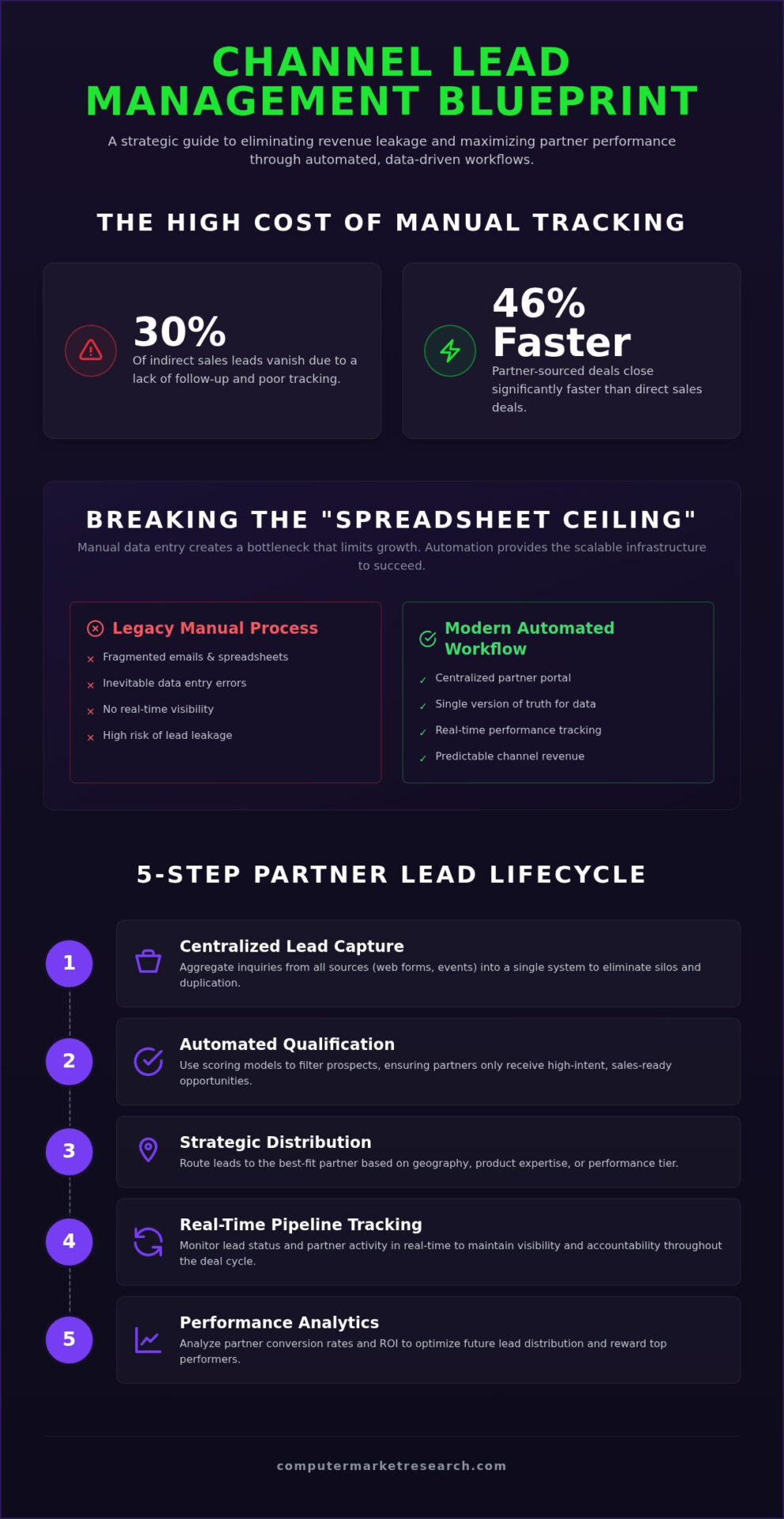
Did you know that over 30% of your indirect sales leads currently vanish into a black hole where they remain unanswered? It’s a frustrating reality for many channel leaders who still rely on manual spreadsheets and fragmented emails to track partner activity. When data is siloed and tracking is manual, errors are inevitable. Optimizing your channel partner lead management isn’t just about sending names to partners. It’s about building a disciplined system of data integrity that ensures every opportunity is accounted for.
You likely already know that partner-sourced deals close 46% faster than direct deals, yet you’re struggling with a lack of visibility into partner performance. This guide provides a strategic blueprint to master the mechanics of lead distribution and tracking to eliminate revenue leakage. We’ll examine how to transition from legacy manual processes to automated workflows that provide real-time transparency. You’ll learn how to use PartnerPortal™ to implement a single version of truth for your data, resulting in higher conversion rates and audit-proof ROI for every dollar of your channel spend.
Key Takeaways
- Define a systematic process for lead qualification that ensures your partners receive only high-intent prospects; this maximizes their closing potential.
- Modernize your channel partner lead management by implementing a “Leads-in, Leads-out” policy that rewards high-performing partners with quality opportunities.
- Discover why manual data entry creates a “Spreadsheet Ceiling” that limits growth and learn how to transition to a more scalable automated infrastructure.
- Utilize PartnerPortal™ to centralize all partner data. This eliminates the fragmented information that typically leads to operational bottlenecks.
- Drive predictable channel revenue by establishing clear accountability through real-time tracking of partner conversion rates.
What is Channel Partner Lead Management in 2026?
In 2026, channel partner lead management is defined as the systematic process of capturing, qualifying, and distributing leads to third-party partners while maintaining rigorous visibility throughout the entire deal cycle. It’s the operational engine that powers indirect sales. Partners naturally prioritize brands that provide high-quality, ready-to-close opportunities over those that simply dump raw, unverified data into their inboxes. This discipline ensures that every marketing-generated lead has a clear path to conversion through the partner network.
Effective management addresses three core pillars that manual systems often ignore:
- Data accuracy and cleansing across the entire partner ecosystem.
- Speed of lead delivery to ensure prospects are contacted while intent is high.
- Accountability for conversion outcomes through closed-loop reporting.
Many organizations confuse lead distribution with comprehensive management. Lead distribution is the singular, often manual, act of passing contact information to a reseller. In contrast, effective Lead Management encompasses the full lifecycle of a prospect, including status updates, conversion tracking, and post-sale analysis. Without this end-to-end oversight, you lose the ability to forecast channel revenue accurately. This is critical because partner-sourced deals close 46% faster than non-partner deals, making their management a top priority for predictable growth.
The Shift from Passive to Active Lead Management
Relying on manual emails to send leads is a legacy strategy that fails in a competitive global market. Active management requires real-time data flow to maintain partner mindshare. If a partner doesn’t see immediate value or a clear path to closure, they’ll focus on your competitors’ products instead. You need a system that alerts you the moment a lead is ignored. Lead leakage refers to the percentage of qualified opportunities that go unaddressed or fall out of the sales funnel due to poor tracking or partner apathy, directly eroding the return on channel investment. Transitioning to an active model ensures that no lead is left to wither in an unmonitored inbox, especially as 62% of firms with over $25M ARR have already adopted automated systems to streamline these interactions.
Why Ease-of-Doing-Business (EoDB) Wins
High-performing partners are busy and often represent multiple vendors simultaneously. They gravitate toward companies that make their jobs easier. A centralized PartnerPortal™ reduces operational friction by providing a single location for lead access, deal registration, and reporting. When you deliver high-quality, pre-qualified leads through a structured system, you build deep psychological loyalty. This reliability positions your brand as a preferred partner, ensuring your leads are prioritized over less organized competitors. Effective channel partner lead management through channel partner management software transforms your indirect sales force from a collection of independent entities into a synchronized extension of your internal team.
The 5-Step Lifecycle of a Partner-Managed Lead
Successful channel partner lead management follows a disciplined, five-step sequence that transforms raw data into predictable revenue. This lifecycle begins with Centralized Lead Capture, where inquiries from web forms, trade shows, and marketing campaigns are aggregated into a single system. Without centralization, leads reside in silos, leading to duplication and missed opportunities that eventually result in revenue leakage.
The second stage is Automated Qualification. Here, scoring models filter prospects to ensure partners only receive high-intent inquiries. Next comes Strategic Distribution, where leads are routed based on specific criteria like geography, product expertise, or partner tier status. Following distribution, Real-Time Pipeline Tracking allows vendors to monitor progress as leads move from initial contact to closed-won status. Finally, Performance Analytics provide the data necessary to optimize future distribution strategies based on actual conversion results and historical partner success rates.
Automating Lead Qualification and Scoring
Sending “cold” or unverified leads to your top-tier partners is a fast way to lose their trust and mindshare. To maintain high engagement, you must define what constitutes a “Sales Ready” lead based on BANT (Budget, Authority, Need, Timeline) or similar frameworks. This prevents partner frustration and ensures their sales teams focus on deals with a high probability of closing. By utilizing PartnerPortal™, you can set automated triggers that re-assign leads if a partner fails to acknowledge them within a specific timeframe. Aligning these processes with Channel Management Best Practices ensures that your qualification standards remain consistent across your global ecosystem.
Strategic Lead Distribution Models
Choosing the right routing model is essential for a healthy channel. While a round-robin approach ensures fairness, a performance-based model rewards the partners who demonstrate the highest conversion rates. Many organizations find a hybrid approach works best, where high-value leads are reserved for top-tier partners. Integrating this with Channel Partner Management Software allows for seamless deal registration, which protects partner margins and prevents channel conflict. If you’re looking to modernize your current workflow, you can explore our automated distribution tools to see how they eliminate manual bottlenecks. This level of automation ensures that channel partner lead management remains a scalable part of your growth strategy rather than a manual burden.
The Spreadsheet Ceiling: Why Manual Tracking Fails
The “Spreadsheet Ceiling” represents the critical point where manual data entry begins to compromise organizational growth. For many organizations, this threshold is reached when reporting errors exceed 20%, a common byproduct of fragmented tracking across disconnected files. Relying on static documents creates a “Lead Black Hole” where approximately 40% of leads sent via email are never followed up on. Without automated oversight, these opportunities simply vanish, resulting in significant revenue leakage that often goes undetected until year-end audits.
This lack of transparency also leads to the high cost of inaccurate data. Companies frequently find themselves overpaying on incentives or rebates for leads that weren’t actually partner-originated. Effective Maximize Partner Relationship Management requires moving beyond these legacy methods to ensure financial precision. Manual processes don’t just slow you down; they create active friction between direct and indirect sales teams. When two teams claim the same prospect without a clear, timestamped record, the resulting conflict damages internal morale and external partner trust.
The Hidden Costs of Administrative Burden
Managing channel partner lead management through manual updates consumes hundreds of hours each month. Administrative teams spend their time chasing partners for status reports rather than analyzing performance data. This delay prevents VPs of Sales from making real-time decisions, as the information they review is often weeks out of date. In manual systems, channel conflict is an inevitable outcome of overlapping claims and the absence of a single version of truth. These operational bottlenecks act as a primary obstacle to scaling a global channel program efficiently.
Data Integrity and Audit Risks
For Global 2000 companies, “good enough” data isn’t an option. These enterprises require audit-proof lead-to-revenue trails to justify channel spend and ensure regulatory compliance. Clean POS data plays a vital role in this process by verifying lead closure against actual sales records. Transitioning to a structured Channel Data Management Guide ensures that your financial tracking is accurate and your ROI data is indisputable. By centralizing channel partner lead management, you eliminate the data errors that plague manual workflows and build a foundation for sustainable, high-quality information.
Best Practices for Maximizing Partner Conversion
Maximizing partner conversion requires addressing the psychological and operational friction that often exists in the channel. A “Leads-in, Leads-out” policy is a powerful incentive for building a high-performance culture. It ensures that your highest-quality opportunities are routed exclusively to partners who demonstrate a consistent track record of follow-up and closure. This meritocratic approach prevents lead stagnation and encourages partners to prioritize your brand over competitors who may distribute leads indiscriminately. When partners know that their performance directly dictates their future opportunity volume, their engagement levels rise significantly.
Accountability is further strengthened when you align channel partner lead management with Market Development Funds (MDF). By making future fund eligibility contingent on lead follow-up performance, you create a direct financial link between marketing spend and sales activity. Automated notifications are essential to support this workflow. They remind partners of aging leads before they grow cold, ensuring that the opportunities that typically go unanswered in manual systems are captured and pursued. This level of automation is critical given that Microsoft attributes approximately 95% of its commercial business to partners, proving that even the largest global enterprises rely on precise partner execution.
Nurturing Leads Through Partner Enablement
Conversion rates often stall because partners lack the right content to move a prospect through the sales funnel. Providing co-branded marketing assets directly within your portal speeds up the sales cycle and ensures brand consistency. You can use PartnerPortal™ to track which specific whitepapers or case studies drive the most conversions across different partner tiers. For more advanced strategies on scaling these efforts, consult our Through-Channel Marketing Automation Guide to see how integrated tools simplify the enablement process for your global network.
Measuring What Matters: Decision-Grade KPIs
To truly optimize your program, you must move beyond measuring the raw volume of leads and focus on “Decision-Grade” KPIs. Metrics such as Lead Conversion Rate and Time to Close provide a much clearer picture of channel health than simple lead counts. Real-time dashboards allow you to identify underperforming partners before they negatively impact your quarterly targets, giving you the chance to intervene with training or re-assignment. Calculating the ROI of a partner lead program is achieved by dividing the total revenue generated from partner-closed leads by the total cost of lead generation and management infrastructure. If you’re ready to see these metrics in action for your own organization, you can claim your 90-day free trial to begin centralizing your data and improving conversion performance.
PartnerPortal™: The Infrastructure for Scalable Growth
PartnerPortal™ serves as the definitive centralized hub for Global 2000 channel operations. It replaces fragmented legacy processes with a unified infrastructure specifically designed for global scale. Backed by Computer Market Research’s 40 years of channel expertise, this platform specializes in eliminating the manual data entry errors that typically derail indirect sales programs. While many solutions focus solely on the act of distribution, PartnerPortal™ prioritizes underlying data integrity through sophisticated automated cleansing. This ensures that both lead and POS data are always accurate and ready for analysis; it provides the high-quality information required for complex financial tracking and rebate programs. By modernizing your channel partner lead management infrastructure, you remove the primary obstacles to predictable growth.
Centralizing Your Global Channel Ecosystem
Effective management requires seamless integration between your portal, existing CRM, and ERP systems. This deep connectivity creates a single version of truth that eliminates the disputes and channel conflict often found in manual systems. When data flows automatically across your global ecosystem, you gain the transparency needed to manage complex relationships without high administrative friction. This centralized approach ensures that every partner has access to the same high-quality information. You can Claim your 90-day free trial of PartnerPortal™ today to experience how a modernized infrastructure transforms your reporting accuracy and partner trust.
From Operational Burden to Revenue Engine
Transitioning to SaaS automation can reduce the administrative overhead associated with manual lead tracking. Some industry professionals report a reduction of up to 50% in administrative tasks after moving away from spreadsheet-based workflows. This shift allows your channel operations team to move away from mundane data reconciliation and focus on strategic revenue growth. Computer Market Research positions itself as a pragmatic, data-focused partner for sales leaders who value order and performance. By anchoring your global program in modern PartnerPortal™ Centralization, you turn your channel from a complex operational burden into a high-performance revenue engine. This systematic approach is the only logical step for organizations looking to eliminate lead leakage and drive sustainable indirect sales. The 90-day free trial offers a risk-free entry point to prove the value of automated data administration within your own workflow.
Modernizing Your Indirect Revenue Strategy
Moving beyond the spreadsheet ceiling is the only logical step for organizations aiming to secure their market position in 2026. By implementing a structured 5-step lifecycle and prioritizing data integrity, you transform your channel from a source of frustration into a predictable revenue engine. Effective channel partner lead management requires more than just passing information; it demands a single version of truth that only specialized automation can provide.
With over 40 years of channel management expertise, CMR has built a systematic way to solve the data challenges facing Global 2000 enterprises. We specialize in eliminating the lead leakage that typically occurs when manual tracking methods fail. Our cloud-based PartnerPortal™ centralizes your entire ecosystem, providing the transparency needed to drive higher partner conversion rates and audit-proof your channel spend. It’s time to replace operational bottlenecks with a scalable, modernized infrastructure. You can Claim Your 90-Day Free Trial of PartnerPortal™ to begin optimizing your distribution and tracking today. Building a more efficient, data-driven channel starts with the right foundation.
Frequently Asked Questions
What is the difference between lead distribution and lead management?
Lead distribution is the isolated act of passing contact information to a third party. In contrast, channel partner lead management covers the entire lifecycle of a prospect. This includes centralized capture, automated qualification, strategic routing, and closed-loop tracking. Management provides the visibility required to ensure accountability, while distribution alone often results in leads being lost or ignored without any record of their progress.
How do I prevent lead leakage in my channel partner program?
Preventing lead leakage requires a system that moves beyond manual emails. You should implement automated notifications and time-based triggers. If a partner doesn’t acknowledge or update a lead within a set timeframe, the system should automatically reassign that opportunity. This ensures prospects are contacted while their intent is high and eliminates the “black hole” where 40% of leads often go unanswered in legacy systems.
What criteria should I use to assign leads to my partners?
Effective distribution uses a mix of geography, product expertise, and historical performance. You should prioritize partners who maintain high conversion rates and follow-up speed. Implementing a “Leads-in, Leads-out” policy ensures your highest-quality opportunities are reserved for top-tier partners. This merit-based approach encourages better engagement across your ecosystem and ensures that leads go to the partners most likely to close them successfully.
Can I integrate a lead management system with my existing CRM?
Yes, modern platforms like PartnerPortal™ are designed to integrate directly with existing CRM and ERP systems. This connectivity creates a single version of truth for both your direct and indirect sales teams. Integration eliminates the need for manual data entry and ensures that pipeline data is updated in real time. It allows your leadership team to view global performance data without switching between disconnected applications.
How do I measure the ROI of leads sent to my channel partners?
ROI is measured by tracking the lead-to-revenue trail through your system. You must divide the total revenue generated from partner-closed deals by the combined costs of lead generation and platform administration. Focusing on decision-grade KPIs like conversion rate and time to close is essential. This data provides an audit-proof record of your channel spend, allowing you to justify marketing investments and optimize your future distribution strategies.
Why is real-time lead tracking critical for Global 2000 companies?
Global 2000 enterprises manage high volumes of data where even small errors lead to significant financial leakage. Real-time tracking provides the transparency needed for accurate incentive payouts and regulatory compliance. It allows sales leaders to identify underperforming regions or partners instantly, enabling proactive interventions before they impact the quarter. This level of control is necessary for maintaining revenue predictability in complex, worldwide partner networks.
How many partners do I need before I should stop using spreadsheets for leads?
If you manage more than ten active partners, manual spreadsheets have likely reached their ceiling. At this scale, the risk of reporting errors and data fragmentation becomes a primary obstacle to growth. If your team spends more than five hours a week chasing status updates, it’s time to automate. Transitioning to a structured system prevents the 20% error rate commonly associated with manual tracking in growing programs.
What is the role of deal registration in channel lead management?
Deal registration protects partner margins and prevents channel conflict by providing a clear record of opportunity ownership. Within a robust channel partner lead management strategy, registration ensures that partners are rewarded for their effort in closing leads you provided. It creates a timestamped trail that prevents direct sales teams or other resellers from claiming the same deal, which is vital for building long-term partner trust.

Article by
Del Heles
Del Heles is the founder and CEO of Computer Market Research (CMR), a channel management software company he launched in 1984. With more than 40 years of experience, he’s known for helping manufacturers and distributors simplify complex partner programs through practical, customer-focused technology solutions.