

In 2026, 62% of companies with over $25 million in annual recurring revenue have transitioned to a dedicated PRM platform. This shift highlights a growing realization: the obvious choice of using your existing CRM for channel management might actually be the opposite of what your business needs to grow. Understanding the technical divide of prm software vs crm is now essential for operations leaders who are tired of manual deal tracking and fragmented data. It’s easy to see why teams try to force a CRM to work, but managing external partners with internal sales tools often leads to complex incentive processing errors and a total lack of visibility into indirect sales performance.
We promise to help you determine which system will actually scale your indirect sales revenue by identifying the key operational differences between these two architectures. This article provides a technical comparison of how these platforms function in a modern B2B ecosystem. We will preview the specific advantages of using PartnerPortal™ technology to automate deal registration and MDF tracking. You’ll learn how to gain real-time visibility into channel inventory and POS data, moving away from obsolete manual workflows toward a professional, data-driven infrastructure that builds trust with your partners and ensures long-term stability.
Key Takeaways
- Distinguish between managing direct customer interactions in a CRM and orchestrating the entire external partner lifecycle through a dedicated PRM.
- Evaluate the structural differences of prm software vs crm to see why account-centric data models often fail to support complex partner hierarchies and incentive programs.
- Identify the operational bottlenecks, such as manual rebate processing and “spreadsheet traps,” that indicate your current infrastructure is hindering indirect sales growth.
- Learn how to integrate PRM and CRM systems to create a unified data flow that enables automated deal registration and accurate revenue attribution in 2026.
- Discover how a specialized partner portal improves POS data visibility and streamlines the critical first 90 days of the partner onboarding process.
The Fundamental Shift: Understanding PRM Software vs CRM
Choosing between prm software vs crm isn’t just a technical decision; it’s a strategic one that defines how your company interacts with the market. A Customer Relationship Management (CRM) system acts as the primary tool for managing direct customer interactions and internal sales pipelines. It works best when your internal team owns the relationship from lead to close. Conversely, Partner Relationship Management (PRM) is a system specifically designed to manage the entire lifecycle of third-party channel partners, including resellers, distributors, and agents.
The fundamental conflict arises because direct and indirect sales require different operational logic. Standard CRM software assumes a linear path where your employees follow a set process. When you introduce independent business entities into that workflow, the system struggles to account for their autonomy. This often forces channel managers back into the manual tracking of deals in spreadsheets, which creates fragmented data. Without a specialized platform, you lose the ability to track how products move from your partners to the end users, leading to a total loss of visibility into your indirect sales performance.
To better understand the core distinctions between these two systems, watch this helpful comparison video:
Direct Sales (CRM) vs. Indirect Sales (PRM)
The primary distinction lies in who you are managing. A CRM manages employees who follow internal directives, while a PRM manages independent business entities that have their own goals and processes. Customer-centric data structures in a CRM are built around individual accounts, which doesn’t support partner-centric workflows like deal registration or co-op fund allocation. This creates a visibility gap where you lose sight of sell-through data. Without this insight, you can’t accurately forecast demand or measure the true ROI of your channel investments. Transitioning to a dedicated prm software vs crm strategy allows you to capture real-time visibility into channel inventory and POS data.
The Problem with CRM Customization
Many organizations attempt to build partner portals inside their existing CRM to save on initial costs. This often leads to a square peg, round hole dilemma for channel managers who find that internal tools lack the nuance required for complex industry relationships. The hidden costs of maintaining these custom integrations are high, and the resulting partner experience is usually clunky. PRM is a specialized ecosystem for indirect revenue that provides the modern infrastructure needed to eliminate manual tracking. Relying on a dedicated channel sales management software ensures that your data remains clean, accurate, and scalable. It moves your organization away from operational bottlenecks and toward a steady, expert-led path for revenue expansion.
What is PRM Software? Managing the Indirect Lifecycle
PRM software is a specialized ecosystem designed to manage the entire lifecycle of third-party partners. It goes far beyond the basic lead sharing found in standard CRM systems. The core pillars of a robust PRM include recruitment, onboarding, deal registration, and incentive management. By 2026, the industry has recognized that the “First 90 Days” of a partner relationship are critical for long-term success. During this window, automated workflows reduce administrative friction, ensuring that new partners feel supported rather than overwhelmed by manual requests. This creates a superior Partner Experience (PX), which is now a decisive factor for companies competing for the attention of top-tier distributors. When evaluating prm software vs crm, it’s vital to look at how each handles this early momentum.
Onboarding and Recruitment
Successful channel programs rely on self-service registration and automated vetting processes to scale effectively. PartnerPortal™ streamlines this initial setup by centralizing training modules, certifications, and marketing collateral in one location. Instead of chasing documents through email, managers can track progress through automated milestones. This systematic approach ensures that every partner meets compliance standards before they start selling. It protects your brand’s integrity while accelerating time-to-revenue. To see how these automated workflows can eliminate your manual tracking hurdles, you can explore a trial of our specialized channel tools.
Deal Registration and Lead Management
One of the most common causes of channel conflict is the lack of transparency in deal ownership. PRM software solves this by providing a clear, automated deal registration process. When a partner registers a lead, the system checks for duplicates and provides real-time status updates. This ensures the partner’s hard work is protected from internal or external poaching. Lead distribution can also be automated based on partner tier or geography, rewarding high-performance partners with high-quality opportunities. This level of precision keeps partners motivated and prevents the internal sales team from inadvertently competing with the channel. This operational clarity is a primary reason why the prm software vs crm debate favors specialized tools for indirect growth.
PRM vs CRM: A Side-by-Side Functional Comparison
When we analyze prm software vs crm, the most significant technical divergence lies in the underlying data architecture. CRM systems utilize an account-based structure designed for one-to-one relationship management, primarily serving internal sales teams. These platforms focus on forecasting internal activities and direct customer interactions. PRM platforms employ a partner-centric model that supports complex, hierarchical relationships across multiple independent organizations. This distinction is vital for operations leaders who need to manage external third-party reps who require a high degree of autonomy. Because these external users are not your employees, PRM systems require much higher levels of self-service and sophisticated security protocols to protect sensitive corporate data.
The user experience also differs fundamentally between the two. In a CRM, the focus is on providing managers with control and oversight of their staff. In a PRM, the focus is on empowering partners to be successful without constant internal intervention. If a system is too difficult for a partner to use, they simply won’t use it. This leads back to the manual tracking methods that cause fragmented data and operational bottlenecks. A dedicated PRM ensures that the transition from internal lead management to external partner execution remains seamless and secure.
Incentives, MDF, and Rebate Management
Standard CRM systems often struggle with the granular tracking required for Market Development Funds (MDF). Manual tracking of these funds leads to significant administrative burden and potential financial leakage. Specialized PRM tools automate complex rebate calculations by normalizing POS data, which ensures that payments are accurate and timely. This automation allows you to track the actual ROI on channel spend, a capability that standard CRMs don’t offer natively. By 2026, the ability to link incentive payments directly to validated sales data has become a baseline requirement for Global 2000 companies.
Channel Data and Inventory Visibility
PRM software provides the unique ability to track inventory across a multi-tier distribution network. While a CRM shows your internal pipeline, it rarely provides insight into what is actually happening on the retail or distributor floor. Achieving this level of reporting requires robust Channel Data Management (CDM). This process involves cleansing and normalizing POS data to provide “decision-grade” insights. It allows you to compare direct sales forecasts against partner-led sell-through data, providing a holistic view of your market position. Without this visibility, your organization remains vulnerable to inventory imbalances and missed revenue opportunities.
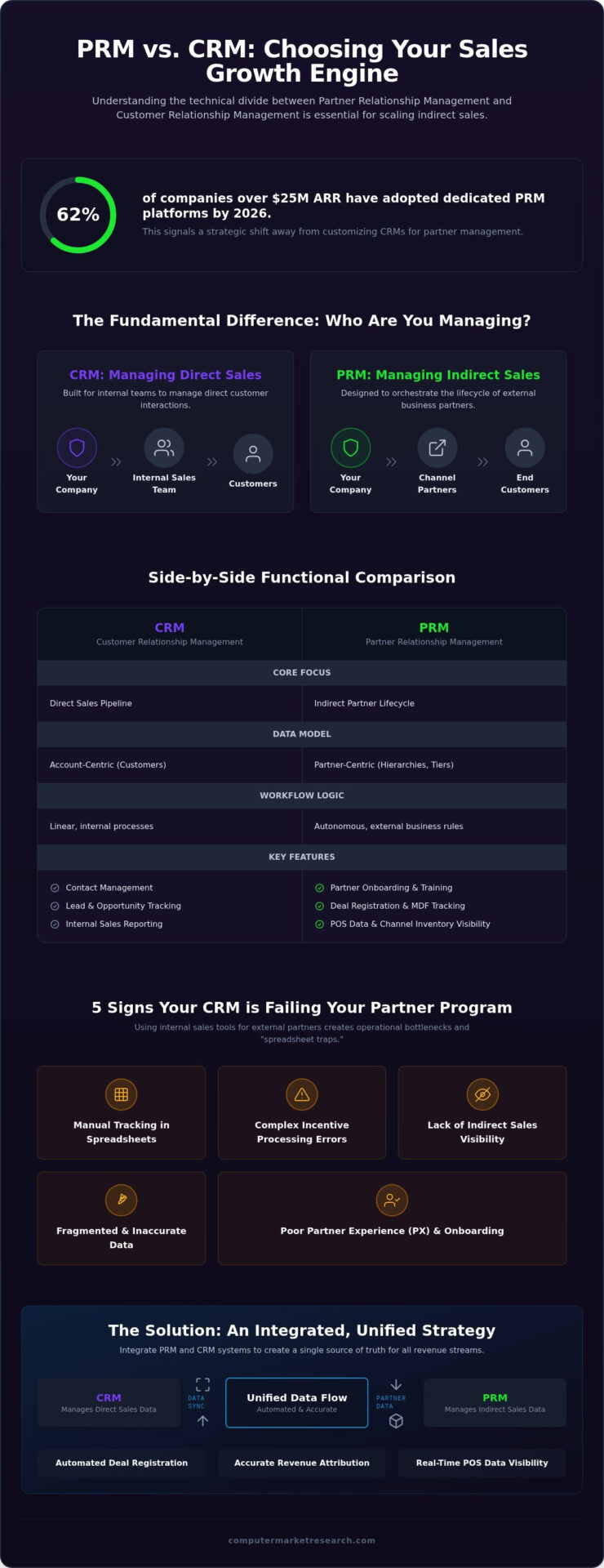
5 Signs Your CRM is Failing Your Partner Program
Identifying the threshold where a standard CRM becomes a liability for channel operations is critical for maintaining growth in 2026. While a CRM excels at managing internal sales activities, it often fails to provide the specialized infrastructure required for complex partner ecosystems. If your team spends more time managing tools than managing relationships, you are likely experiencing the limitations of prm software vs crm capabilities. Relying on an internal-facing tool to manage an external network creates operational bottlenecks that eventually stall revenue and frustrate your most valuable distributors.
Manual Spreadsheet Overload
When tracking partners becomes a full-time administrative job, your organization has fallen into the “Spreadsheet Trap.” Relying on manual data entry leads to inevitable errors, particularly in high-stakes areas like Ship and Debit management. Inaccurate data in these processes can result in significant financial leakage and strained partner trust. Manual processes are the primary obstacle to channel growth, as they cannot scale with the speed or volume of modern commerce. If your channel managers are spending hours each week reconciling version-controlled documents, it’s a clear sign that your current system is obsolete.
Poor Visibility into Partner Performance
Many channel managers struggle with the “Black Box” problem, where they know exactly what was sold to partners but have zero insight into what those partners sold to end customers. This lack of sell-through visibility makes demand forecasting nearly impossible and leaves you guessing about market trends. Inconsistent reporting across different partner tiers further complicates the issue, leaving leadership with fragmented information that cannot support strategic decisions. Professional POS data management is the cure for blind channel management, providing the transparency needed to measure true ROI and inventory health.
Beyond data visibility, an inadequate system often results in a total inability to audit co-op and MDF claims effectively. When your finance team must manually verify every marketing claim against a static spreadsheet, the risk of overpayment and fraudulent claims increases significantly. This operational friction doesn’t just cost money; it delays partner payments and erodes the relationship. Additionally, a poor CRM interface is a leading cause of low partner engagement. Modern distributors expect professional, self-service tools that respect their time. If your portal is difficult to navigate or lacks real-time updates, partners will naturally drift toward competitors who offer a more streamlined, modernized infrastructure.
To eliminate these operational bottlenecks and secure your data integrity, you can claim your 90-day free trial of PartnerPortal™ today.
Integrating PRM with Your CRM for a Unified Strategy
Modern channel leaders understand that the discussion of prm software vs crm isn’t about choosing one system to replace the other. The goal is orchestration. A unified tech stack where both systems coexist creates a “decision-grade” environment that supports both direct and indirect revenue streams. In this model, the CRM remains the internal engine for employee-led sales, while the PRM extends your reach to independent business entities. A bi-directional flow of data ensures that lead flows, account syncing, and revenue attribution remain consistent across the entire organization. This alignment transforms fragmented information into a reliable source of truth that both internal teams and external partners can trust.
The Ideal Tech Stack for Channel Leaders
In a high-performance ecosystem, PartnerPortal™ acts as the professional front-end for your partners. It handles the nuances of the partner lifecycle while feeding validated data back into your internal CRM. This bi-directional synchronization ensures that when a partner updates a deal status, your internal sales and marketing teams see it in real time. This technical harmony reduces the friction of manual updates and prevents channel conflict. To further improve the partner experience, we utilize Single Sign-On (SSO) to reduce “portal fatigue.” This allows your distributors to access training, collateral, and deal registration without managing multiple sets of credentials.
Managed Services: The Secret to Data Accuracy
Even the most advanced software isn’t a silver bullet for POS and inventory normalization. Raw data from various distributors often arrives in inconsistent formats that a standard platform cannot reconcile without human oversight. This operational burden is why Managed Data Services are essential for maintaining a healthy CRM/PRM ecosystem. Expert data cleansing ensures that your financial tracking and incentive programs are based on accurate, normalized information. This approach removes the administrative burden from your operations team, allowing them to focus on strategic growth rather than manual data correction.
As a seasoned partner in B2B data administration, CMR specializes in bridging the gap between legacy CRM systems and modernized PRM infrastructure. We provide the technical competence required to solve complex industry relationships and operational bottlenecks. To move your organization away from manual errors and toward a path of stability and performance, Partner Smarter with Computer Market Research.
Modernizing Your Channel Infrastructure for 2026
The distinction between prm software vs crm represents a fundamental shift in how your organization manages growth. While your CRM remains a vital tool for internal operations, scaling an indirect network requires a specialized platform built for the partner lifecycle. Moving away from the spreadsheet trap and manual tracking methods isn’t just an efficiency gain; it’s a requirement for maintaining stability and data accuracy in a complex B2B ecosystem. By replacing legacy processes with modern infrastructure, you ensure that your team focuses on strategy rather than administrative maintenance.
Since 1984, Computer Market Research has helped Global 2000 enterprises solve operational bottlenecks through automated channel data normalization. Our specialized expertise ensures that your incentives and POS data remain precise, providing a clear path out of fragmented information. Integrating PartnerPortal™ into your existing stack creates a unified environment that empowers your partners and secures your revenue through technical competence. Request a Demo of PartnerPortal™ to see how these systems can drive your indirect sales forward. We look forward to supporting your journey toward a more resilient and transparent sales ecosystem.
Frequently Asked Questions
Do I really need PRM software if I already have a full-featured CRM?
Yes, because most direct-sales platforms are architected for internal employees rather than independent business entities. While you can customize a CRM to handle basic lead sharing, the technical divide in prm software vs crm becomes clear when managing complex incentives and normalized POS data. Specialized platforms provide the necessary external security and self-service tools that internal-facing systems lack. This ensures a professional partner experience that internal sales tools simply cannot replicate without expensive, high-maintenance customizations.
How long does it take to implement a PRM system vs a CRM?
A CRM implementation often requires six to twelve months because it must map every internal sales process. In contrast, a purpose-built PRM like PartnerPortal™ can often be configured and branded more efficiently since the core channel workflows are already established. Computer Market Research provides professional implementation and integration services to ensure the system connects with your existing financial tools. This structured approach reduces the administrative burden and accelerates your time-to-market compared to building custom partner modules from scratch.
Can PRM software help reduce channel conflict?
PRM software is specifically designed to eliminate friction through transparent deal registration and automated lead distribution. By providing a clear record of who owns a particular opportunity, the system prevents internal sales teams or other partners from inadvertently poaching leads. Real-time status updates ensure that all parties have visibility into the pipeline. This transparency builds trust within your network and ensures that your indirect sales strategy remains stable and predictable as you scale your operations.
What is the average ROI of switching from CRM-based partner management to a PRM?
The ROI of switching to a specialized prm software vs crm strategy is primarily driven by the elimination of manual tracking and administrative errors. Global 2000 companies have found that automating co-op/MDF and rebate processing significantly reduces financial leakage and overpayment. Managed Data Services further enhance ROI by providing cleansed, normalized POS data for accurate reporting. While specific returns depend on your channel volume, the efficiency gains from modernized infrastructure provide a clear path to improved profitability.
Does PRM software integrate with my existing ERP system?
Technical integration with ERP and financial systems is a core component of a modern channel stack. Computer Market Research has provided these complex digital integrations since 1984, ensuring that data flows seamlessly between your partner portal and your back-office infrastructure. This connection is vital for accurately processing ship and debit claims and managing inventory levels across a multi-tier distribution network. It ensures your financial records reflect validated, decision-grade information rather than unverified partner reports or manual entries.
How does PRM software handle MDF and co-op fund management?
The software automates the entire lifecycle of market development funds, from initial allocation to final claim validation. Partners submit their marketing claims directly through the portal, which then triggers an automated vetting process based on your specific program rules. This replaces the obsolete method of tracking fund balances in fragmented spreadsheets. By centralizing these financial transactions, you gain real-time visibility into your channel spend and can audit claims with much higher precision and speed than legacy systems allow.
Is PRM software only for large enterprises?
While Computer Market Research serves many Global 2000 companies, any organization relying on indirect sales can benefit from professional management tools. Medium-sized businesses also face the spreadsheet trap and manual data errors that hinder growth. Implementing a systematic way to manage partners allows smaller organizations to project the same level of technical competence as industry leaders. It provides a scalable foundation that grows alongside your partner network without requiring a proportional increase in administrative staff or manual overhead.
What is the difference between a partner portal and PRM software?
A partner portal is the front-end interface where your distributors log in to access resources or register deals. PRM software is the holistic, back-end system that powers that interface and manages the entire partner lifecycle. This includes the complex engines for rebate calculations, POS data normalization, and inventory tracking. While a portal provides an access point, the PRM provides the logic and data integrity required to run a successful, professional channel program in a modern, data-driven environment.

Article by
Del Heles
Del Heles is the founder and CEO of Computer Market Research (CMR), a channel management software company he launched in 1984. With more than 40 years of experience, he’s known for helping manufacturers and distributors simplify complex partner programs through practical, customer-focused technology solutions.