

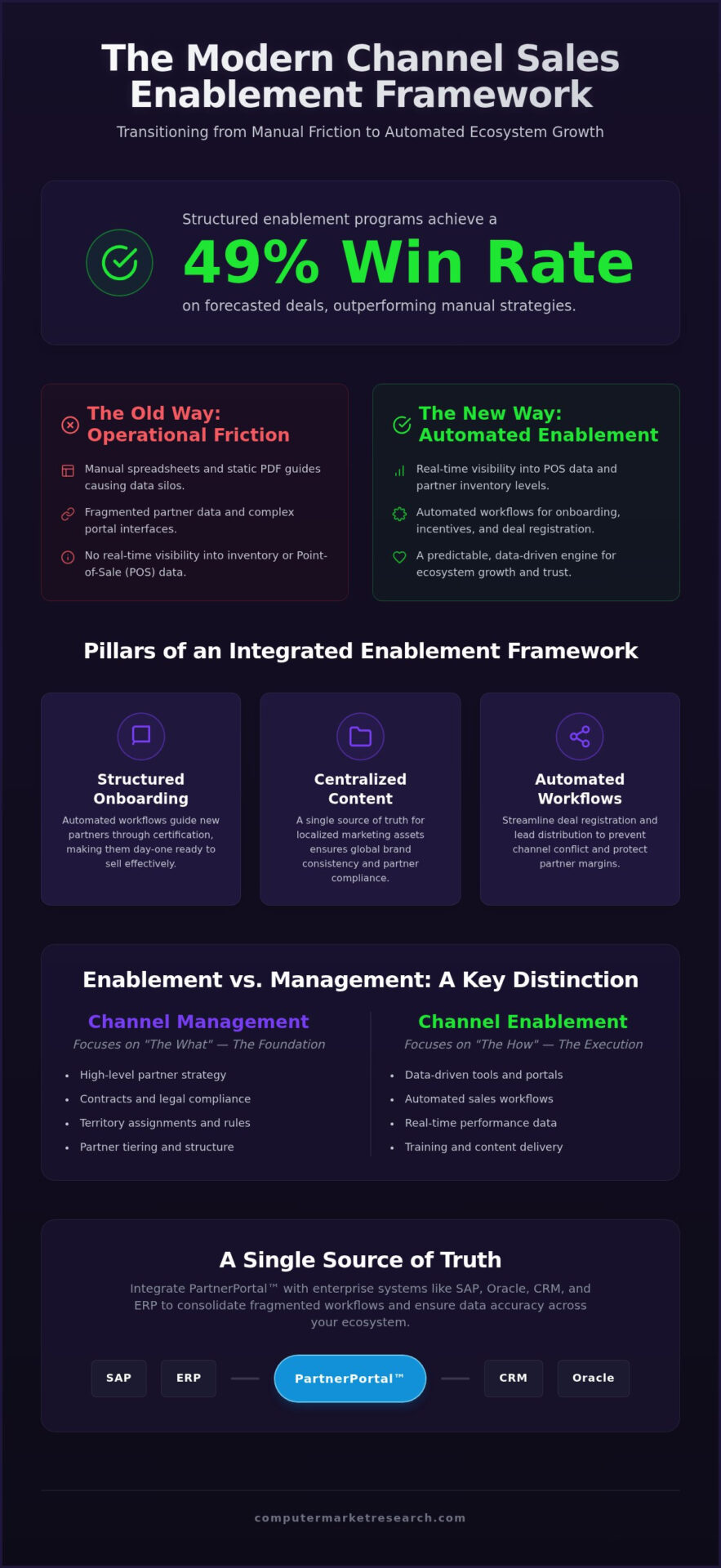
If your channel sales enablement strategy still relies on manual spreadsheets and static PDF guides, you aren’t just falling behind; you’re losing revenue to operational friction. Organizations that successfully implement structured enablement achieve a 49% win rate on forecasted deals, yet many leaders remain buried under fragmented partner data and complex portal interfaces.
You understand the frustration of manual rebate processing and the lack of real-time visibility into partner inventory. These bottlenecks don’t just slow down sales; they erode trust within your ecosystem. It’s time to move toward a model where data transparency and automated workflows do the heavy lifting for your team. Our approach focuses on technical competence to alleviate the specific frustrations of business leaders dealing with manual errors.
This guide provides a clear path out of these operational hurdles. You’ll learn how to empower your partners and drive indirect revenue through automated data and strategic enablement frameworks. We will explore how modernizing your infrastructure with real-time POS data and error-free incentive processing creates a predictable engine for ecosystem growth.
Key Takeaways
- Transition from passive information sharing to a results-driven model of operational automation that removes friction from every partner transaction.
- Build a day-one ready ecosystem using structured onboarding frameworks and centralized content management to ensure global brand consistency.
- Resolve the data bottleneck by replacing manual tracking with real-time visibility into POS data and inventory to drive a more efficient channel sales enablement strategy.
- Measure success beyond top-line revenue by tracking portal adoption and the direct impact of automated incentive programs on partner engagement.
- Consolidate fragmented workflows into a single source of truth by integrating PartnerPortal™ with enterprise CRM and ERP systems such as SAP and Oracle.
What is Channel Sales Enablement in 2026?
In 2026, channel sales enablement is defined as the strategic combination of tools, data, and resources provided to indirect partners to optimize their sales performance. This discipline has evolved beyond mere information sharing, where vendors simply pushed static collateral to portals. Today, it focuses on operational automation, which removes manual friction from the partner’s daily workflow. This shift is critical because internal sales enablement strategies often fail when applied to external partners. While internal teams share your company culture, external partners manage multiple vendors and prioritize the path of least resistance. If your systems are complex, partners won’t use them.
To better understand this concept, watch this helpful video:
The Core Objectives of Modern Enablement
The primary goal of modern enablement is to accelerate partner onboarding through standardized, automated workflows. When a partner can go from signing a contract to closing their first deal in days rather than months, the vendor secures a competitive advantage. Additionally, reducing channel conflict is paramount. By utilizing robust channel sales management software for deal registration, vendors protect partner margins and encourage aggressive prospecting. This technical infrastructure provides the real-time visibility needed to create predictable revenue streams from an otherwise opaque partner pipeline.
Enablement vs. Channel Management: The Distinction
Distinguishing between management and enablement is essential for operational clarity. While Sales operations and channel management typically focus on the “what”—such as contracts, territories, and compliance—enablement focuses on the “how.” It provides the execution layer that turns strategic goals into measurable sales activities. You can’t have effective enablement without a foundational management strategy in place. Enablement acts as the execution layer for channel strategy, ensuring that high-level goals are met through practical, data-driven tools.
The Pillars of an Integrated Enablement Framework
A robust channel sales enablement framework acts as the structural support for a successful indirect sales channel strategy. It ensures that every partner, regardless of region or tier, has immediate access to the resources required to represent your brand accurately. This integration starts with structured onboarding. Instead of manual training sessions, automated workflows guide partners through certification and system access, making them day-one ready. Centralized content management follows this by providing a single source for localized marketing assets. This prevents brand dilution and ensures that partners don’t waste time creating their own non-compliant materials.
A comprehensive approach to channel sales enablement requires more than just a software license; it demands a philosophy of partner-centric design. When you centralize your assets and automate your workflows, you remove the administrative burden that often prevents partners from focusing on actual sales activities. To ensure those activities are backed by deep product knowledge, digital learning consultancies like Knowledgefront can help design the high-impact eLearning solutions necessary for partner success.
Streamlining Deal Registration and Lead Distribution
Operational friction often stems from internal competition. Automated deal registration is the primary tool for preventing partner vs. partner conflict, as it provides clear ownership of an opportunity from the moment of entry. Effective lead management ensures that manufacturer-generated leads don’t get lost in a digital black hole. High-performing ecosystems implement strict follow-up protocols, requiring partners to engage with distributed leads within a 24-hour window. Closing the loop between demand generation and partner execution transforms a passive funnel into an active revenue engine.
Strategic Co-op and MDF Management
Financial incentives are powerful drivers of partner behavior, but they only work if they’re easy to access and track. Using Market Development Funds (MDF) strategically allows vendors to incentivize specific activities, such as entering new market segments or promoting specific product lines. Moving away from manual claim processing to automated co-op/MDF platforms eliminates the delays that frustrate partners. This automation ensures that funds are aligned with high-growth territories while maintaining audit-readiness for global compliance. When partners see that their marketing efforts are reimbursed quickly and accurately, they’re more likely to prioritize your brand over competitors.
To see how a modernized framework can stabilize your indirect sales, you might consider how a structured pilot program could identify and resolve your current operational bottlenecks.
Overcoming the Data Bottleneck in Channel Sales
While many strategies focus on marketing collateral, the most persistent obstacle to scaling an indirect network is the data bottleneck. Manual spreadsheets are the primary enemy of growth; they’re slow, prone to error, and offer zero real-time utility. For a modern channel sales enablement strategy to succeed, you need “decision-grade” insights that only automated channel data management can provide. Without this foundation, your visibility into the supply chain remains opaque, leading to inefficiencies that drain manufacturer margins and stall partner momentum.
One specific area of financial risk involves ship & debit claims. When these are processed manually based on inaccurate partner reports, the risk of overpayment or duplicate claims increases significantly. Manufacturers often lose millions in margin due to these administrative gaps. Standardizing these financial workflows ensures that every dollar spent on channel incentives is backed by verified transaction data, providing a clear path to profitability.
The Critical Role of POS and Inventory Management
Real-time inventory visibility is no longer a luxury. It’s the only way to prevent the dual threats of stockouts and overstocking within your partner network. For retailers who need to manage these complex workflows at an enterprise scale, you can learn more about Ommni. When manufacturers have access to accurate POS data, they can adjust production schedules and marketing spend in real-time to meet actual market demand. POS data serves as the ultimate truth of channel sales performance, providing an unvarnished view of what’s actually moving off the shelves. This level of transparency allows for a more agile response to shifting consumer behaviors across different global regions, ensuring your products are in the right place at the right time.
Collecting, cleansing, and normalizing data from hundreds of partners is a massive administrative burden that often overwhelms internal operations teams. Most organizations find that their best talent spends the majority of their time acting as “data cleaners” rather than “strategy executors.” By utilizing Managed Data Services, businesses can offload the complex task of normalizing fragmented reseller reports to specialized experts who understand the nuances of B2B data administration.
This transition provides a measurable business benefit that goes beyond simple efficiency. Instead of struggling with messy CSV files and conflicting spreadsheets, your team can focus on identifying high-growth opportunities and refining partner performance. Shifting this burden to a systematic SaaS solution ensures that your channel sales enablement efforts are powered by high-quality information rather than guesswork. It’s the difference between reacting to last month’s failures and predicting next month’s success with confidence.
Calculating and Maximizing ROI on Enablement
Measuring the return on investment for channel sales enablement requires looking beyond top-line revenue. While sales growth is the ultimate goal, leading indicators like partner engagement and portal adoption provide a more accurate picture of long-term health. High-performing organizations use these metrics to identify which partners are truly invested in the brand. When you track how often partners access training modules or utilize marketing assets, you gain the “decision-grade” data needed to prune underperforming accounts. This allows you to double down on high-potential partners who demonstrate the highest propensity for growth.
The correlation between structured channel incentive programs and incremental sales growth is well-documented. However, the cost of managing these programs can often erode the very margins they’re designed to protect. Automation is the solution here. By moving away from manual tracking, you significantly reduce the “cost-per-claim” in rebate and incentive programs. This efficiency ensures that more of your budget goes toward rewarding partner performance rather than covering administrative overhead.
Automating Rebates and Incentives
Partner loyalty is often driven by the speed of gratification. When a reseller closes a deal, the delay in receiving their rebate can create friction that dampens future motivation. Automated systems provide nearly instant rebate processing, which reinforces positive selling behavior. These systems also serve as a critical layer of financial security. By integrating POS data with incentive workflows, you prevent overpayments and fraudulent claims that often slip through manual audits. You can design structures that reward specific selling behaviors, such as multi-product bundles or service attachments, rather than just raw volume.
Visibility into Channel ROI and Performance
Executive dashboards are the central nervous system of a modern channel strategy. These tools provide real-time visibility into the entire journey from MDF spend to closed-won deals. Without this visibility, marketing funds are often treated as “sunk costs” rather than strategic investments. Effective partner relationship management allows you to attribute specific revenue outcomes to the enablement resources provided. This transparency builds trust with leadership and justifies continued investment in the partner ecosystem.
If you’re ready to move from fragmented spreadsheets to a unified view of your channel performance, you can start with a 90-day free trial to see the impact of automated ROI tracking on your operations.
Centralizing Operations with CMR PartnerPortal™
PartnerPortal™ acts as the central nervous system for your indirect network, consolidating the disparate data streams discussed in previous sections into a manageable, cloud-based SaaS platform. By integrating directly with enterprise systems like Oracle, SAP, and other leading CRM platforms, the platform eliminates the need for manual data entry and cross-referencing. This integration ensures that your channel sales enablement strategy is supported by a single source of truth, allowing for seamless communication between your internal ERP and your global partner network. When data flows automatically between these systems, the risk of human error is virtually eliminated, providing the stability required for enterprise scale.
The modular design of the platform allows organizations to address their most pressing operational bottlenecks first. You might begin with MDF management to stabilize marketing spend before expanding into POS tracking and inventory management. This systematic approach has allowed Global 2000 companies to eliminate manual errors that previously led to significant revenue leakage. By recovering lost revenue through automated financial processing and Managed Data Services, these enterprises transform their channel from a cost center into a predictable growth engine. These results aren’t just theoretical; they’re the direct outcome of replacing legacy processes with a disciplined, data-driven framework.
A Unified Interface for Partners and Manufacturers
Portal fatigue is a real barrier to partner productivity and a primary reason why many enablement initiatives fail. When partners must navigate multiple logins for lead registration, rebate claims, and marketing assets, adoption rates plummet. PartnerPortal™ provides a single, branded interface that centralizes all partner needs under one roof. Self-service capabilities empower partners to track their own rebates and claim statuses in real-time, which builds trust and reduces the administrative burden on your internal support teams. This ease of use drives high adoption rates across global reseller networks, ensuring that your tools are actually utilized to drive sales.
The Path to Professional Channel Maturity
Achieving professional channel maturity requires moving from reactive troubleshooting to proactive strategy. Using Partner Smarter methodologies, manufacturers can leverage clean, historical channel data to build predictive forecasting models. This shift allows you to anticipate market shifts rather than simply reacting to them after the fact. The long-term value of this modernized infrastructure is a stable, scalable ecosystem that rewards performance and precision. To see how these tools can modernize your operations and drive indirect revenue, request a demo of PartnerPortal™ and begin the transition toward automated channel sales enablement.
Future-Proofing Your Indirect Revenue Engine
Modernizing your partner ecosystem requires a transition from manual, spreadsheet-based tracking to a systematic approach centered on operational automation. By prioritizing decision-grade data and removing the administrative friction of legacy processes, you empower your partners to focus on selling rather than data entry. A successful channel sales enablement strategy hinges on this technical competence, ensuring that every incentive and inventory movement is backed by absolute transparency.
Computer Market Research has served Global 2000 companies since 1984, providing a modular cloud-based SaaS infrastructure designed for the complexities of B2B data administration. Our expertise in Managed Data Services for POS and Inventory allows your team to shift from cleaning data to executing high-level strategy. You don’t have to navigate these operational bottlenecks alone. With the right tools, you can transform your channel into a predictable and scalable source of growth.
Optimize your channel sales with CMR’s PartnerPortal™ and start building a more resilient partner network today.
Frequently Asked Questions
What is the difference between sales enablement and channel sales enablement?
Internal sales enablement focuses on providing your direct employees with the tools and training they need to close deals. In contrast, enablement for the channel targets external partners who often manage multiple vendor relationships simultaneously. This requires a different approach that prioritizes reducing administrative friction and “portal fatigue.” You must provide a technical infrastructure that makes it easier for third-party resellers to sell your products than those of your competitors.
How do you measure the success of a channel sales enablement program?
Success is measured through a combination of engagement metrics and operational efficiency. You should track partner adoption rates, the volume of deal registrations, and the speed of lead follow-up. Beyond raw revenue, it’s critical to measure the reduction in “cost-per-claim” for rebates and the accuracy of POS data. High-performing programs demonstrate a clear correlation between the utilization of enablement resources and incremental sales growth within specific partner tiers.
What are the most important features of a channel enablement tool?
The most critical features include automated deal registration, centralized content management, and robust POS data management. A modular cloud-based SaaS platform like PartnerPortal™ should also offer integrated MDF and rebate processing to ensure financial transparency. Seamless integration with your existing ERP and CRM systems is essential. This integration creates a single source of truth that prevents the data fragmentation common in legacy manual processes.
How can I improve partner engagement with our enablement resources?
You can improve engagement by simplifying the partner experience and removing technical hurdles. Providing a single, branded login for all resources helps eliminate the frustration of navigating multiple systems. Automated, error-free incentive processing also builds significant trust within your network. When partners experience “instant gratification” through faster rebate processing and clear visibility into their performance, they’re more likely to prioritize your brand in their daily sales activities.
Is a partner portal enough for effective channel sales enablement?
A portal is merely the user interface. Effective channel sales enablement requires a robust backend infrastructure to handle data normalization and cleansing. Without Managed Data Services to process messy POS and inventory reports, a portal remains a static repository of information. True enablement combines a unified partner interface with automated financial and operational workflows that remove friction from every transaction across the global supply chain.
How does channel data management impact sales enablement ROI?
Effective data management directly impacts ROI by eliminating the revenue leakage caused by manual errors in ship & debit or rebate claims. It provides the “decision-grade” insights needed for predictive forecasting and inventory optimization. By automating the cleansing of fragmented reseller reports, your internal operations teams can shift their focus from data administration to strategic growth. This transition ensures that your enablement budget is spent on high-impact activities rather than manual data entry.
Can you automate MDF and co-op fund management for global partners?
Automation is the only reliable way to scale marketing funds across global regions while maintaining strict compliance. Automated platforms track the entire journey from fund allocation to closed-won deals, ensuring that MDF spend is aligned with high-growth territories. This system provides an audit-ready trail that protects the manufacturer from fraudulent claims. It also simplifies the submission process for partners, encouraging them to utilize available funds for local demand generation.
How do I prevent channel conflict through enablement tools?
Automated deal registration is the primary mechanism for preventing partner vs. partner conflict. It provides clear opportunity ownership and protects the margins of those who proactively prospect. By using channel sales enablement tools to distribute leads transparently and track registration status, manufacturers create an organized marketplace. This systematic approach ensures that partners feel protected and motivated to represent your brand over competitors while maintaining healthy ecosystem relationships.

Article by
Del Heles
Del Heles is the founder and CEO of Computer Market Research (CMR), a channel management software company he launched in 1984. With more than 40 years of experience, he’s known for helping manufacturers and distributors simplify complex partner programs through practical, customer-focused technology solutions.