

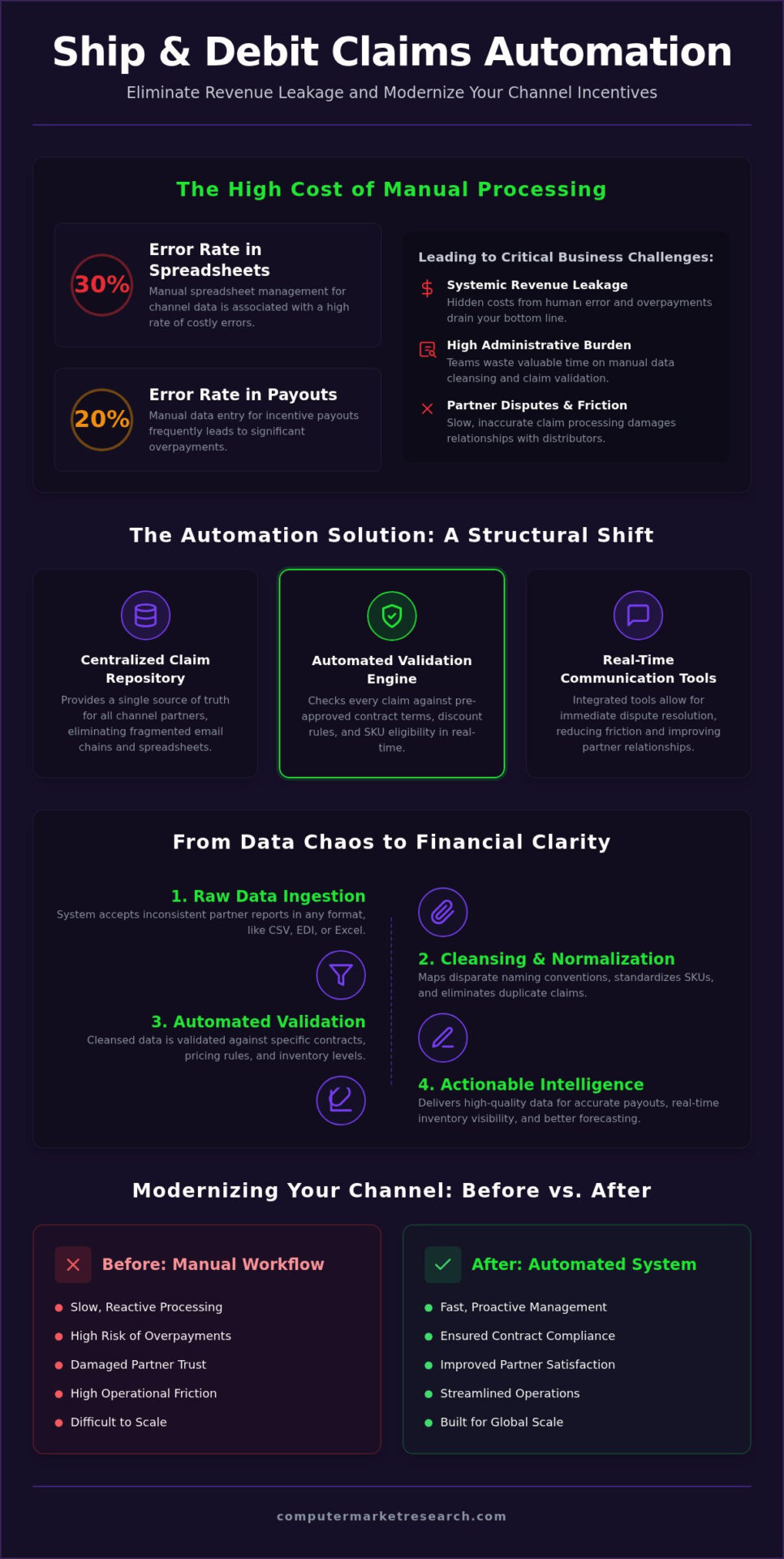
Manual spreadsheet management for channel data is associated with a 30% error rate, making ship and debit claims automation a necessity rather than a luxury for modern manufacturers. When your financial accuracy depends on fragmented data and human entry, the result is inevitable revenue leakage. You’ve likely felt the strain of high administrative burdens and the friction that arises when partners dispute rejected claims. It’s a systemic challenge that traditional, manual workflows simply can’t solve as your channel grows in complexity.
We understand that maintaining control over global pricing agreements requires more than just better oversight; it requires a structural shift. This guide explores how to eliminate manual processing errors and stop the financial drain of overpayments. You’ll discover how to gain real-time visibility into channel inventory and automate the validation of POS data against your specific contracts. We’ll preview the path to faster claim turnaround times and improved partner trust, moving your operations away from legacy bottlenecks and toward a modernized, data-driven infrastructure that protects your bottom line.
Key Takeaways
- Stop systemic revenue leakage by identifying the hidden costs of manual verification and human error within your channel programs.
- Implement ship and debit claims automation to replace fragmented spreadsheets with a centralized system that ensures real-time validation and faster processing.
- Master the process of cleansing and normalizing Point-of-Sale data to transform inconsistent partner reports into high-quality, actionable financial information.
- Identify the essential cloud-based features and managed services needed to scale your incentive programs across Global 2000 operations.
- Reduce administrative friction and improve partner satisfaction by moving toward a transparent, automated model for price protection and claim management.
What is Ship and Debit Claims Automation?
Ship and debit is a fundamental channel incentive mechanism that provides price protection for distributors. It enables partners to sell inventory at competitive market rates while being reimbursed by the manufacturer for the difference. For decades, this process was managed through manual spreadsheet-based reconciliation, a method that is notoriously slow and prone to errors. Ship and debit claims automation transforms this workflow into a streamlined digital process that ensures every credit request is accurate and contractually compliant.
Relying on manual processes often leads to significant operational friction. In Global 2000 environments, the sheer volume of transactions makes manual evaluation impossible. Manual methods don’t scale. Research indicates that manual data entry can result in a 20% error rate in incentive payouts, leading to substantial revenue leakage. By adopting ship and debit claims automation, organizations move from a reactive stance to a proactive management strategy. This transition eliminates the administrative burden of data cleansing and allows financial teams to focus on high-level channel strategy.
The Core Components of an Automated System
A robust system moves beyond simple data entry. It creates a structured environment where information is normalized and verified automatically.
- Centralized claim repository: This provides a single source of truth for all channel partners, eliminating the need for fragmented email chains.
- Automated validation engines: These systems check every claim against pre-approved contract terms, discount rules, and SKU eligibility.
- Real-time communication tools: When a dispute arises, integrated tools allow for immediate resolution, reducing the friction that often damages partner relationships.
Why 2026 is the Year for Automation
The distribution landscape has reached a tipping point. Multi-tier distribution networks are becoming increasingly complex. This makes it harder to track inventory as it moves through the channel. Partners now demand faster payouts to maintain their own liquidity and loyalty. If your system takes weeks to process a claim, you risk losing your most valuable distributors. Precision is the priority. Ship and debit automation serves as the essential bridge between sales incentives and financial accuracy. Using ship and debit management software ensures that your organization remains competitive in an era where data transparency is the new standard.
How Automated Systems Process Complex Channel Data
Point-of-Sale (POS) data serves as the foundational layer for any effective channel incentive program. Without granular visibility into what was sold, to whom, and at what price, manufacturers are left guessing. Ship and debit claims automation leverages this raw data to validate every transaction against contractual agreements. This ensures that credits are only issued for legitimate sales that meet specific eligibility criteria. Precision is the priority. Automated validation removes the guesswork that often leads to overpayment.
Data Cleansing and Normalization
Raw partner reports are rarely uniform. One distributor might list a product by its internal SKU, while another uses a legacy name or a partial description. This fragmentation creates significant manual work for operations teams. Automation systems perform the “dirty work” of cleansing this information. They map disparate naming conventions to a single, standardized SKU list. Standardization is critical for maintaining an accurate audit trail across a global partner network.
Processing this information also filters out noise. It identifies and eliminates duplicate claims before they ever reach the finance department. By normalizing data from various formats like CSV, EDI, or Excel, the system creates a high-quality data set. Order replaces chaos. This transformation turns messy reports into actionable business intelligence that supports better forecasting. Organizations looking to refine these workflows often find that advanced data management systems are the only way to maintain accuracy at scale.
Real-Time Inventory Visibility
Effective ship and debit claims automation provides a clear view of product movement from the distributor to the end-user. It establishes a single version of truth regarding channel inventory levels. If you don’t know what’s in stock, you can’t accurately authorize debits. The system links inventory reports directly to claim eligibility. This prevents over-payments on products that haven’t actually shipped or were returned to the distributor. Real-time visibility stops the “double dipping” that often occurs in manual systems.
Integrating this data with your existing ERP system ensures total financial consistency. It closes the loop between sales activities and accounting entries. This synchronization allows for immediate reconciliation and reduces the time spent on manual audits. It’s about control. You can explore these automation capabilities with a 90-day trial to see how cleansed data improves your financial reporting and partner relationships.
The Financial Impact: Stopping Revenue Leakage
Manual processing isn’t just slow; it’s expensive. When you rely on spreadsheets, you’re essentially inviting human error into your financial statements. Industry research suggests that manual data entry leads to a 20% error rate in incentive payouts. Over time, these small discrepancies accumulate into significant revenue leakage that directly impacts your bottom line. Ship and debit claims automation acts as a financial firewall, ensuring that every credit issued is backed by verified transaction data. By eliminating the “dirty work” of manual verification, your finance team can shift from auditing past mistakes to optimizing future channel investments.
Identifying Sources of Revenue Leakage
Revenue leakage often occurs in the blind spots of manual systems. Without automated validation, it’s nearly impossible to catch sophisticated errors across thousands of line items. Common sources of loss include:
- Unclaimed credits: Partners miss out on price protections due to complex filing requirements, leading to frustration and future participation drops.
- Double-dipping: A single sale is claimed against multiple incentive programs, such as volume rebates and ship and debit, without the manufacturer realizing the overlap.
- Clerical errors: Simple mistakes in volume-based discount calculations often favor the distributor over the manufacturer.
Automated validation engines cross-reference every claim against your specific contract terms. This prevents over-claims and fraudulent submissions by checking POS data in real-time. It’s about precision. When the system automatically flags a duplicate or an incorrect discount, you stop the loss before the payment is ever authorized. This level of control is impossible to maintain with a legacy, spreadsheet-based approach.
Improving Partner Satisfaction
Financial reliability is the cornerstone of a healthy channel relationship. If your partners have to wait weeks for claim resolution, their cash flow suffers. This creates friction and erodes trust, often leading to partners prioritizing other manufacturers who pay faster. Ship and debit claims automation reduces the dispute cycle from weeks to hours by providing immediate feedback on claim status. Providing partners with transparent updates through a dedicated portal strengthens your indirect sales relationships. They no longer have to guess when they’ll be reimbursed.
Calculating the ROI of an automated solution involves more than just counting saved man-hours. It’s about the total value of recovered revenue and the increased velocity of your channel. When you factor in the reduction of that 20% payout error rate and the administrative time saved, the business case becomes undeniable. Organizations that prioritize automated ship and debit management see a direct correlation between data integrity and improved channel profitability. Order and performance replace the chaos of manual tracking.
Key Features to Look for in Ship and Debit Software
Selecting the right platform for ship and debit claims automation requires a focus on technical depth rather than generic dashboard features. A solution must prioritize the ability to ingest and cleanse multi-format partner reports, including EDI, CSV, and Excel files. For Global 2000 firms, scalable cloud architecture is essential to manage the high volume of transactions across diverse geographic regions. This infrastructure ensures that as your channel expands, the system maintains performance without requiring manual intervention or additional administrative staff.
Logic is the engine of accuracy. Your software should allow for customizable business rules that mirror your specific pricing and discount structures. This includes the ability to handle complex multi-tier distribution logic and promotional windows. Seamless integration with your existing CRM and ERP platforms is another non-negotiable requirement. When data flows directly between these systems, you eliminate the silos that lead to financial discrepancies. You can evaluate these technical requirements to ensure your chosen system provides the control needed for modern channel management.
Automation and Workflow Logic
Effective systems replace manual oversight with configurable workflow logic. This allows organizations to set specific approval levels based on claim value, ensuring that high-dollar transactions receive expert scrutiny while smaller, routine claims move through the system automatically. Automated notifications play a critical role here. They immediately alert partners or internal teams when POS data is missing or incorrect, preventing the delays that stall payouts. Every action within the system must generate a permanent audit trail. These records are vital for maintaining compliance and simplifying financial reporting during year-end audits.
Reporting and Analytics
Modern platforms transform historical data into forward-looking strategy. Dashboards should provide more than just a summary of past payments; they must visualize channel performance and incentive spend across different product lines and partner tiers. Predictive insights are also becoming a standard requirement, allowing managers to anticipate future claim volumes based on current inventory levels and sales trends. Real-time analytics convert raw POS data into strategic channel decisions. This visibility ensures that incentive programs are actually driving the desired sales behaviors rather than just draining resources. To see these features in action, you can claim your 90-day free trial and begin normalizing your channel data today.
Modernizing Your Channel with CMR PartnerPortal™
Modernization isn’t just about software; it’s about shifting the operational paradigm from reactive auditing to proactive management. CMR PartnerPortal™ provides a secure, cloud-based environment where complex B2B data is transformed into financial clarity. By adopting ship and debit claims automation through this module, Global 2000 enterprises can finally replace the obsolescence of manual tracking with a systematic approach. This shift ensures that every credit issued is verified against accurate Point-of-Sale records, protecting the manufacturer’s bottom line from the cumulative effects of fragmented information.
Computer Market Research has spent decades refining the managed data services that power these systems. Our expertise lies in the technical competence required to handle high volumes of transaction data without sacrificing accuracy. This focus on data quality allows your internal teams to move away from clerical data entry and toward strategic channel optimization. The portal serves as a definitive source for all incentive-related information, providing the stability and reliability that complex industry relationships demand.
The Advantage of a Centralized Platform
Efficiency is often lost when partners are forced to navigate multiple disparate systems to manage their incentives. PartnerPortal™ solves this by housing Ship & Debit alongside other critical functions like Co-op/MDF Management and Rebates & Incentives. This centralization creates a seamless user experience that encourages partner participation and loyalty. When all incentive programs share the same normalized data set, the risk of conflicting information or “double dipping” across different programs is virtually eliminated. It’s about creating a single version of the truth for your entire channel ecosystem.
Getting Started with CMR
Implementation is a structured journey designed to respect your organization’s time and technical requirements. We utilize a phased approach that allows for thorough testing and configuration before a full global rollout. The platform is built to integrate directly with your core business systems, including Oracle and SAP environments, ensuring that your financial records remain the primary source of truth. You can Learn more about Ship and Debit Management Software to understand how our infrastructure can be tailored to meet your specific channel ROI goals. This transition to ship and debit claims automation represents the final step in moving away from legacy obstacles and toward a high-performance, automated future.
Secure Your Channel Revenue with Modern Automation
The transition from legacy spreadsheets to a modernized infrastructure is no longer optional for organizations looking to protect their margins. By prioritizing data integrity and systematic cleansing, you eliminate the significant error rates commonly found in manual incentive payouts. Implementing ship and debit claims automation ensures that every credit issued is contractually compliant and backed by verified Point-of-Sale data. It’s the most effective way to stop revenue leakage while simultaneously reducing the administrative burden on your finance team.
CMR has provided these specialized managed data services since 1984, helping Global 2000 firms navigate the complexities of multi-tier distribution with quiet confidence. A centralized PartnerPortal™ ecosystem allows you to synchronize sales incentives with financial accuracy, strengthening partner relationships through faster, transparent payouts. Don’t let fragmented information stall your growth. You can Request a Demo of CMR’s Automated Ship and Debit Software to experience the stability and precision of a systematic solution. Taking control of your channel data today creates a clear path toward sustainable growth and long-term profitability.
Frequently Asked Questions
What is the difference between ship and debit and a standard rebate?
Ship and debit is a specific price protection mechanism designed to help distributors maintain margins when market prices drop below their acquisition cost. Unlike standard rebates, which are generally earned through high-volume purchasing or meeting long-term performance targets, ship and debit is transaction-based. It allows partners to sell inventory at current market rates and claim the difference back from the manufacturer, ensuring they remain competitive without losing profit on every sale.
How does ship and debit automation prevent revenue leakage?
Ship and debit claims automation prevents leakage by replacing subjective manual reviews with a rigorous, rules-based validation engine. While spreadsheets often allow duplicate claims or incorrect discount calculations to slip through, an automated system cross-references every transaction against active contract terms and inventory levels. This ensures that credits are only authorized for legitimate sales. It shifts your financial oversight from a reactive sampling process to a comprehensive, 100% audit of all activity.
Can automated ship and debit software integrate with our existing ERP?
Yes, professional platforms like PartnerPortal™ are engineered for deep integration with leading enterprise environments, including SAP, Oracle, and other major CRM solutions. This connectivity ensures that validated claim data flows directly into your financial ecosystem without manual intervention. By synchronizing these systems, you eliminate the data silos that often lead to reconciliation delays and reporting errors. It provides your finance team with a secure, real-time view of all pending and processed credits.
What kind of data is required for automated claim validation?
The system requires granular transactional data to ensure every claim is contractually compliant. This includes Point-of-Sale details such as the sale date, specific SKU numbers, end-user information, and the actual price charged. When this data is mapped against your pre-approved pricing agreements and current channel inventory reports, the software can automatically confirm eligibility. High-quality data normalization ensures that even inconsistent partner reports are transformed into accurate, actionable information for your finance department.
How long does it take to implement a ship and debit automation system?
Implementation timelines vary based on the complexity of your channel, but most organizations follow a structured, phased rollout that delivers measurable results within a few months. The process begins with configuring your specific business rules and branding the portal to match your corporate identity. Technical integration with your ERP or CRM follows, ensuring a seamless data flow. A methodical approach allows your internal teams and partners to adapt to the new automated workflows without disrupting ongoing sales cycles.
Does automation require partners to change how they report POS data?
Automation doesn’t force your partners to change their existing reporting habits or adopt rigid new templates. Advanced systems use managed data services to ingest and cleanse reports in various formats, such as EDI, CSV, or Excel. The software handles the “dirty work” of normalizing this disparate information into a standardized format. This flexibility is vital for maintaining high partner participation rates, as it removes the administrative friction typically associated with manual price protection programs.
What are the security risks of cloud-based ship and debit management?
Cloud-based management actually reduces security risks by moving sensitive financial data out of unsecured spreadsheets and into a controlled, encrypted environment. Professional SaaS solutions utilize enterprise-grade security protocols, including multi-factor authentication and regular compliance audits, to protect your proprietary information. This systematic approach ensures that only authorized users can access claim details or financial reports. It provides a level of data integrity and auditability that legacy, manual tracking methods simply cannot match.
How do I measure the success of an automated claims program?
Success is measured by the tangible improvement in your channel ROI and the reduction in disputed claims. Key metrics include the decrease in claim processing time, the recovery of previously leaked revenue, and the reduction in man-hours dedicated to manual verification. You should also see an increase in partner satisfaction as payouts become faster and more transparent. Ultimately, the transition to an automated model is successful when your data becomes a strategic asset rather than an administrative burden.

Article by
Del Heles
Del Heles is the founder and CEO of Computer Market Research (CMR), a channel management software company he launched in 1984. With more than 40 years of experience, he’s known for helping manufacturers and distributors simplify complex partner programs through practical, customer-focused technology solutions.