

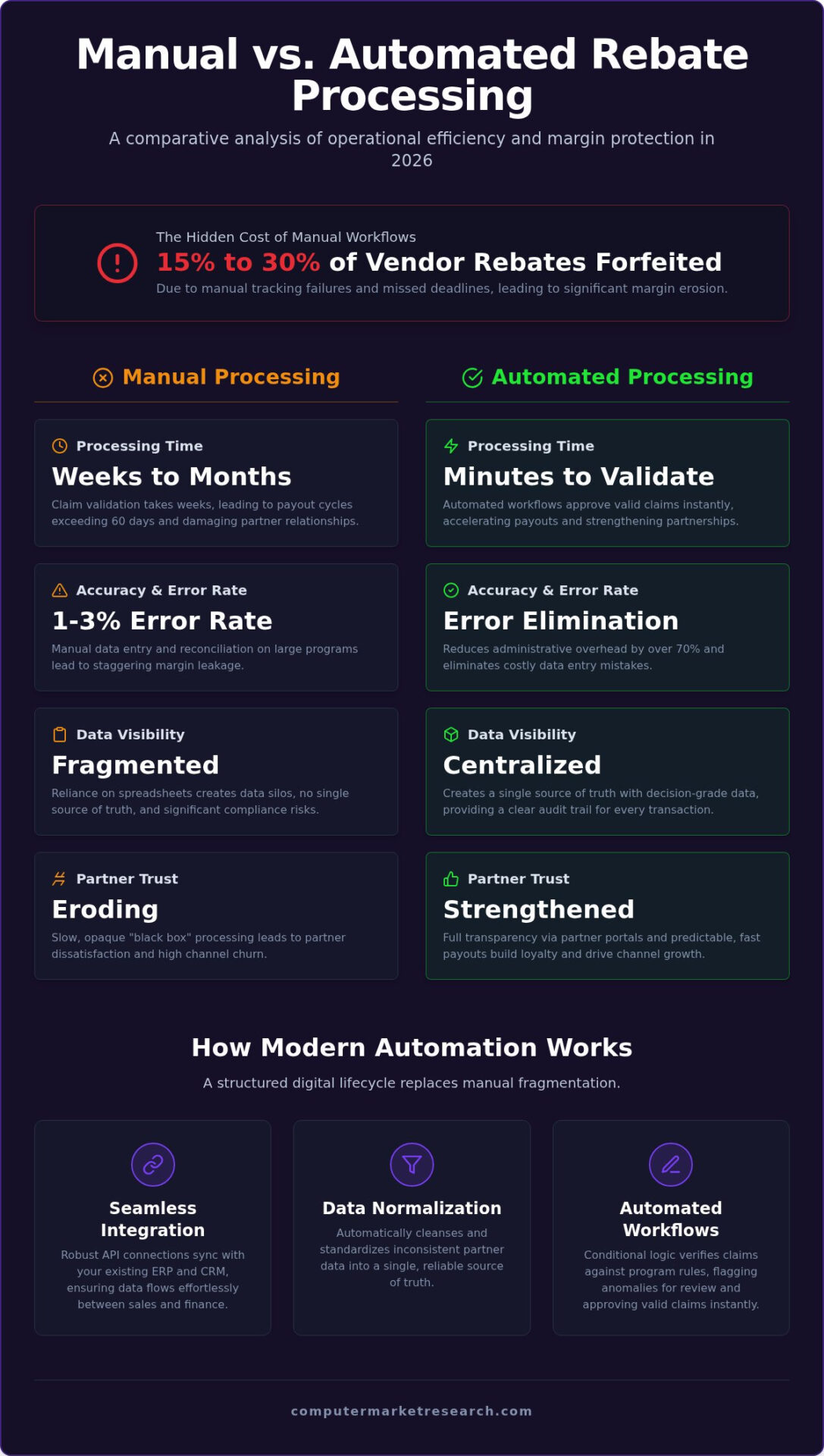
Manufacturing companies forfeit an estimated 15 to 30 percent of earned vendor rebates due to manual tracking failures and missed deadlines, according to a May 2026 ProcIndex report. It’s a staggering loss that stems from relying on fragmented spreadsheets and manual data entry. You likely recognize the friction these legacy systems create. Slow payout cycles damage partner relationships, while a lack of real-time visibility makes it impossible to measure true incentive ROI. These aren’t just minor inconveniences; they’re structural obstacles to your organization’s growth.
By automating rebate processing, you can transform these operational bottlenecks into a clear path for margin protection. This strategic guide explores how to eliminate manual errors and accelerate channel growth through a centralized rebate lifecycle. We’ll show you how to reduce administrative overhead by more than 70 percent, eliminate fraudulent claims, and improve partner satisfaction through transparent tracking. The transition to modern infrastructure is the only logical step for a growing organization that values data integrity and performance. We will lead you through a systematic approach to modernizing your workflows for 2026 and beyond.
Key Takeaways
- Identify the hidden operational costs of manual workflows and how they lead to significant margin erosion through administrative errors.
- Understand the technical advantages of automating rebate processing through seamless ERP and CRM integrations for a centralized digital lifecycle.
- Evaluate the comparative ROI of switching from weeks of manual claim validation to minutes of automated, audit-ready processing.
- Discover a structured five-step implementation plan to audit existing manual data gaps and define robust eligibility criteria.
- Learn how decision-grade data and automated cleansing services stabilize partner relationships and drive measurable channel growth.
The High Cost of Manual Rebate Management in 2026
Manual management isn’t just a slow process; it’s a significant financial liability for modern enterprises. While a Rebate (marketing) strategy is designed to drive sales volume, executing that strategy via spreadsheets often achieves the opposite. Legacy systems lack the computational logic to handle overlapping incentives across complex, multi-tier distribution networks. This leads to “invisible” costs that quietly erode your bottom line, including hundreds of administrative hours spent on manual reconciliation and the high price of data entry errors. Automating rebate processing is no longer an optional upgrade; it’s a fundamental requirement for maintaining control over your margins.
Spreadsheets fail because they cannot provide a single version of the truth. When data is fragmented across different departments, duplicate payments and missed deadlines become inevitable. For Global 2000 firms, these inconsistencies represent a major non-compliance risk in financial reporting. If your team can’t provide a clear audit trail for every incentive dollar spent, you’re vulnerable to both internal and external scrutiny.
The Margin Leakage Problem
Even a modest 1 to 3 percent error rate on a multi-million dollar program causes staggering margin erosion. Manual filters are rarely sophisticated enough to catch “gray market” sales where products are diverted outside authorized channels. Identifying these fraudulent or ineligible claims requires clean POS data to ensure every payout is tied to a legitimate, verified transaction. Without automated validation, these leakages continue unnoticed, directly reducing the net profitability of your entire channel strategy.
Partner Dissatisfaction and Trust Deficits
Modern distributors operate on thin margins and high velocity. They won’t tolerate 60-day payout cycles caused by manual bottlenecks. When a partner submits a claim only to have it disappear into a “black box” of internal processing, their loyalty erodes. This friction leads to “channel churn,” where your top-performing partners shift their focus to competitors who offer faster, more predictable incentives. In the context of B2B relationships, Partner Trust is the measurable assurance that incentive programs are administered with total financial transparency and predictable speed. If you don’t provide that transparency, your partners will find someone who does.
How Modern Rebate Automation Systems Work
Modern rebate automation replaces the chaos of manual fragmentation with a structured digital lifecycle. This transformation centers on automating rebate processing through robust API integrations with existing ERP and CRM environments. When organizations commit to automating rebate processing, they transition from reactive accounting to proactive incentive management. Data flows seamlessly between sales activities and financial payouts, ensuring that every incentive is tied to a verified business outcome.
Data Normalization and POS Integration
The most significant challenge in global distribution is the inconsistency of incoming data. Partners often submit reports using different naming conventions, currencies, or file formats, creating a fragmented landscape that manual teams struggle to reconcile. Modern systems utilize channel data management to normalize these inputs automatically. This process cleanses and reconciles diverse reports into a single source of truth. It ensures that claim validation isn’t based on guesswork but on decision-grade data derived from verified sales and inventory records. This level of precision is exactly what’s needed to manage Fortune 500 complexity effectively.
Automated Approval Workflows
Once data is normalized, the system applies conditional logic to verify claims against program rules. If a claim meets all criteria, it’s approved instantly. This high-velocity approach mirrors the reliability of professional financial systems like the Automated Standard Application for Payments (ASAP), which handles secure electronic transfers at scale. When the system detects an anomaly, such as a duplicate claim or a price discrepancy, it flags the record for human review. Meanwhile, partners enjoy full transparency through a secure portal where they can track statuses in real-time. This visibility eliminates the “black box” frustration mentioned previously and fosters a culture of accountability. To see how these workflows can scale with your business, you can request a walkthrough of our automation features.
Manual vs. Automated: A Comparative ROI Analysis
The financial justification for automating rebate processing extends far beyond simple administrative relief. While manual cycles often stretch into weeks of tedious verification, automated systems complete the same tasks in minutes. This acceleration isn’t just a matter of convenience; it’s a fundamental shift in how capital is deployed within the channel. When a business can handle ten times the partner volume without a proportional increase in headcount, the cost-to-serve drops dramatically. This scalability allows Global 2000 firms to expand their market reach while maintaining lean operational structures. Additionally, the transition provides a definitive audit trail for every transaction, ensuring that financial compliance is a byproduct of the process rather than a separate, labor-intensive hurdle. Professional financial oversight, such as the services provided by McConnell Bookkeeping for monthly reconciliations and accurate statements, further reinforces this commitment to data integrity.
The strategic value of this transition is equally significant. By moving away from reactive data entry, finance leaders can use real-time incentive data to forecast future sales trends with greater precision. This forward-looking capability transforms the rebate function from a cost center into a strategic intelligence engine. Just as the U.S. government modernizes electronic refund process workflows to enhance security and speed, private sector leaders must adopt modern infrastructure to remain competitive.
Calculating the Hard ROI
To measure the true impact of automating rebate processing, organizations must quantify the reduction in Full-Time Equivalent (FTE) hours previously lost to spreadsheet reconciliation. There’s also the “error-save” factor to consider. By implementing automated validation, you prevent the 1 to 3 percent margin leakage typically caused by duplicate claims and “gray market” diversions. These recovered funds often cover the cost of the system implementation within the first few quarters of operation. For a detailed framework on these metrics, consult our guide on Maximizing Channel ROI.
Soft ROI: Partner Experience and Brand Value
Beyond the balance sheet, automation fundamentally alters your standing in the channel. Fast, predictable payouts elevate your brand to “preferred vendor” status, making it easier to attract and retain high-performing distributors. When partners don’t have to spend hours disputing incentive calculations, the volume of support tickets drops, freeing your team for higher-value activities. Automated incentives drive mindshare in the channel by providing partners with immediate financial gratification and total clarity on their earnings potential. This transparency builds a level of trust that manual, “black box” systems can’t replicate.
5 Steps to Implementing an Automated Rebate Program
Transitioning to a modernized infrastructure requires a methodical approach that prioritizes data integrity and system connectivity. Following a structured roadmap ensures that automating rebate processing delivers the promised ROI without disrupting existing channel operations. The journey begins with a comprehensive audit of your manual workflows to identify “data gaps” where information typically goes missing during spreadsheet handoffs. Once these gaps are understood, you can define clear program rules and eligibility criteria that leave no room for ambiguity. This clarity is essential for the third step; integrating your core ERP, CRM, and POS feeds into a centralized system. From there, you launch a partner-facing portal for claim submission and conclude by establishing a cycle to monitor, analyze, and refine your incentive structures based on real-world performance data.
Successful integration depends on creating a seamless flow of information between your financial systems and the rebate engine. When these systems communicate in real-time, the need for manual data entry disappears. This connectivity allows for a more agile approach to channel management, where you can adjust incentives based on inventory levels or market shifts. By automating rebate processing, you turn a static accounting function into a dynamic lever for market influence.
Defining the Logic Engine
A robust logic engine is the heart of any automated system. It must translate complex, tiered rebates into software-readable rules that execute with mathematical precision. This is particularly critical when managing ship and debit management, where price protection and inventory adjustments must align perfectly with transaction data. The system should also be configured to handle global nuances, such as currency conversions and regional tax rules, without manual intervention. By codifying these rules, you eliminate the subjective interpretation that often leads to overpayments and disputes.
Partner Onboarding and Training
Successful implementation depends on partner adoption. Moving distributors away from familiar email and Excel workflows requires a platform that offers immediate, tangible value. Utilizing PartnerPortal™ allows you to provide self-service tools that reduce the administrative burden on your internal team. Partners can submit claims, track approvals, and view payout history in a single, secure environment. This transparency builds the partner trust discussed earlier. To accelerate your transition from legacy obstacles to modern infrastructure, you can start your 90-day free trial today and see these workflows in action.
Optimizing Channel Growth with CMR PartnerPortal™
CMR PartnerPortal™ provides the modern infrastructure necessary to centralize your entire rebate and incentive lifecycle. While previous sections detailed the technical mechanics of automating rebate processing, the ultimate goal is sustainable channel growth. Global 2000 companies trust CMR because we understand the complexity of large-scale operations. Our platform integrates seamlessly with your existing stack, ensuring every incentive program aligns with broader business objectives. By consolidating these functions, you eliminate the fragmentation that often plagues international distribution networks.
Effective growth requires more than just software; it demands a comprehensive Partner Relationship Management ecosystem. Within this framework, rebates serve as a critical lever for influencing partner behavior. When your incentive programs are transparent and reliable, you build the trust that secures long-term loyalty. This ecosystem approach ensures your data flows logically from deal registration to final payout, providing a holistic view of performance across all tiers of your distribution channel.
Managed Data Services: The CMR Differentiator
The primary obstacle to automating rebate processing is the inconsistent quality of incoming partner data. CMR addresses this through Managed Data Services, which offload the administrative burden of collection and normalization. Our experts handle the heavy lifting of POS data cleansing to ensure information is accurate and “decision-grade” before it hits your financial systems. This synergy between technical automation and human expertise provides a level of precision that software alone cannot achieve. It removes the risk of “garbage in, garbage out” that often undermines automated workflows.
Ready to Modernize Your Rebate Program?
Moving away from legacy obstacles toward a performant, automated future is a strategic necessity for growing organizations. Real-time visibility into your incentive programs changes the nature of your next Quarterly Business Review (QBR). Instead of defending manual errors or explaining payout delays, you can focus on strategic optimization and market expansion. You’ll have the data-driven insights needed to refine your programs and maximize returns. See how CMR can automate your rebates today.
Modernizing Your Channel Infrastructure for 2026
Legacy manual processes represent a structural obstacle that no longer has a place in high-performing organizations. By automating rebate processing, you move beyond the risks of margin leakage and partner friction toward a state of total financial transparency. You’ve seen how a centralized digital lifecycle, supported by robust data normalization, transforms complex distribution challenges into a scalable engine for growth.
Computer Market Research has been a pragmatic partner to Global 2000 and Fortune 500 enterprises since 1984. Our cloud-based SaaS infrastructure, combined with expert Managed Data Services, ensures your incentive programs are built on a foundation of accurate, decision-grade information. This systematic approach allows your team to focus on strategic optimization rather than administrative reconciliation. It’s time to replace fragmented spreadsheets with a reliable, expert-led solution that values performance above all else.
Take the first step toward operational stability today. Request a Demo of CMR PartnerPortal™ and discover how our decades of channel expertise can accelerate your organization’s growth. We look forward to helping you build a more resilient channel.
Frequently Asked Questions
What is the primary benefit of automating rebate processing?
The primary benefit is the elimination of manual errors that lead to margin leakage and overpayments. By automating rebate processing, organizations ensure that every payout is tied to a verified sale, protecting net profitability. This shift also accelerates payout cycles, which directly strengthens partner relationships. Instead of managing fragmented spreadsheets, teams gain a centralized source of truth that provides real-time visibility into program performance and total financial control.
Can rebate automation software integrate with my existing ERP?
Yes, modern rebate automation systems are designed to integrate seamlessly with existing ERP and CRM platforms via robust API connections. This connectivity ensures that data flows logically between sales records and financial payouts without manual intervention. By bridging these systems, organizations eliminate data silos and ensure that incentive calculations are based on the same verified information used for corporate accounting and Global 2000 financial reporting.
How does automation prevent fraudulent or duplicate rebate claims?
Automation prevents fraud and duplicate claims by applying standardized validation rules and cross-referencing submissions against POS data. The system automatically flags claims that don’t match verified sales records or those that have already been processed. This rigorous validation ensures that “gray market” sales and overlapping incentives are caught before payouts occur. It replaces subjective manual reviews with a disciplined, logic-based engine that maintains total auditability for every transaction.
How long does it take to implement a rebate management system?
Implementation timelines typically depend on the complexity of your channel structure and the state of your current data infrastructure. A phased approach ensures that core systems are integrated and data cleansing protocols are established before full deployment. While every organization is unique, a structured roadmap prioritizes high-impact modules to deliver value quickly. This systematic transition ensures that legacy obstacles are removed without disrupting ongoing channel operations or partner activities.
Does automating rebates improve partner satisfaction?
Yes, automating rebate processing significantly improves partner satisfaction by providing faster payouts and total financial transparency. Partners can track their claim status in real-time through a secure portal, which eliminates the frustration of “black box” processing. When payments are predictable and accurate, you build the trust necessary to earn “preferred vendor” status. This transparency reduces the administrative burden on partners and minimizes the volume of time-consuming incentive disputes.
Is automated rebate processing secure for sensitive financial data?
Secure financial data management is a core feature of modern cloud-based rebate platforms. These systems utilize enterprise-grade encryption and rigorous access controls to protect sensitive information during transmission and storage. Unlike fragmented spreadsheets that are prone to unauthorized access or loss, a centralized SaaS infrastructure provides a secure, audit-ready environment. This ensures compliance with financial reporting standards and protects the integrity of your global incentive and pricing programs.
What is the difference between rebate automation and a PRM system?
Rebate automation is a specialized discipline focused on the financial lifecycle of incentives, whereas a PRM system is a broader ecosystem for managing all partner interactions. While a PRM like PartnerPortal™ includes rebate management, it also handles lead distribution, deal registration, and training. Rebate-specific tools provide the deep computational logic required for complex financial tracking, while the PRM ensures these incentives are integrated into the overall partner experience and growth strategy.
Can automation handle complex, tiered rebate structures?
Automation is specifically built to handle complex, multi-tiered rebate structures that manual methods often fail to track accurately. The system utilizes a logic engine to calculate payouts based on diverse criteria, such as volume thresholds, product categories, or regional tax rules. This capability ensures that even the most intricate incentive programs are administered with mathematical precision. It allows organizations to design sophisticated growth strategies without increasing their internal administrative overhead.

Article by
Del Heles
Del Heles is the founder and CEO of Computer Market Research (CMR), a channel management software company he launched in 1984. With more than 40 years of experience, he’s known for helping manufacturers and distributors simplify complex partner programs through practical, customer-focused technology solutions.