

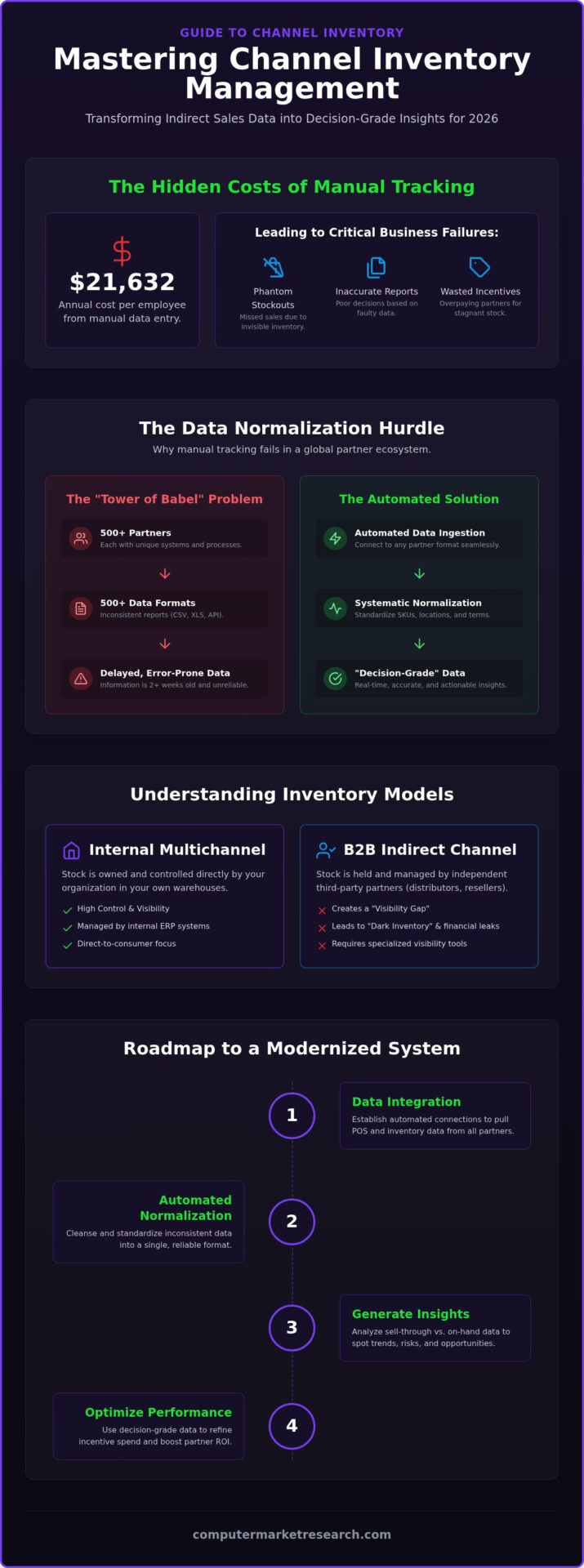
Did you know that syncing siloed inventory across disconnected systems costs your organization approximately $21,632 annually for every single employee tasked with manual data entry? For global enterprises, these hidden costs are compounded by phantom stockouts and the administrative burden of correcting inaccurate partner reports. You’ve likely felt the frustration of over-incentivizing partners for stagnant stock because your current channel inventory management processes lack real-time transparency. It’s a common operational bottleneck that erodes both partner trust and your bottom line.
We’ve designed this 2026 guide to help you reclaim control over your indirect sales data. You’ll learn how to master the complexities of B2B visibility to eliminate stockouts and optimize global performance through precise, automated workflows. We’ll examine the transition from manual spreadsheet cleansing to decision-grade inventory insights. This journey moves beyond simple tracking, focusing instead on the automated normalization of POS and inventory data. By the end of this guide, you’ll have a clear path toward a more resilient, high-performing channel ecosystem that values accuracy and performance above all else.
Key Takeaways
- Learn to distinguish between internal multichannel stock and the systematic tracking of inventory held by your third-party partners.
- Identify how automated data normalization resolves the “Tower of Babel” problem in channel inventory management by eliminating manual cleansing.
- Understand why B2B partner independence requires a specialized approach that differs from traditional retail omnichannel models.
- Discover the direct financial link between real-time visibility and optimized incentive spend, including rebates and price protections.
- Establish a structured roadmap for transitioning from legacy manual tracking to a modernized system that provides decision-grade insights.
What is Channel Inventory Management in B2B Ecosystems?
In the B2B sector, channel inventory management is the systematic tracking and oversight of stock held by third-party partners like distributors, value-added resellers (VARs), and retailers. It’s distinct from internal multichannel models where you own the stock and control the warehouse. In an indirect channel, the partner holds the inventory, creating a visibility gap that often leads to significant financial leakage. As we navigate the specific market volatility of 2026, real-time visibility has shifted from a luxury to a strategic necessity. The transition from legacy spreadsheet tracking to cloud-based automated systems is the only way to maintain operational stability in a fragmented global market.
To better understand this concept, watch this helpful video:
The Role of Indirect Sales Channels
Distributors and resellers act as inventory buffers within the supply chain, absorbing the shock of manufacturing lead times and localized demand spikes. However, these buffers often hide “dark inventory,” which is stock that exists but isn’t visible to the manufacturer. When stock remains unreported, it triggers a domino effect of poor manufacturing schedules and missed revenue opportunities. Global 2000 companies require specialized visibility tools because standard ERPs don’t provide the external connectivity needed to track stock across hundreds of independent partner locations. This transparency is critical for several reasons:
- Demand Smoothing: Partners absorb excess production to prevent factory shutdowns.
- Local Fulfillment: Resellers provide the immediate availability that enterprise buyers expect.
- Risk Mitigation: Diversified inventory across partners protects against single-point failures in the logistics network.
Key Components of Enterprise Inventory Control
Effective Channel coordination begins with Point-of-Sale (POS) data integration. This data provides the foundation for decision-grade insights, allowing you to see past the initial sale to the distributor and focus on the final transaction. By analyzing inventory on-hand reporting against sell-through data, you can spot trends before they become crises. This level of transparency is vital for channel sales management success, ensuring that your production and incentive programs align with actual market movement. Modernizing your channel inventory management ensures you’re no longer over-incentivizing partners for products that are simply collecting dust in a regional warehouse.
The Data Normalization Hurdle: Why Manual Tracking Fails
The primary obstacle to effective channel inventory management isn’t a lack of information; it’s a lack of consistency. Global enterprises often face what we call the “Tower of Babel” problem, where 500 different partners report stock levels in 500 different data formats. When your visibility depends on fragmented reports, manual data entry becomes an unavoidable, yet dangerous, necessity. This process introduces significant human error and creates a dangerous latency. By the time a spreadsheet is manually cleansed and consolidated, the data is often two weeks old, making it useless for reacting to the rapid market shifts of 2026.
To move beyond these bottlenecks, organizations must prioritize the creation of “Decision-Grade Data.” This is information that has been scrubbed of errors, mapped to internal systems, and made immediately actionable for executive leadership. There is also a significant opportunity cost to consider. When highly-paid analysts spend hundreds of man-hours manually cleansing CSV files, they aren’t performing the high-level strategy work they were hired for. You’re essentially using your most expensive talent as a human filter for “dirty” data.
The Process of Data Cleansing and Mapping
Standardizing SKU nomenclature across a global partner network requires more than a simple search-and-replace function. Each distributor may have their own internal coding system that doesn’t align with your master data. Effective channel data management involves mapping these partner-specific product codes to your manufacturer master data with absolute precision. This technical alignment is a core component of Supply Chain Coordination with Contracts, ensuring that the incentives you offer are based on actual inventory on hand rather than reporting discrepancies. Without this mapping, you risk phantom stockouts or, conversely, overstocking a region that is already saturated.
Managed Data Services vs. In-House Automation
Many organizations attempt to build in-house automation, only to find that the sheer variety of partner ERP systems makes it a never-ending IT project. Outsourcing the administrative burden to specialized Managed Data Services allows your team to focus on performance rather than file formatting. CMR’s services ensure 99%+ accuracy in partner reporting by handling the complex ingestion and validation of disparate files. Data normalization is the critical bridge between raw partner files and executive insights. If you’re ready to eliminate the manual burden and see your actual stock levels, you can start your 90-day trial to experience the power of automated data normalization first-hand.
Multichannel vs. Omnichannel vs. Indirect Inventory
Enterprise leaders often struggle to distinguish between various inventory models, yet the differences are critical for operational success. While retail brands focus on omnichannel strategies to provide a seamless consumer experience, this model frequently fails in the B2B sector due to partner independence. In a B2B environment, you don’t own the warehouses or the staff of your distributors. They are independent entities with their own financial goals and logistical constraints. This lack of direct control makes channel inventory management a unique discipline that requires specialized infrastructure. Implementing a robust partner portal software is the most effective way to bridge the gap between your internal ERP and the external reality of your partner network.
Multichannel: The Siloed Approach
Managing web, direct, and partner stock in separate silos is a legacy approach that creates unnecessary risk. When these channels don’t communicate, you’ll inevitably face the paradox of overstocking in one region while experiencing critical stockouts in another. These siloes prevent you from seeing the total available inventory across the ecosystem, leading to poor production planning and missed sales targets. The shift in 2026 is toward unified visibility, where every channel is part of a single, cohesive data stream. By breaking down these siloes, you can redirect inventory to where it’s actually moving, rather than letting it sit idle in a disconnected warehouse.
The Indirect Channel Reality
The most significant challenge in an indirect model is the human element. Many partners are hesitant to share real-time data because they fear it will be used to squeeze their margins or bypass them entirely. To overcome this, you must build trust by positioning visibility as a tool for mutual growth. When you have clear insights into their stock levels, you can help them optimize their own ROI by preventing over-purchasing and ensuring they always have the right SKUs on hand. We position our solution as a neutral, secure data repository that protects partner interests while providing you with the transparency you need. This collaborative approach turns channel inventory management into a relationship-building exercise rather than a mere tracking task. It’s about empowering your partners with better information so they can sell more of your product with less effort.
Optimizing Channel ROI Through Inventory Visibility
Financial performance in indirect sales is inextricably linked to stock transparency. Without precise channel inventory management, manufacturers often fall into the trap of over-paying on rebates and price protections. This happens because incentive programs are frequently based on sell-in data rather than actual sell-through or current stock levels. By gaining real-time visibility, you can ensure that every dollar of incentive spend is backed by a verified transaction. Accuracy drives performance. This level of oversight is particularly critical when managing ship & debit claims. If you can’t verify that a partner actually held the stock they claim to have sold at a discount, you risk paying for ghost inventory or fraudulent claims.
Beyond basic rebates, inventory velocity data allows for more surgical allocation of Market Development Funds (MDF). Instead of spreading marketing dollars evenly across your network, you can prioritize partners who demonstrate high turnover for specific product lines. This data-driven approach ensures that your investments are directed toward the most productive areas of your ecosystem, maximizing your overall channel ROI. It’s a shift from speculative spending to performance-based investment.
Preventing Inventory Distortions and Bullwhip Effects
Accurate visibility prevents the panic-ordering cycles that often destabilize manufacturing schedules. When partners lack confidence in your ability to fulfill orders, they tend to over-order during peak times, leading to artificial demand spikes. The bullwhip effect in indirect sales occurs when distorted information from the channel leads to excessive inventory fluctuations that ripple back through the entire supply chain. By providing a clear, shared view of stock levels, you stabilize production planning and ensure that your supply chain remains resilient even during periods of market volatility. This stability reduces warehouse costs and prevents the need for emergency production runs.
Validating Financial Claims with POS Data
Inventory on-hand reports serve as a secondary validation layer for all partner financial claims. This transparency significantly reduces “grey market” activity by ensuring that products are sold through authorized channels rather than being diverted to unauthorized resellers. Our PartnerPortal™ automates this validation process by cross-referencing POS data with reported inventory levels in real time. This system removes the administrative burden from your finance team and builds a culture of accountability within your partner network. If you’re ready to stop the financial leakage in your channel, you can start your 90-day trial to see how automated visibility transforms your ROI.
Implementing a Modern Channel Inventory Solution
Transitioning to a modernized infrastructure requires moving beyond the spreadsheet-as-a-database mentality. A robust channel inventory management solution must act as the definitive source of truth for your global operations. This necessitates seamless CRM and ERP integration so that sales, finance, and supply chain teams don’t operate on conflicting numbers. Our PartnerPortal™ centralizes these functions into a single hub, providing the stability and precision needed for Global 2000 enterprises to manage complex partner networks without the risk of data fragmentation.
Step 1: Centralize Partner Onboarding
The foundation of visibility is built during the onboarding phase. You must establish clear data-sharing protocols and set expectations for POS and inventory reporting frequency from day one. It shouldn’t be a one-way street. By using a centralized portal, you provide value back to the partner through lead sharing and streamlined communication, making compliance a logical benefit for them rather than a chore. This alignment ensures that your channel inventory management strategy is supported by high-quality information from every node in your network.
Step 2: Automate the Data Pipeline
Legacy email-based reporting is a primary obstacle to growth. It’s time to move toward secure portal uploads that utilize automated validation rules to flag errors at the source. This ensures that dirty data never enters your system. By leveraging CMR’s Managed Data Services, you can offload the administrative burden of data cleansing entirely. This specialized team handles the heavy lifting of normalization, ensuring your data is not only accurate but also compatible with your master product records across different regions and ERP systems.
Step 3: Drive Actionable Insights
Once the pipeline is automated, the final step is to empower your regional managers with real-time dashboards. These tools provide the decision-grade insights needed to react to market shifts instantly. You can set up automated alerts for low-stock or slow-moving inventory at specific partner locations, allowing for proactive stock rebalancing. By identifying slow-moving stock early, you can adjust incentive programs before excess inventory leads to costly price protections. This level of control builds a more resilient ecosystem and ensures your investments are always performance-based. If you’re ready to modernize your infrastructure, you should optimize your channel visibility with CMR today.
Mastering Global Visibility in 2026
The transition from manual data cleansing to automated normalization is no longer an optional upgrade; it’s a fundamental requirement for maintaining channel ROI. By addressing the “Tower of Babel” data problem and clearly distinguishing between owned and indirect stock models, your organization can eliminate the financial leakage associated with phantom stockouts and inaccurate incentive payments. High-quality, decision-grade information is the only reliable way to stabilize your supply chain against the inherent volatility of the modern global market.
Achieving excellence in channel inventory management requires a partner with deep technical competence and a proven track record. Trusted by Global 2000 enterprises since 1984, CMR provides Managed Data Services that deliver 99%+ accuracy and seamless integration with your major CRM and ERP systems. This systematic approach alleviates the administrative burden on your team and builds a foundation of trust with your partners. You can schedule a demo of PartnerPortal™ to automate your inventory visibility and experience the stability of a modernized data infrastructure. The path to operational clarity is within reach.
Frequently Asked Questions
What is the difference between POS data and inventory data?
POS data captures the specific transaction at the point of sale to the end-user, whereas inventory data tracks the stock currently residing within a partner’s warehouse. POS data provides essential sell-through insights, but inventory data is the primary metric for identifying potential stockouts before they occur. By merging these datasets, manufacturers gain a comprehensive view of channel health, allowing for more precise production adjustments and localized demand planning across global territories.
How do you handle partners who refuse to share inventory data?
You should lead with value by demonstrating how transparency improves the partner’s own profitability through better stock rebalancing and reduced over-purchasing. Many distributors are protective of their data due to perceived competitive risks. By providing a secure environment and handling the technical burden through Managed Data Services, you can build the necessary trust. Framing data sharing as a prerequisite for optimized incentive eligibility often encourages compliance across the partner network.
Can channel inventory management software integrate with my existing tech stack?
Modern solutions are designed to integrate seamlessly with leading enterprise ERP and CRM platforms to ensure a single source of truth. This connectivity allows for the automated flow of normalized data into your central records, eliminating the need for manual updates or disconnected spreadsheets. By synchronizing your channel inventory management system with your core applications, your finance and sales teams gain immediate access to validated information without the friction of switching between tools.
How much does it cost to implement an enterprise channel inventory system?
The cost of implementation varies based on the scale of your partner network and the complexity of your specific data mapping requirements. Organizations should view this as a strategic investment designed to eliminate the high costs of manual data cleansing and the financial impact of phantom stockouts. While pricing is tailored to enterprise needs, the ROI is typically realized through the reduction of over-paid incentives and the optimization of global inventory levels.
What is the primary benefit of data normalization in channel management?
Data normalization provides the decision-grade insights necessary to convert fragmented partner files into actionable business intelligence. Without this process, manufacturers are forced to rely on “dirty” data that contains SKU discrepancies and formatting errors. Normalization ensures that every record aligns with your master product data, providing a consistent foundation for channel inventory management and enabling more accurate forecasting across disparate global regions and various partner ERP systems.
How does inventory visibility help with Ship & Debit claim validation?
Visibility into on-hand stock levels acts as a critical validation layer that prevents the approval of fraudulent or duplicate claims. In a Ship & Debit environment, you must verify that the partner actually held the inventory they are claiming a discount for. By cross-referencing inventory reports with POS records, you create a transparent audit trail that protects your margins and ensures that financial incentives are only paid for legitimate, verified transactions.
Is a partner portal necessary for effective inventory tracking?
A dedicated portal is essential for centralizing the entire channel inventory management workflow into a secure, structured environment. Relying on legacy methods like email or manual file transfers introduces significant latency and increases the risk of human error. A portal like PartnerPortal™ automates the collection process and provides real-time dashboards, making it the only scalable way to manage complex, multi-tier distribution networks while maintaining high data accuracy standards.
What are the common challenges of global channel inventory management in 2026?
The most significant challenges include managing the “Tower of Babel” effect created by disparate partner data formats and navigating the increased market volatility of 2026. Global operations also face hurdles related to regional data regulations and the increasing complexity of multi-tier supply chains. Overcoming these obstacles requires a shift toward automated systems that can normalize high-velocity data in real time, providing the stability needed to maintain performance in a fragmented landscape.

Article by
Del Heles
Del Heles is the founder and CEO of Computer Market Research (CMR), a channel management software company he launched in 1984. With more than 40 years of experience, he’s known for helping manufacturers and distributors simplify complex partner programs through practical, customer-focused technology solutions.