

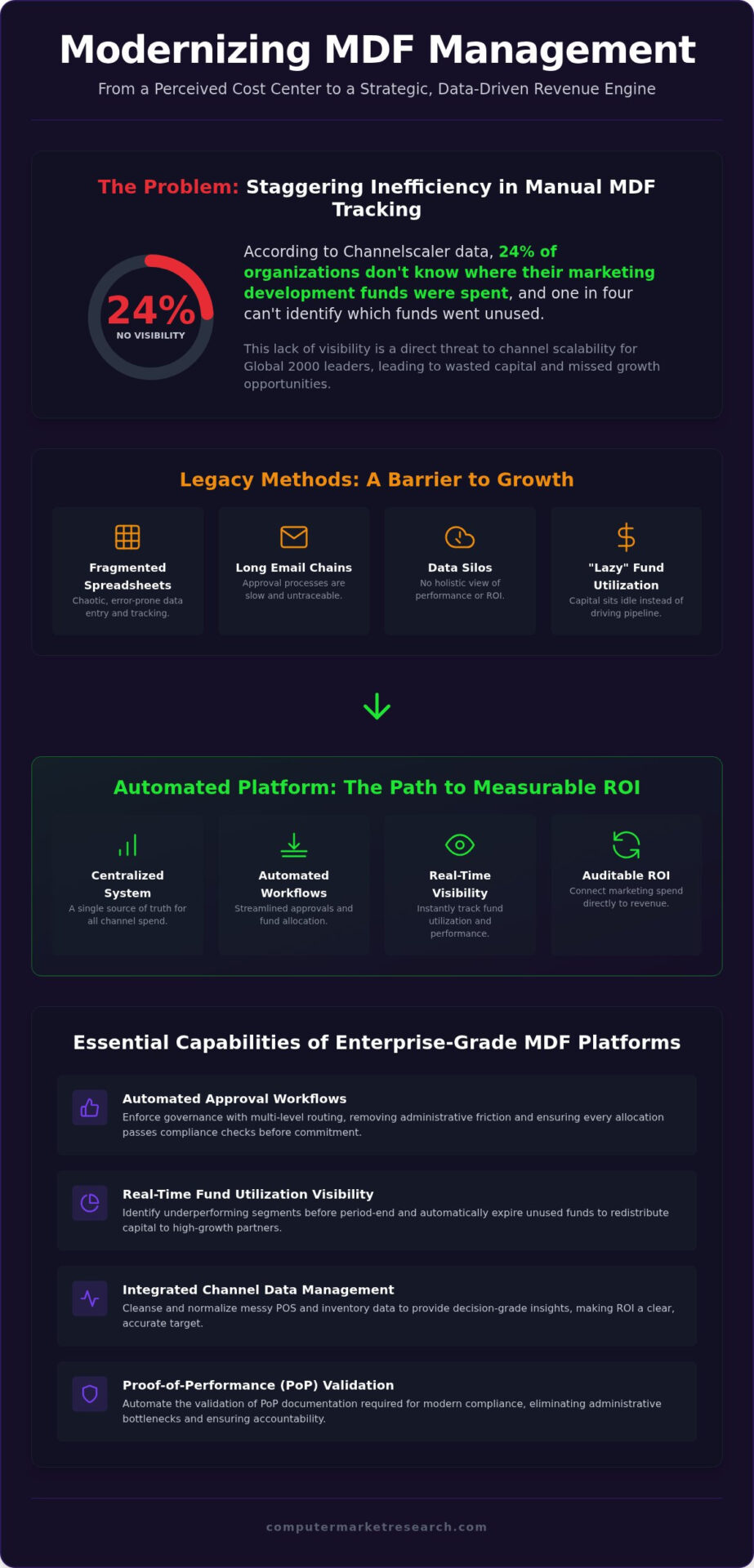
According to data from Channelscaler in January 2026, 24% of organizations don’t know where their marketing development funds were spent, and one in four can’t identify which funds went unused. For Global 2000 leaders, this lack of visibility isn’t just a nuisance; it’s a direct threat to channel scalability. You’ve likely experienced the exhaustion of managing fragmented spreadsheets and the high error rates that accompany manual reimbursement claims. If your team is currently drowning in manual tracking, then purpose-built mdf management software offers the only logical path toward reclaiming operational control and validating performance without an administrative uphill battle.
This guide shows you how to replace these obsolete manual methods with purpose-built automation like PartnerPortal™. By adopting a system designed for automated data normalization and auditable workflows, you’ll learn how to eliminate operational bottlenecks and secure a clear path to measurable ROI. We’ll examine the technical infrastructure required to automate proof-of-performance validation and provide the real-time reporting necessary to connect marketing spend directly to channel revenue growth.
Key Takeaways
- Learn how to transform marketing development funds from a perceived cost center into a strategic, data-driven revenue engine.
- Identify the core requirements for enterprise-grade mdf management software, including automated approval workflows and real-time visibility into fund utilization.
- Evaluate the operational risks and hidden costs of legacy manual tracking methods compared to the stability of automated SaaS platforms.
- Discover how standardizing global taxonomies and KPIs ensures fund governance remains aligned with corporate growth objectives.
- Understand the advantage of integrating managed data services to achieve decision-grade information and eliminate administrative bottlenecks.
Defining MDF Management Software in the Modern Channel
Modern mdf management software functions as a centralized SaaS platform designed for rigorous fund governance. In the current B2B environment, Global 2000 organizations have moved past viewing channel marketing as a simple line-item expense. It’s now a strategic revenue driver. Effective Market Development Funds (MDF) strategies rely on a centralized system of record to govern spend and ensure that every dollar allocated to a partner aligns with specific corporate growth objectives. This transition requires a shift from reactive fund distribution to proactive, data-driven investment.
To better understand how infrastructure and management systems provide the foundation for enterprise operations, watch this helpful video:
By 2026, the complexity of global partner networks has made manual spreadsheets a primary obstacle to growth. Fragmented data prevents teams from seeing which partners are actually performing. Integrating mdf management software into your PartnerPortal™ ecosystem creates a seamless connection between fund allocation, deal registration, and final revenue outcomes. This visibility is essential for maintaining a competitive edge in a landscape where speed and accuracy are the benchmarks of success.
The Core Purpose of Market Development Funds
It’s vital to distinguish between discretionary and earned funds. MDF is typically discretionary, provided to partners upfront to stimulate demand. In contrast, co-op funds are earned by partners based on a percentage of their historical sales. Both serve to incentivize partner-led demand generation, yet they require different management styles. MDF management software serves as the definitive system of record for channel marketing spend, ensuring every dollar is trackable and auditable. Without this structure, vendors often struggle to justify the continued investment in partner programs during budget reviews.
Why Legacy Tracking Methods Fail at Enterprise Scale
Fragmented spreadsheets and long email chains carry massive hidden costs. Manual processes are prone to high error rates, leading to financial non-compliance and “lazy” fund utilization where capital sits idle instead of driving pipeline. Data silos prevent a holistic view of ROI, making it impossible to compare performance across different regions or partner tiers. The obsolescence of these manual methods is clear; they cannot handle the volume of proof-of-performance (PoP) validation required for modern compliance. Moving to an automated system eliminates these bottlenecks, allowing your team to focus on strategic optimization rather than administrative troubleshooting.
Essential Capabilities of Enterprise-Grade MDF Platforms
Enterprise-grade mdf management software must do more than simply record transactions; it must enforce governance across complex global networks. High-performing organizations utilize automated request and approval workflows that incorporate multi-level routing. This ensures that every allocation passes through necessary compliance checks before a single dollar is committed. By automating these paths, you remove the administrative friction that typically stalls partner momentum and leads to missed market opportunities.
Real-time visibility into fund utilization allows managers to identify underperforming segments before the end of a fiscal period. Automatic expiration of unused allocations ensures that capital is redistributed to high-growth areas rather than sitting idle. To achieve this level of precision, the platform must integrate directly with channel data management systems. This integration is critical because it cleanses messy POS and inventory data, providing the decision-grade insights necessary to justify every marketing spend. Without this layer of data normalization, ROI remains a moving target that’s impossible to hit with accuracy.
Advanced Workflow Automation and Governance
Governance starts with customizable eligibility rules. You can define specific parameters based on partner tier, geographic region, or product focus. This level of control prevents funds from being misallocated to partners who lack the maturity to execute complex campaigns. Automated reminders for claim deadlines and fund expiration further reduce the administrative burden on your team while keeping partners accountable. For Global 2000 firms, this structure is essential for maintaining auditability and meeting the rigorous financial and regulatory compliance standards required in 2026.
Proof-of-Performance (PoP) and Claim Processing
Validating that an activity actually occurred is often the most significant bottleneck in channel management. Standardizing the evidence required for reimbursement within the software ensures consistency. This standardization significantly reduces the cycle time from activity execution to payment, which builds partner trust. When you streamline this process, measuring ROI of channel marketing becomes a data-driven exercise rather than a series of educated guesses. Linking these claims directly to ship and debit management software provides a holistic view of the financial relationship with each partner. If you’re ready to see how automation can transform your workflows, you can explore our platform’s capabilities with a focused evaluation.
MDF Software vs. Spreadsheets: Calculating the Operational Cost
Relying on legacy spreadsheets to manage millions in channel spend creates a scalability ceiling that most Global 2000 firms hit long before they realize it. While manual tracking might seem cost-effective initially, the operational tax is significant. A single administrator can typically manage only a handful of partners effectively before manual data entry leads to a cascade of errors. This visibility gap prevents leadership from seeing which activities drive revenue, essentially turning marketing investments into a guessing game. By transitioning to mdf management software, organizations eliminate these manual bottlenecks and gain the precision required for enterprise-scale growth.
The impact of error-prone data extends beyond internal frustration; it erodes the very foundation of partner trust. When reimbursement claims are delayed or rejected due to spreadsheet discrepancies, partners don’t perceive the vendor as a reliable business ally. This friction directly correlates with lower program participation rates. Scalability limits are also reached quickly; a manual system typically requires one full-time equivalent (FTE) for every 50 active partners. In contrast, mdf management software allows a single administrator to manage hundreds of partners with higher accuracy and less stress.
The Hidden Labor Costs of Manual Management
The hidden labor costs of manual management often reside in the hours senior employees spend on data cleansing and claim validation. When high-value channel managers are buried in low-value administrative tasks, the opportunity cost to the business is immense. Automated normalization reduces administrative overhead by up to 50%, allowing your team to focus on partner strategy rather than technical troubleshooting. This shift is critical for addressing The MDF Dilemma, where vendors struggle to make funding work effectively across diverse partner ecosystems without a centralized system.
Partner Experience and Program Participation
Partner experience is the next casualty of manual systems. If a partner finds it difficult to submit a claim or faces frequent reimbursement errors, they simply disengage. In 2026, a frictionless partner portal is no longer a luxury; it is a baseline requirement for participation. High-performing partners gravitate toward vendors who provide clear, automated workflows and real-time fund visibility. If your current process relies on email chains and version-controlled files, you should review these 5 Signs You’ve Outgrown Spreadsheets for Partner Management to prevent further program attrition.
Strategic Best Practices for MDF Program Implementation
Success with mdf management software requires more than technical integration. It demands a rigorous alignment between fund allocation and overarching corporate growth objectives. For Global 2000 firms, this starts with standardizing taxonomy and KPIs across diverse global regions. Without a shared language for marketing activities, centralized reporting remains fragmented and unreliable. When “Lead Generation” means something different in EMEA than it does in North America, your data loses its ability to inform strategic decisions.
A phased rollout strategy is the most effective way to minimize operational disruption. You should begin by onboarding high-impact partner tiers where the potential for revenue gain is highest. This approach allows you to refine approval workflows and validation rules on a smaller scale before a global expansion. Comprehensive training and onboarding are equally vital. High partner adoption rates depend on a system that’s intuitive and demonstrably faster than the legacy manual processes it replaces. If the software doesn’t save the partner time, they’ll continue to resist the transition.
Defining Clear Eligibility and Performance Rules
Transparent guidelines are the primary defense against channel conflict. You must clearly define which activities qualify for funding and what specific evidence is required for reimbursement. This is particularly important when structuring incentives for “Z-tier” or emerging partners who may require more prescriptive guidance to drive demand. Integrating these rules into a broader channel sales management strategy ensures that MDF isn’t an isolated marketing cost. Instead, it becomes a synchronized component of the sales pipeline that drives predictable outcomes.
Establishing a Data-First ROI Framework
An enterprise-grade implementation must prioritize real-time dashboards that track marketing spend against actual pipeline. Clean POS data is the cornerstone of this framework. It allows you to verify campaign success by linking specific marketing activities to end-customer sales. This level of precision is what separates high-growth organizations from those still struggling with “lazy” fund utilization. For a deeper look at these dynamics, see our resource on Market Development Funds (MDF): The Strategic Guide to Channel Growth in 2026. If you’re ready to transition from manual bottlenecks to a modernized infrastructure, you can start your 90-day evaluation of PartnerPortal™ today.
Driving Channel Performance with CMR PartnerPortal™
CMR PartnerPortal™ provides the unified infrastructure necessary to execute complex channel strategies at scale. It centralizes MDF, rebates, and deal registration into a single, auditable environment, ensuring that every incentive program aligns with your primary revenue goals. While many platforms offer basic tracking, the unique advantage of CMR lies in its managed data services. This specialized approach ensures that the messy POS and inventory data often found in global channels is cleansed and normalized before it reaches your reports. For Global 2000 enterprises, this level of precision is the difference between speculative spending and data-backed investment.
Scaling global programs requires more than just a software license. It needs multi-currency and multi-language support to accommodate diverse partner networks across different regulatory environments. CMR’s heritage, dating back to 1984, positions the company as a seasoned consultant rather than just a SaaS provider. This experience is vital when you’re navigating the nuances of international financial tracking and incentive programs. By choosing a partner that understands the technical depth of B2B data administration, you secure a clear path out of operational bottlenecks.
A Holistic Approach to Partner Relationship Management
Point solutions often lead to fragmented information and data silos. Integrated modules perform better because they allow for a comprehensive view of the partner lifecycle within a single system of record. Real-time visibility into inventory and POS through the portal ensures that manufacturers can validate the impact of marketing spend on actual sell-through. This visibility reduces the administrative burden on your team, as the system automatically cross-references claims with confirmed sales data. When mdf management software is part of a holistic PRM strategy, it transforms from a simple tracking tool into a powerful engine for demand generation.
Next Steps: Modernizing Your Channel Infrastructure
Transitioning to modernized mdf management software is a strategic evolution that requires careful planning. You should begin by assessing your current program maturity and automation readiness to identify where manual errors are most prevalent. Professional implementation and integration services ensure that your new infrastructure aligns perfectly with existing ERP and CRM systems. This methodical approach ensures that the transition feels like a logical step for your organization. If you’re ready to eliminate manual errors and scale your channel ROI with decision-grade data, you can schedule a demo of CMR PartnerPortal™ to see these systems in action.
Modernizing Your Channel Strategy for Sustainable Growth
Since 1984, Computer Market Research has provided the technical expertise required to manage complex B2B relationships for Global 2000 and Fortune 500 companies. Our PartnerPortal™ platform ensures your data is normalized and your workflows are auditable, allowing your team to focus on high-value strategy rather than low-value administration. If you’re ready to secure a clear path to improved returns, it’s time to optimize your channel spend with PartnerPortal™. Establishing a transparent, data-driven foundation today ensures your channel remains competitive and resilient in the years to come.
Frequently Asked Questions
What is the primary difference between MDF and co-op funds?
MDF is discretionary and typically provided upfront to partners for specific demand-generation activities. In contrast, co-op funds are earned by partners based on a percentage of their historical sales volume. While MDF focuses on future growth and strategic market penetration, co-op funds function as a reward for past performance. Automated systems manage both through distinct rule sets to ensure financial compliance and strategic alignment.
How does MDF management software improve channel partner ROI?
Purpose-built mdf management software improves ROI by eliminating “lazy” fund utilization and reallocating capital to high-performing partners in real time. Automation reduces the administrative overhead associated with manual claim validation, which lowers the operational cost of the program. By integrating with POS data management modules, the software provides the decision-grade insights needed to link specific marketing activities directly to sell-through revenue, ensuring every dollar is accountable.
Can MDF software integrate with my existing CRM?
Yes, enterprise platforms like PartnerPortal™ are designed to integrate seamlessly with major CRM and ERP systems. This ensures a single system of record for all channel operations. By syncing data between your existing tech stack and mdf management software, you can track the entire lead-to-revenue lifecycle. This connectivity allows sales and marketing teams to view fund utilization alongside opportunity data for a holistic view of partner performance; to optimize your CRM for these types of enterprise integrations, you can visit CRM Mates.
What proof-of-performance documentation is typically required?
Proof-of-performance (PoP) documentation typically includes invoices, creative samples, and digital activity logs that verify a marketing campaign occurred as planned. Standardizing these requirements within an automated platform ensures consistency across your global partner network. Common examples include tear sheets for print ads, screenshots of digital banners, or attendance lists for hosted webinars. Digital systems allow partners to upload these documents directly, significantly reducing the cycle time for reimbursement.
How does automation prevent fraud in MDF programs?
While smaller businesses can benefit from basic automation, this specific category of software is primarily engineered for Global 2000 and Fortune 500 enterprises with complex channel structures. These organizations manage thousands of partners across multiple regions, requiring the technical depth and data normalization capabilities that only enterprise-grade systems provide. The focus is on handling high-volume transactions and maintaining rigorous compliance standards that smaller, generalist tools simply cannot support at scale.
How long does it typically take to implement an MDF platform?
The implementation timeline for an enterprise MDF platform typically ranges from several weeks to a few months, depending on the complexity of your existing data silos. A phased rollout is often recommended, starting with high-impact partner tiers to refine workflows before a global launch. Professional implementation services focus on integrating the platform with your current CRM and ERP systems while normalizing historical data to ensure a stable foundation for future growth.
What are the most important KPIs to track in an MDF program?
The most important KPIs to track include fund utilization rates, claim processing cycle times, and the ratio of marketing spend to partner-sourced revenue. You should also monitor partner participation levels across different tiers to identify engagement gaps. By tracking these metrics within a centralized dashboard, channel leaders can make data-driven decisions about where to increase investments. High-performing programs prioritize “return on objective” alongside traditional financial ROI to measure long-term strategic success.

Article by
Del Heles
Del Heles is the founder and CEO of Computer Market Research (CMR), a channel management software company he launched in 1984. With more than 40 years of experience, he’s known for helping manufacturers and distributors simplify complex partner programs through practical, customer-focused technology solutions.