

Approximately 60% of available Market Development Funds go unclaimed every year because the administrative process is too difficult for partners to navigate. For Global 2000 leaders, this isn’t just a missed opportunity; it’s a symptom of a deeper visibility crisis that obscures your true mdf program roi. You’re likely tired of wrestling with messy, unnormalized partner POS data and the high administrative overhead that comes with legacy claim processing. It’s frustrating when you can’t see fund utilization in real time or prove that your spend is actually moving the needle on sales.
We understand that fragmented information is the primary obstacle to your growth. This guide provides the technical roadmap you need to master the metrics, formulas, and data strategies that transform your MDF program into a verifiable revenue driver. You’ll learn how to implement a standardized ROI framework and leverage automated tracking to eliminate manual spreadsheet errors. We will walk through the transition from reactive reporting to a modernized system using PartnerPortal™ to create a single source of truth for your channel spend. By the end of this article, you’ll have a clear path to align marketing investments with measurable revenue outcomes.
Key Takeaways
- Implement a standardized ROI formula that moves your program beyond simple activity tracking toward verifiable gross profit outcomes.
- Master the data normalization strategies required to achieve a clear view of your mdf program roi across complex global partner networks.
- Quantify and eliminate the “Administrative Tax” by automating claim validation to reclaim lost productivity and significantly reduce processing cycles.
- Transition to outcome-based funding models that reward high-performance partner behaviors and align spend with modern marketing automation.
- Centralize your global channel operations within a single source of truth to ensure compliance and real-time visibility into fund utilization.
Why Traditional MDF ROI Models Are Failing in 2026
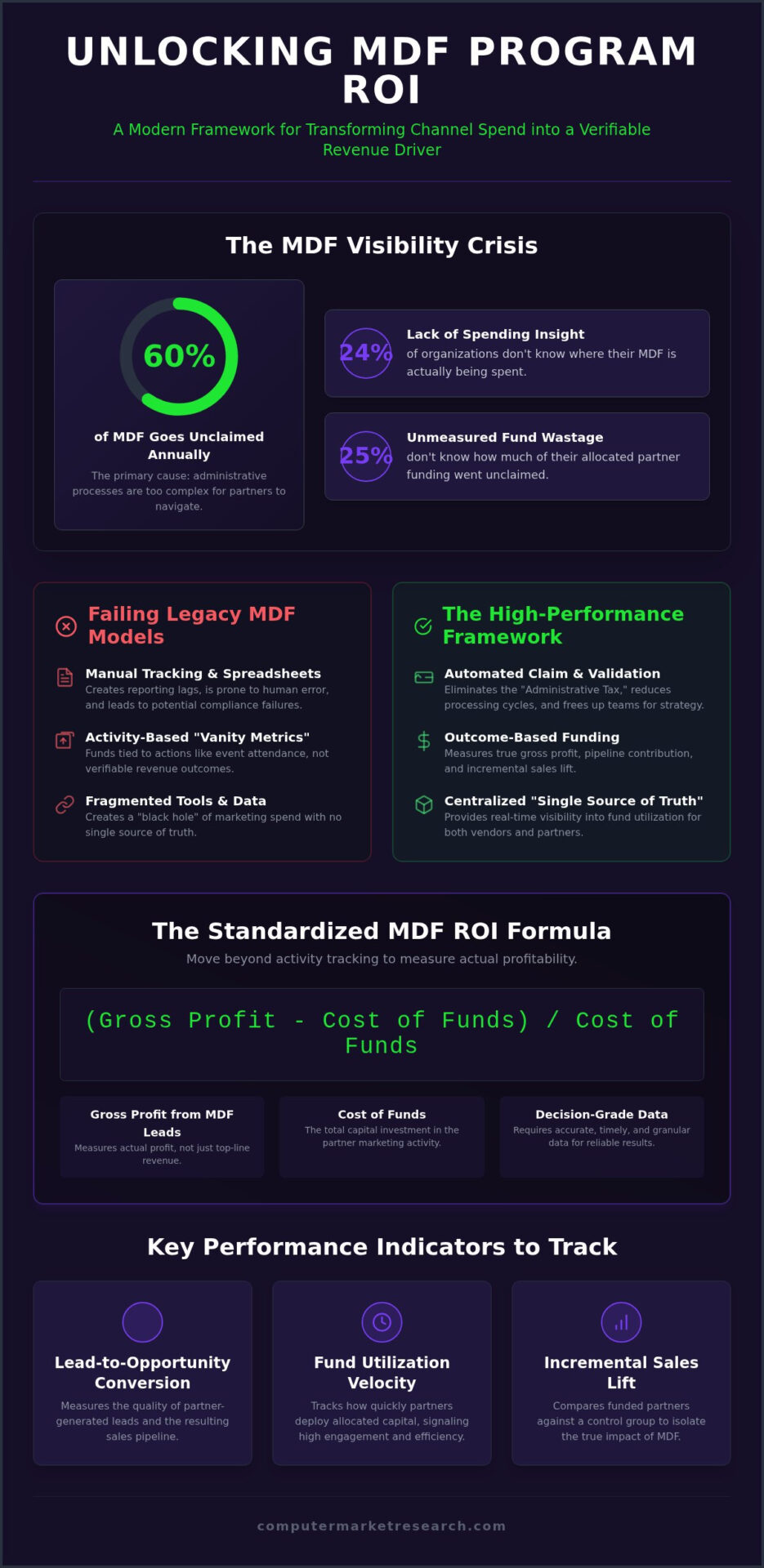
Many organizations continue to treat Market Development Funds as a “black hole” of marketing spend. According to research from July 2026, approximately 60% of available funds go unclaimed each year because the administrative process is too difficult for partners to navigate. This lack of participation creates a vacuum where your mdf program roi remains completely unmeasured. When funds are actually utilized, they’re often tied to vanity metrics like event attendance or logo placement rather than actual revenue outcomes. This activity-based funding model is becoming obsolete as leadership demands verifiable proof of partner-driven growth.
Legacy systems and fragmented tools are the primary culprits behind this visibility crisis. Recent data indicates that 24% of organizations don’t know where their MDF is spent, and 25% don’t know how much went unclaimed. Relying on disconnected spreadsheets creates a significant lag in reporting that makes real-time optimization impossible. By the time a manual report is compiled, the data is often weeks or months old. This delay prevents you from reallocating funds to high-performing partners who are actually driving pipeline, effectively capping your potential yield.
The Death of Manual MDF Tracking
Manual claim processing isn’t just a slow workflow; it’s a primary obstacle to growth. It introduces significant risks of financial non-compliance and potential audit failures. Without a centralized system, verifying proof of performance becomes a subjective exercise prone to human error. Modern digital infrastructure replaces these fragmented tools with automated workflows, ensuring that every dollar is tracked against a specific deal registration or lead. Transitioning away from manual methods allows your team to focus on strategy rather than the “administrative tax” of validating thousands of partner receipts.
From Cost Center to Revenue Driver
Redefining your MDF program requires a fundamental shift in perspective. You must view these funds as a strategic investment rather than an unavoidable expense. By aligning fund allocation with your corporate Go-To-Market (GTM) objectives, you ensure that partner activities directly support broader revenue goals. Transparency is the key to building trust within your channel. When partners see a clear, automated path to funding, their participation rates increase. Utilizing a platform like PartnerPortal™ provides a single source of truth, allowing both vendors and partners to view real-time performance data. This shift from reactive reporting to proactive strategy is the only way to secure a verifiable mdf program roi in a competitive landscape.
The MDF ROI Formula: Data Accuracy and Performance Metrics
MDF ROI is the ratio of verifiable partner growth to total fund allocation. To move beyond the visibility crisis mentioned in the previous section, organizations must adopt a standardized calculation: (Gross Profit from MDF Leads – Cost of Funds) / Cost of Funds. This formula ensures you’re measuring actual profitability rather than just top-line revenue, which often obscures the true health of your channel investments.
Calculating a reliable mdf program roi requires “Decision-Grade Data.” This refers to information that is accurate, timely, and granular enough to support high-stakes financial decisions. Without this foundation, your ROI figures are merely estimates that won’t hold up under executive scrutiny; for many leaders, this is where Power BI consulting Luxembourg becomes essential for building robust, automated reporting frameworks. It’s also vital to distinguish between direct attribution and sales influence. While direct attribution tracks leads generated by a specific campaign, sales influence accounts for touchpoints that accelerated an existing deal. Both are necessary for a holistic view, but they require distinct tracking layers to prevent data duplication.
Key Performance Indicators (KPIs) for MDF Success
High-performing programs track specific metrics to gauge health before the final sale occurs. Since January 2026 research shows that 41% of MDF goes unused or under-utilized, monitoring these indicators is essential for optimization. Key metrics include:
- Lead-to-opportunity conversion: This measures the quality of partner-led marketing activities and the strength of the resulting pipeline.
- Fund utilization velocity: This tracks how quickly partners deploy allocated capital, signaling high engagement and operational efficiency.
- Incremental sales lift: This compares the performance of funded partners against a control group of non-funded partners to isolate the impact of spend.
Normalizing Partner Data for Accurate Reporting
The primary hurdle to accurate reporting is the heterogeneous nature of partner POS and inventory reports. Every partner uses a different reporting format, leading to “garbage in, garbage out” scenarios that undermine your mdf program roi calculations. Utilizing Managed Data Services solves this by cleansing and normalizing fragmented information into a consistent, actionable format. By integrating this refined data with your CRM, you achieve closed-loop reporting that connects every dollar spent to a specific, verifiable revenue outcome. You can request a demonstration of these automated systems to see how data normalization improves your reporting accuracy and partner transparency.
Eliminating the Administrative Tax on MDF Program ROI
Every dollar spent on manual claim validation is a dollar not spent on market growth. This “Administrative Tax” represents the hidden internal labor costs and operational overhead associated with chasing down receipts and verifying compliance. It directly erodes your mdf program roi by inflating the total cost of program management. Modernized systems solve this by replacing manual reviews with algorithmic validation. Industry data suggests that transitioning to automated workflows can reduce claim processing time by up to 80%, allowing your operations team to shift their focus from data entry to high-level strategic analysis.
Faster partner reimbursements also provide a significant boost to program performance. When partners receive their funds quickly, they’re more likely to reinvest that capital into subsequent campaigns, creating a virtuous cycle of activity. Automation doesn’t just speed things up; it also hardens your program against financial leakage. Automated compliance checks identify duplicate claims, missing proof of performance, and potential fraud with a level of precision that manual audits can’t match. This ensures that every cent of your budget is used exactly as intended.
Streamlining the Claim and Audit Workflow
Standardizing your digital audit trail is essential for global compliance, especially for organizations managing funds across multiple tax jurisdictions. Automated Proof of Performance (PoP) collection ensures that all required documentation is captured at the point of submission. You can optimize your Co-op/MDF program by implementing a system that flags discrepancies instantly. This proactive approach eliminates the friction of back-and-forth communication between your team and your partners, ensuring that audits are a routine check rather than a labor-intensive project.
Reducing Partner Friction to Drive Participation
There’s a direct correlation between “Ease of Doing Business” (EODB) and your overall mdf program roi. If your program is too complex, your best partners will simply ignore it, leaving valuable funds on the table. Self-service portals empower partners to manage their own fund utilization and track claim status in real-time. This transparency eliminates the “black hole” effect and mirrors the focus on direct engagement seen on platforms like OohYeah!, which allows fans to support music artists directly. By preventing “fund-squatting” and using automated expiration triggers, you can reallocate stagnant funds to high-performing partners who are ready to drive immediate revenue, ensuring your budget is always working at peak efficiency.
Maximizing your marketing yield requires moving beyond flat fund allocation toward a model that rewards specific, high-value partner behaviors. Tiered funding models are a highly effective way to achieve this. By segmenting partners based on their historical mdf program roi and data accuracy, you can prioritize investments for those who consistently demonstrate the highest conversion rates. This approach incentivizes lower-tier partners to improve their reporting standards and campaign execution to gain access to larger budget pools.
Alignment with Through-Channel Marketing Automation (TCMA) is another critical factor in driving yield. When you integrate your MDF program with automated marketing tools, you reduce the creative burden on partners while maintaining brand consistency. You can also leverage real-time inventory data to trigger localized campaigns. If POS reports show a surplus of a specific product in a certain region, you can instantly release targeted funds to partners in that area to stimulate demand. This level of agility ensures that your spend is always reactive to actual market conditions rather than static quarterly plans.
Joint Business Planning (JBP) serves as the strategic foundation for these activities. Rather than simply approving individual requests, use JBP sessions to align fund allocation with long-term revenue targets. This collaborative approach ensures that both the vendor and the partner are working toward the same Key Performance Indicators, turning the relationship from a transactional one into a true strategic partnership. To see how these strategies can be automated for your organization, you should claim your 90-day free trial of our management platform.
Focusing Funds on High-Growth Markets
Data-driven organizations use normalized POS and inventory reports to identify geographic and vertical market opportunities that others miss. By analyzing where demand is surging, you can shift your budget to capture emerging trends before your competitors react. This is particularly effective for competitive displacement. You can use this Strategic Guide to Market Development Funds to learn how to weaponize your MDF to win market share from rivals in key territories. Using funds to subsidize “switch-and-save” programs for end-users can provide a significant boost to your overall mdf program roi.
Improving Partner Enablement and Readiness
Finding the right balance between funding demand generation and partner enablement is essential. While demand gen provides immediate results, investing in partner training and certification delivers a higher marketing yield over time. Better-equipped partners are more efficient at closing leads and require less support from your internal teams, which lowers your total cost of sales. Tracking the long-term ROI of these enablement activities allows you to see which training programs actually lead to increased revenue, ensuring your enablement budget is spent on high-impact initiatives.
Scaling Global MDF Programs with PartnerPortal™ Automation
Scaling global programs requires more than just a larger budget; it necessitates a unified digital infrastructure that can handle the complexity of multi-tier distribution. By centralizing the global partner experience in a single cloud-based portal, organizations eliminate the geographic silos that typically obscure your mdf program roi. The synergy between PartnerPortal™ and Co-op/MDF management allows for a seamless flow of data from the initial fund request to the final payout. This real-time visibility empowers channel leaders to make proactive decisions based on current performance rather than historical estimates. For Global 2000 enterprises, this level of scalability is a prerequisite for long-term stability and operational excellence. It ensures that your program remains agile enough to pivot as market dynamics shift, preventing the stagnation that often plagues legacy channel models.
The Power of Unified Channel Management
Connecting deal registration, incentives, and MDF provides a 360-degree view of partner performance. Silos are the enemy of efficiency. This unified approach provides several operational benefits:
- It eliminates the data silos that often exist between finance, sales, and marketing departments.
- It ensures that fund allocation is directly tied to deal registration and verified sales activity.
- It provides partners with a consistent, friction-free interface for all channel interactions.
When these teams share a single source of truth, the administrative friction that previously hampered growth is removed. This allows for more strategic capital deployment, ensuring that your marketing spend is always aligned with your most profitable sales channels and partner behaviors.
Implementing a Data-Driven MDF Strategy
Transitioning from legacy spreadsheets to the PartnerPortal™ platform is a structured process that begins with data consolidation. CMR’s Managed Data Services play a vital role here by ensuring that every piece of incoming channel information is cleansed and normalized before it enters your reporting suite. It’s the essential prerequisite for ensuring mdf program roi accuracy across your entire network. Closing the loop involves several critical steps:
- Consolidating fragmented POS and inventory reports into a standardized format.
- Linking specific marketing activities to closed deals within your CRM.
- Automating the validation of proof-of-performance documents to speed up reimbursements.
By following this roadmap, you transform your MDF program into a high-performance growth lever. This modernization ensures that your channel infrastructure remains resilient as market conditions evolve, providing a clear path out of operational bottlenecks and toward verifiable revenue results.
Future-Proofing Your Channel Marketing Investment
Transitioning from manual spreadsheets to automated digital infrastructure is no longer optional for organizations seeking verifiable results. By standardizing your ROI calculations and normalizing partner data, you eliminate the administrative overhead that often erodes your margins. Achieving a superior mdf program roi depends on your ability to turn fragmented POS reports into decision-grade insights that support strategic growth. It’s time to replace legacy obstacles with a modernized system that builds trust through technical competence and accuracy.
Since 1984, we’ve helped Fortune 500 and Global 2000 companies achieve real-time visibility into their channel marketing spend. Our automated data cleansing ensures you’re working with high-quality information rather than manual errors. It’s the only logical step for growing organizations that value order and performance. Ready to see how this modernization can drive your revenue growth? You can request a demo of CMR’s Co-op/MDF Management Platform to start your transformation today. You have the roadmap; now it’s time to build a more transparent and profitable partner network.
Frequently Asked Questions
How do I calculate MDF ROI for long sales cycles?
Calculating ROI for extended sales cycles requires tracking leading indicators such as pipeline value and incremental sales lift rather than waiting for final revenue. You should monitor lead-to-opportunity conversion rates and deal registration velocity within your CRM to gauge program health. This proactive approach allows you to measure the impact of your spend months before the final transaction occurs, ensuring that your strategic investments remain aligned with long-term revenue targets.
What is a good ROI for a market development fund program?
A strong benchmark for a mature program is typically a 5:1 revenue-to-spend ratio, though this varies significantly by industry and partner tier. High-performing organizations often focus on gross profit yields rather than just top-line revenue to ensure true profitability. You should evaluate your program against historical performance and industry peers while prioritizing partners who consistently demonstrate high data accuracy and low administrative overhead during the claim process.
How does automation improve the ROI of my MDF program?
Automation improves your mdf program roi by eliminating the manual labor associated with claim validation and compliance audits. By reducing processing times by up to 80%, you reclaim the “Administrative Tax” and allow your team to focus on strategic market development. Faster reimbursements also increase partner participation and engagement, creating a virtuous cycle where capital is reinvested into new campaigns more frequently, ultimately driving higher total channel revenue.
What are the most common barriers to measuring MDF success?
The primary barriers to measuring success include fragmented partner POS data and a continued reliance on manual spreadsheets for tracking. Many organizations suffer from a lack of real-time visibility, which prevents them from reallocating funds to high-performing partners. These data silos between finance, sales, and marketing make it impossible to achieve a 360-degree view of partner performance, resulting in unclaimed funds and unmeasured marketing spend across the global channel.
Can I track MDF ROI without clean POS data?
Accurate tracking of mdf program roi is impossible without normalized POS data because fragmented reports create “garbage in, garbage out” scenarios. You cannot verify the incremental sales lift of a campaign if your partner reports are inconsistent or incomplete. Utilizing Managed Data Services to cleanse and normalize this information is the essential prerequisite for decision-grade insights. Without this foundation, your ROI calculations remain mere estimates that cannot withstand rigorous executive or financial scrutiny.
What is the difference between MDF ROI and Co-op ROI?
MDF ROI measures the effectiveness of discretionary funds used for strategic growth and market expansion, while Co-op ROI tracks the return on earned funds based on historical purchase volumes. MDF is typically forward-looking and tied to specific marketing objectives; Co-op is often reactive and focused on partner loyalty. Both require accurate data normalization, but MDF tracking is generally more complex because it involves verifying specific performance outcomes rather than just purchase accruals.
How do I handle multi-touch attribution in channel marketing?
Handling multi-touch attribution requires a clear distinction between direct lead generation and sales influence within your tracking system. You should use a centralized portal to capture every partner interaction, from the initial fund request to the final deal registration. This ensures that you don’t duplicate revenue credit across multiple campaigns. By integrating this data with your CRM, you can see which specific MDF activities accelerated the deal, providing a more holistic view of marketing yield.
What proof of performance is required for MDF ROI verification?
Verification requires standardized proof of performance such as third-party invoices, digital marketing logs, tear sheets, and deal registration data. These documents must be verifiable and tied directly to the funded activity to ensure financial compliance. Utilizing an automated system to collect and flag discrepancies in these documents prevents fraud and overpayment. Standardizing these requirements across your global partner network ensures that your audit trail is always ready for internal or external review.

Article by
Del Heles
Del Heles is the founder and CEO of Computer Market Research (CMR), a channel management software company he launched in 1984. With more than 40 years of experience, he’s known for helping manufacturers and distributors simplify complex partner programs through practical, customer-focused technology solutions.