

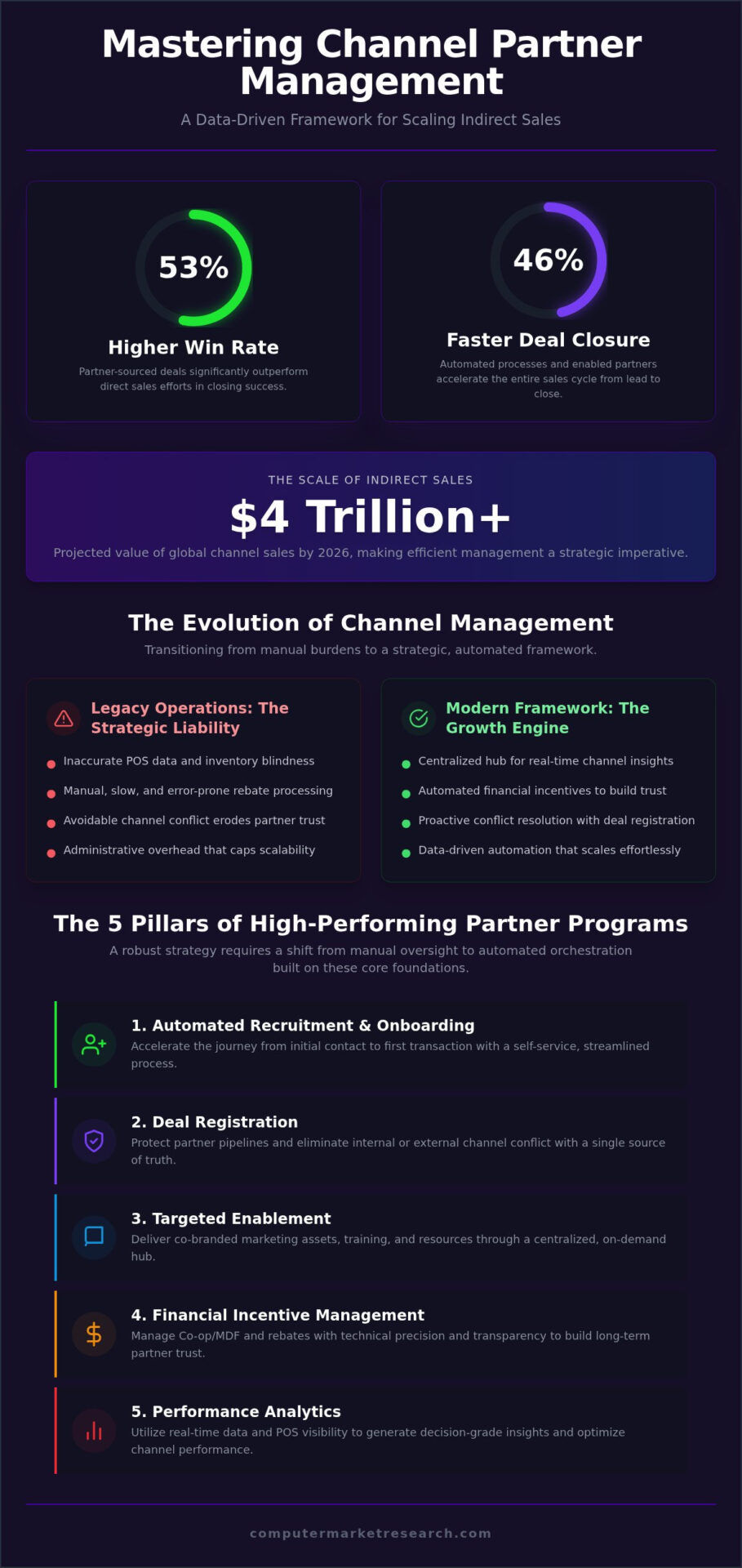
Partner-sourced deals close 46% faster and boast a 53% higher win rate than direct sales, yet many organizations still treat their indirect channels as an administrative afterthought. This disconnect often results in inaccurate POS data, manual rebate processing, and avoidable channel conflict. In a global market where channel sales are projected to exceed $4 trillion by 2026, relying on legacy tracking methods is no longer a minor nuisance. It’s a strategic liability. Modern channel partner management has evolved from a relationship-based discipline into a rigorous, data-driven automation requirement.
You likely recognize that manual workflows for MDF claims and deal registrations are capping your scalability and frustrating your most productive partners. We understand that visibility into inventory and accurate financial tracking are essential for maintaining operational stability. This guide provides a clear path to mastering the complexities of indirect sales by automating partner recruitment, financial incentives, and performance tracking. We’ll examine how to replace operational bottlenecks with centralized operations and decision-grade channel insights. By leveraging systems like PartnerPortal™, you can transition from reactive troubleshooting to a proactive, automated strategy that maximizes every partner interaction.
Key Takeaways
- Transition from manual relationship tracking to a data-driven channel partner management framework that scales without increasing administrative overhead.
- Establish high-performing programs by automating recruitment and deal registration to accelerate time-to-revenue and eliminate channel conflict.
- Solve financial friction by automating Co-op/MDF and rebate claims, ensuring the transparency required to build long-term partner trust.
- Centralize fragmented indirect sales operations into a single source of truth for real-time visibility into POS data and inventory levels.
- Scale global operations using modular automation tools like PartnerPortal™ to streamline the partner lifecycle while maintaining technical precision.
Why Channel Partner Management is Your 2026 Growth Engine
Effective channel partner management serves as the structural backbone for scaling indirect revenue without bloating internal headcounts. In an era where 62% of firms with over $25 million in ARR have adopted specialized software, the discipline has shifted from subjective relationship building to objective, platform-based orchestration. With global channel sales values expected to surpass $4 trillion in 2026, and the PRM software market projected to reach $1.997 billion, enterprises are scrutinizing channel ROI more than ever. Success now depends on “Partner Mindshare,” which is earned by vendors who prioritize ease of doing business through technical precision and automated support.
The Cost of Inefficient Channel Operations
Manual data entry and fragmented spreadsheets aren’t just administrative burdens; they’re financial leaks. These inefficiencies often lead to inaccurate POS data and inventory blindness, causing vendors to overpay on rebates or miss critical market shifts. Research indicates that partner-sourced deals have a 53% higher win rate, yet this advantage is lost if channel conflict arises from poor deal registration. When partners compete for the same leads due to manual errors, it erodes trust and damages brand reputation among top-tier distributors. For a foundational look at these dynamics, see our guide on What is Channel Management?.
Defining the Modern Partner Lifecycle
The partner journey isn’t a linear event but a continuous loop from onboarding to performance optimization. Many organizations fail by focusing solely on recruitment, creating a graveyard of “zombie” partners who are signed but never enabled. Modern channel partner management requires a centralized partner relationship management system to maintain engagement and track progress. By implementing partner relationship management (PRM) protocols, companies ensure that data flows seamlessly between the vendor and the partner ecosystem. This infrastructure helps deals close 46% faster, transforming passive resellers into high-performing extensions of the internal sales team.
The 5 Pillars of High-Performing Partner Programs
High-performing programs aren’t built on handshakes alone; they’re constructed on five technical pillars that prioritize efficiency and transparency. A robust channel partner management strategy requires a shift from manual oversight to automated orchestration. Implementing these five pillars ensures that your program remains competitive and scalable. These core pillars include:
- Automated Recruitment and Onboarding: Accelerating the journey from initial contact to the first transaction.
- Deal Registration: Protecting the pipeline and eliminating internal or external channel conflict.
- Targeted Enablement: Delivering co-branded marketing assets and training through a centralized hub.
- Financial Incentive Management: Managing MDF and rebates with technical precision to build trust.
- Performance Analytics: Using real-time data transparency to drive decision-grade channel insights.
Streamlining Onboarding and Enablement
Speed is the most critical metric during the initial partner phase. If a new partner can’t access training or marketing collateral within minutes, their interest wanes and your time-to-revenue expands. Creating a self-service experience allows partners to progress through certifications at their own pace, which reduces the administrative burden on your internal team. Centralizing these assets within a partner portal software hub ensures that every distributor uses the latest co-branded materials. Partner Enablement is the delivery of tools, training, and resources that empower partners to sell and support your products effectively. When this process is automated, you eliminate the risk of “zombie partners” and turn new recruits into active revenue generators faster.
Protecting the Pipeline with Deal Registration
Channel conflict occurs when multiple partners, or even your direct sales team, compete for the same lead. This redundancy wastes resources and destroys the trust required for long-term channel partner management success. Automated deal registration solves this by providing a first-come, first-served protection layer. When a partner registers a lead, automated workflows can approve or deny the claim instantly based on pre-set logic. This transparency prevents friction between direct and indirect teams, ensuring that partners feel their investments in lead generation are secure. By removing the manual “gatekeeper” role from the approval process, you provide the speed and reliability that high-tier partners expect. If you’re ready to see how these pillars function in a live environment, you can start your 90-day free trial today to explore the PartnerPortal™ modules.
Solving the Financial Friction: MDF, Rebates, and Incentives
Financial transparency remains the primary driver of trust within any indirect sales ecosystem. When incentive programs are opaque or slow to pay, partners divert their focus to competitors who offer more reliable financial structures. In the current economic climate, channel partner management requires a shift away from manual audits toward real-time validation. By adopting advanced partner management strategies, organizations can compress the “claim-to-check” cycle from several weeks to less than 48 hours. This transition eliminates the administrative friction that typically burdens both the manufacturer’s finance team and the partner’s accounting department. Speed isn’t just a convenience; it’s a competitive advantage that secures partner loyalty.
Maximizing ROI with Automated MDF Programs
Effective management of market development funds (MDF) requires more than just a budget; it requires a system for verifying marketing outcomes. Unlike Co-op funds, which are accrual-based and tied to past performance, MDF is forward-looking and carries higher risk. Global enterprises often struggle to track how these funds are utilized across different regions and languages. A centralized Co-op/MDF platform for distributors provides the visibility needed to monitor fund utilization in real-time. This ensures that marketing investments are spent on activities that actually drive demand, rather than being lost to administrative leakage or unspent allocations.
Automating Rebates and Ship & Debit Claims
Manual rebate processing often leads to overpayment and significant data discrepancies. For manufacturers dealing with high-volume distributors, the “Ship & Debit” process is a frequent source of operational pain. This occurs when a distributor sells a product at a discount to a specific customer and then claims the difference back from the manufacturer. Validating these claims manually against fragmented POS data is nearly impossible at scale. Specialized ship and debit management software automates this validation by cross-referencing claims with cleansed sales data. This protects manufacturer margins from fraudulent or duplicate claims while ensuring partners receive their credits promptly. Effective channel partner management ensures that financial incentives act as a growth lever rather than an operational bottleneck.
Operational Excellence: Automating the Partner Lifecycle
Modernizing your channel partner management infrastructure requires a structured approach to digital transformation. It begins with auditing current manual workflows to identify precisely where data bottlenecks occur. Often, these bottlenecks reside in the “data burden,” which is the exhausting process of collecting and cleansing fragmented reports from hundreds of global partners. Once identified, organizations must centralize this information into a single source of truth to ensure operational consistency across all regions. This systematic audit prevents the common mistake of automating a broken process.
Integration is the next critical milestone. Connecting your partner relationship management (PRM) system with existing CRM and ERP platforms ensures that data flows bi-directionally. This connectivity eliminates the risk of standalone portals becoming isolated data silos. Implementing managed data services for POS and inventory cleansing ensures that the information entering your systems is accurate from the start. Finally, rolling out partner-facing features like deal registration and lead management provides the immediate value that keeps distributors engaged and productive.
The Critical Role of Channel Data Management (CDM)
Raw Point-of-Sale (POS) data from partners is notoriously “dirty.” Reports arrive in inconsistent formats, with duplicate entries or missing SKU details, making them unusable for financial planning. Data normalization is the technical process of scrubbing and validating this information to turn fragmented reports into decision-grade insights. Without this step, manufacturers often base strategic decisions on flawed information. This process involves mapping disparate partner codes to your internal SKUs, ensuring that every transaction is accounted for correctly. For a deeper look at this process, explore our Channel Data Management pillar.
Integrating Your Channel Management System
Real-time inventory visibility is a primary benefit of a fully integrated system. It prevents the dual risks of stockouts and overstocking by providing a clear view of what is sitting on distributor shelves. Decision-Grade Insights are data that is cleansed, validated, and ready for executive action. By automating the partner lifecycle, you ensure that your operations team spends more time on strategy and less on data entry. This transformation moves your organization from reactive troubleshooting to proactive ecosystem orchestration. If you are ready to eliminate manual errors and streamline your operations, claim your 90-day free trial of the PartnerPortal™ suite.
Scaling Your Global Indirect Sales with PartnerPortal™
Scaling a global ecosystem requires more than just a digital storefront; it demands a specialized infrastructure capable of handling the heavy lifting of B2B data administration. PartnerPortal™ serves as the comprehensive hub for Global 2000 enterprises seeking to refine their channel partner management. Unlike rigid, all-or-nothing platforms, this suite is completely modular. You only pay for the specific modules your program requires, whether that’s Rebates & Incentives, Deal Registration, or POS Data Management. This flexibility allows organizations to solve immediate operational bottlenecks without the friction of over-investing in unused features.
A significant advantage of the CMR approach is the integration of managed data services. While competitors often leave the “data burden” of cleansing and normalization to your internal teams, CMR offloads this administrative weight entirely. By providing decision-grade insights through technical competence, we ensure that your channel operations remain lean and focused on growth rather than manual error correction. Implementing the 90-day free trial is the fastest method to prove ROI, allowing you to see the immediate impact of automation on your financial accuracy and partner engagement.
Why CMR is the Partner of Choice for Global Enterprises
With over 40 years of experience since our founding in 1984, Computer Market Research (CMR) understands the nuances of complex industry relationships. PartnerPortal™ utilizes a secure, cloud-based SaaS infrastructure that scales effortlessly as your partner count grows. Implementation is streamlined, avoiding the lengthy and expensive deployment cycles associated with legacy on-premise systems. This technical stability provides the quiet confidence business leaders need when managing high-stakes global accounts and fragmented international data sets.
Take the Next Step Toward Channel Automation
The transition from manual chaos to automated precision is the only logical step for organizations aiming to capture their share of the $4 trillion global channel market. Relying on fragmented spreadsheets for your channel sales management is a primary obstacle to scalability and accuracy. By centralizing your operations, you eliminate channel conflict and ensure every financial incentive is validated against real-world data. It’s time to replace legacy obstacles with a modern, data-driven framework that respects your time and professional focus. Claim your 90-day free trial of PartnerPortal™ here to begin your operational transformation.
Modernizing Your Indirect Sales Infrastructure
The shift toward automated ecosystems isn’t a future possibility; it’s a current requirement for organizations that want to remain competitive. By replacing manual workflows with a centralized hub, you eliminate the administrative friction that leads to channel conflict and inaccurate financial reporting. Successful channel partner management now relies on high-quality data normalization and automated incentive validation to build lasting distributor trust. Since 1984, Computer Market Research has provided Global 2000 companies with the technical competence needed to master these complexities. Our cloud-based SaaS suite, PartnerPortal™, offers a modular approach to managing MDF, rebates, and POS data with enterprise-grade security.
Transitioning away from legacy spreadsheets allows your team to focus on strategic growth rather than data entry errors. You can prove the ROI of this transformation by exploring our full suite of modules in a live environment. Claim your 90-day free trial of PartnerPortal™ to begin optimizing your channel operations today. We look forward to helping you build a more precise and scalable partner ecosystem.
Frequently Asked Questions
What is the difference between PRM and channel partner management?
Channel partner management represents the overarching strategic methodology for indirect growth, while Partner Relationship Management (PRM) refers to the technical software used to execute that strategy. Management involves setting specific KPIs and program tiers; the PRM system provides the portal and automation required to track those metrics. High-performing ecosystems rely on this digital infrastructure to maintain consistency and provide a professional experience for global distributors.
How does channel partner management software reduce channel conflict?
Software reduces conflict by enforcing automated deal registration rules that provide verifiable pipeline protection. When a partner submits a lead, the system immediately checks for existing registrations to prevent overlapping claims. This transparency removes the ambiguity of manual approvals and ensures that both direct and indirect teams have clear visibility into lead ownership, which protects partner investments and maintains program integrity.
Can automated systems handle complex global rebate structures?
Automated systems are specifically engineered to manage the complexity of multi-currency, multi-region rebate programs that manual audits often miss. By applying modular software logic, manufacturers can validate volume-based incentives against cleansed POS data in real-time. This ensures financial precision across different territories, protecting your margins while providing partners with the fast, reliable payments they need to maintain healthy cash flow.
How long does it typically take to implement a partner portal?
Implementing a cloud-based SaaS solution like PartnerPortal™ typically takes a few weeks, which is significantly faster than legacy on-premise deployments. The exact timeline depends on the number of modules selected and the depth of data integration required. This rapid deployment model minimizes operational disruption and allows your team to start capturing decision-grade insights and automating financial incentives without long, expensive setup cycles.
What are the risks of managing channel data in spreadsheets?
Managing channel data in spreadsheets introduces critical risks, including version control errors, data silos, and a lack of real-time visibility. Spreadsheets cannot scale with a growing partner network and often lead to overpaid rebates or missed inventory trends. Effective channel partner management requires a secure, centralized database that provides a single source of truth, ensuring that every strategic decision is based on validated, current information.
How do managed data services improve POS data accuracy?
Managed data services improve accuracy by handling the technical “data burden” of normalizing inconsistent distributor reports. These services map disparate partner SKUs to your internal codes and remove duplicate entries before the data enters your system. This process transforms raw, unusable POS files into clean, decision-grade insights that your finance and sales teams can use for precise forecasting and accurate incentive payouts.
Is PartnerPortal™ compatible with major CRM systems?
PartnerPortal™ is designed for seamless integration with major CRM and ERP systems used by Global 2000 companies. This connectivity allows for a bi-directional flow of data, ensuring that your internal sales team can track partner-registered leads within their existing workflow. By syncing these platforms, you eliminate the need for manual data entry and ensure that all partner activity is visible and actionable across your entire organization.

Article by
Del Heles
Del Heles is the founder and CEO of Computer Market Research (CMR), a channel management software company he launched in 1984. With more than 40 years of experience, he’s known for helping manufacturers and distributors simplify complex partner programs through practical, customer-focused technology solutions.