

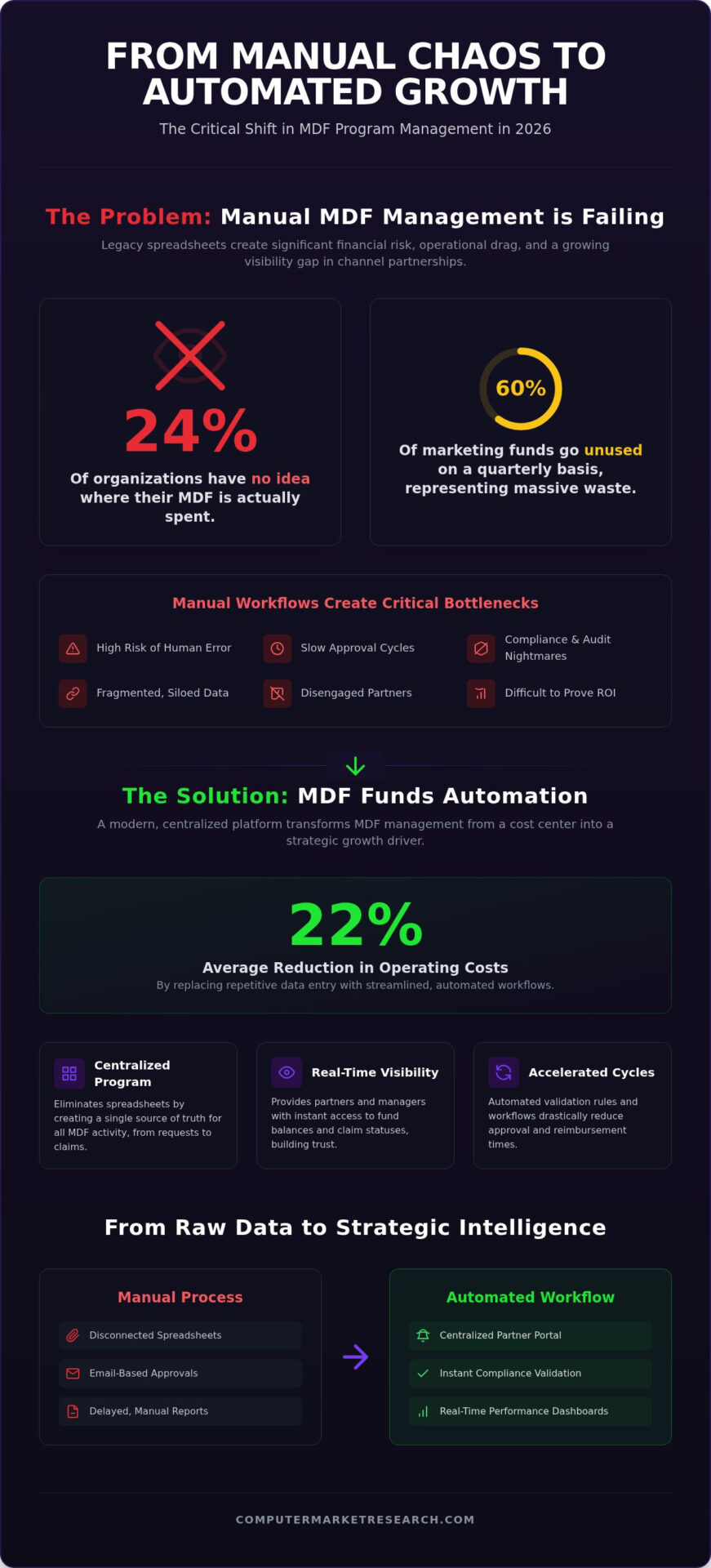
Did you know that 24% of organizations have no idea where their marketing development funds are actually spent? Even more concerning, research from late 2025 shows that up to 60% of these funds go unused on a quarterly basis. If you’re still relying on manual spreadsheets to track partner activity, you aren’t just losing time; you’re losing visibility into your most critical growth levers. Transitioning to mdf funds automation is no longer a luxury for the few. It’s a fundamental requirement for any enterprise that values data integrity and channel performance in 2026.
We understand the headache of slow claim processing and the friction it creates with your most valued partners. It’s difficult to prove marketing ROI to leadership when your source data is fragmented and prone to human error. This guide will show you how to automate your MDF program to eliminate these manual bottlenecks and boost partner engagement. We’ll examine how centralized systems deliver real-time visibility into fund balances and provide the decision-grade data you need to scale your channel growth with confidence.
Key Takeaways
- Eliminate the administrative friction of manual spreadsheets to accelerate approval cycles and remove the risk of human error in fund tracking.
- Implement mdf funds automation to centralize your program lifecycle, ensuring every claim meets compliance standards through instant validation rules.
- Maintain continuous visibility into fund utilization with real-time budget tracking and automated expiration alerts that prevent budget waste.
- Transform raw spend data into strategic intelligence to accurately identify high-performing partners and predict future channel growth.
- Modernize your program infrastructure to deliver the clean, decision-grade data required to prove measurable ROI to executive leadership.
The Operational Burden of Manual MDF Fund Management
Legacy workflows are the primary obstacle to scaling indirect sales in a modern channel ecosystem. Relying on Market development funds (MDF) managed via spreadsheets introduces a high cost of human error that most global enterprises can’t afford. When data is siloed in disconnected files, slow approval cycles inevitably stifle partner marketing momentum. Partners lose interest when they face administrative hurdles, leading to a significant visibility gap where managers don’t know which funds are committed and which are simply sitting idle. Implementing mdf funds automation isn’t just about speed; it’s about removing the structural inefficiencies that prevent real-time utilization reporting and strategic scaling.
The friction caused by manual tracking often results in a “use it or lose it” mentality that doesn’t align with actual market opportunities. If a partner waits weeks for a simple marketing request to clear an email-based approval chain, the window for a timely campaign might close. This delay creates a ripple effect of disengagement across the channel. Without a modernized infrastructure, your program remains reactive rather than proactive, trapped by the limitations of legacy data entry.
To better understand the impact of these operational challenges on your ease of doing business, watch this helpful video:
Fragmented Data and Operational Bottlenecks
Fragmented data creates a persistent disconnect between marketing requests and financial payouts. In most manual environments, email chains serve as the primary approval mechanism, but these chains are notorious failure points where requests get buried or lost. This lack of a centralized hub, such as a dedicated PartnerPortal™, means fund balances are rarely accurate. When a partner sees a balance that doesn’t reflect their recent activity, trust erodes. They won’t commit their own resources to a joint campaign if they aren’t confident the reimbursement process is stable and transparent.
The Compliance and Audit Nightmare
Manual systems struggle to keep pace with rigorous proof-of-performance (PoP) requirements. In non-automated environments, the risk of overpayment or duplicate claims is high because there’s no system to cross-reference historical data instantly. Compliance risk in global MDF programs is defined as the potential for financial loss or legal sanction resulting from the failure to verify that marketing funds were used according to corporate and regulatory guidelines. Without mdf funds automation, auditing these claims becomes a labor-intensive nightmare that often happens months after the spend, making it nearly impossible to recover misallocated funds or correct poor spending habits.
How MDF Funds Automation Streamlines Channel Workflows
Transitioning from legacy spreadsheets to a modernized infrastructure represents a fundamental shift in strategic channel management. Instead of chasing paper trails, mdf funds automation centralizes the entire lifecycle from the initial request through to the final reimbursement. This transition eliminates the “black hole” effect where partners wait indefinitely for answers. By moving to a cloud-based system, organizations can reduce operating costs by an average of 22%, according to May 2026 industry data. This shift allows channel managers to focus on partner development rather than repetitive data entry.
Self-service visibility is a cornerstone of this workflow improvement. When partners can track their own fund balances and claim statuses in real-time, it removes the need for constant status inquiries. This transparency builds the trust necessary for long-term loyalty. It’s a pragmatic approach that replaces fragmented communication with a structured, reliable system.
The Automated Approval Journey
The workflow follows a logical, structured progression that ensures accuracy without manual intervention. First, the partner submits a request through a branded portal, providing all necessary campaign details. Second, the system performs an automated validation against pre-defined program criteria and available budget. If the request meets the rules, it proceeds; if not, it’s flagged immediately for correction. Third, multi-tier approval routing directs the request to the appropriate stakeholder based on specific fund thresholds, ensuring high-value spend gets the right level of scrutiny.
Integration with PRM and CRM Systems
For a truly unified experience, mdf funds automation must connect directly to your existing tech stack. Solutions like PartnerPortal™ serve as the central hub where all partner activities converge. This integration allows for seamless syncing with Microsoft Dynamics and other leading CRM environments, ensuring that fund data is reflected in your primary sales records. APIs play a critical role here, maintaining a single source of truth across all platforms and preventing the data fragmentation that often plagues global enterprises. This connectivity ensures that financial tracking and marketing activities remain perfectly aligned.
If you’re ready to see how these integrations can stabilize your operations and improve your Ease of Doing Business, you might want to explore a trial of the platform to test these workflows yourself.
Core Features of an Automated MDF Management Platform
A high-performance platform must support the nuanced distinctions between earned Co-op funds and discretionary MDF. While Co-op is often accrual-based and tied to sales volume, discretionary pools are typically allocated for specific strategic initiatives. Modern mdf funds automation allows administrators to configure these distinct fund types within a single, unified environment. This ensures that budget tracking remains precise across various shared pools. Real-time visibility into these balances is essential to prevent the common problem of underutilized marketing funds, which often result from a lack of automated expiration alerts that notify partners before their window of opportunity closes.
Simplified claim submission is another critical feature that directly impacts partner engagement. By providing a digital interface for proof-of-performance (PoP) uploads, you remove the need for cumbersome physical documentation or fragmented email attachments. Customizable reporting dashboards then aggregate this data for both vendors and partners. This transparency ensures everyone involved has a clear view of fund health and claim status. These technical capabilities transform the MDF program from a manual administrative burden into a streamlined engine for channel growth.
Distributor-Specific Fund Management
Distribution networks introduce layers of complexity that general-purpose PRM tools often overlook. Managing MDF platforms for distributors requires a system capable of handling multi-tier structures where funds flow through several entities before reaching the end-partner. This includes managing back-end credits and complex multi-currency requirements for global operations. A robust platform normalizes this data, ensuring that financial reconciliations are accurate regardless of the partner’s geographic location or the currency used in the transaction. It’s a level of precision that manual spreadsheets simply cannot maintain at scale.
Automated Compliance and Fraud Prevention
Maintaining integrity in fund management relies on standardizing PoP requirements across all global regions. Automated systems use pre-defined business rules to flag suspicious claims or duplicate invoices immediately upon submission. This proactive approach to compliance is significantly more effective than traditional post-payout audits which often occur too late to recover misallocated capital. By maintaining detailed, immutable audit trails, organizations ensure total financial transparency. The transition to mdf funds automation provides the technical oversight necessary to protect marketing investments while maintaining the trust of legitimate partners.
Driving ROI Through Automated MDF Data Insights
Moving beyond the administrative benefits of mdf funds automation reveals its true value as a strategic intelligence engine. It’s no longer enough to simply track where money goes; you must understand what that spend actually produces. For global enterprises, the primary obstacle to this understanding is fragmented, messy data from multi-tier distribution networks. Managed Data Services ensure that the information entering your system is normalized and accurate, creating “Decision-Grade” insights that leadership can trust for future planning.
When your source data is clean, you can begin to correlate marketing spend directly with deal registration and closed-won revenue. This visibility allows you to predict future channel performance based on current fund utilization patterns. If you know that a specific type of campaign consistently leads to a spike in registration within 60 days, you can allocate resources more effectively to meet quarterly targets. This proactive approach replaces the guesswork of manual tracking with a logical, results-driven strategy.
Correlating MDF Spend with POS Data
Validating marketing effectiveness requires a direct link between the fund request and the eventual sale. Integrating mdf funds automation with cleansed POS data allows you to see exactly how marketing activities influence inventory turnover. You can measure the true ROI of specific activities, such as determining whether technical webinars drive more high-value deals than regional events. This level of granularity is impossible with manual spreadsheets, where POS reports and marketing claims often exist in entirely different universes. By bridging this gap, you ensure every dollar spent is backed by measurable sales performance.
Partner Performance Tiering
Automation enables a more meritocratic approach to fund allocation. By identifying high-performing partners who consistently deliver revenue, you can reward them with additional discretionary funds to accelerate growth. Conversely, the system also highlights “MDF squatters,” which are partners who claim funds regularly but fail to drive significant deal volume or ROI. Identifying these underutilized funds allows you to reallocate capital to more productive areas of the channel. For a deeper look at these incentive strategies, refer to our guide on Maximizing Channel ROI.
To experience how these data insights can transform your channel strategy and provide the visibility you’ve been missing, start your 90-day free trial and gain immediate control over your fund utilization.
Modernize Your Program with CMR’s MDF Automation
Computer Market Research (CMR) provides the technical infrastructure needed to move beyond the limitations of manual tracking. Since our founding in 1984, we’ve focused on solving the specific data administration challenges that hinder channel growth. Our approach to mdf funds automation isn’t just about software; it’s about providing a stable, expert-led path out of operational bottlenecks. By centralizing all partner activities within a single hub, organizations can scale from mid-market operations to Global 2000 requirements without increasing administrative headcount.
The transition from legacy spreadsheets to a modernized system is the only logical step for a growing organization. Manual methods are primary obstacles to growth because they lack the precision required for global financial tracking. CMR’s flexible SaaS model ensures that your program remains agile, allowing you to adapt fund structures and compliance rules as your market presence expands. This focus on modern infrastructure ensures that your marketing spend is always backed by high-quality, decision-grade information.
Managed Services for High-Volume Data
Accurate reporting for manufacturers with complex global footprints requires more than just a portal; it requires a commitment to data cleansing and normalization. CMR’s Managed Data Services offload the heavy lifting of processing high-volume POS and inventory reports. This ensures that the data driving your MDF program is clean and verified before any payouts occur. By offloading this administrative burden, your team can focus on partner strategy rather than correcting entry errors. Our decades of channel expertise allow us to identify and resolve data discrepancies that automated systems alone might miss, providing a level of reliability that generic PRM providers don’t match.
Getting Started with PartnerPortal™
Modernizing your program begins with a structured implementation process designed for partner success. The MDF module within PartnerPortal™ is configured to align with your specific program rules, whether you manage earned Co-op or discretionary funds. Implementing mdf funds automation through a centralized portal ensures that every stakeholder has access to the same verified data. Our team guides you through the onboarding phase, ensuring that both your internal staff and your external partners understand the new workflows. This training phase is critical for maintaining partner engagement and ensuring a smooth transition away from legacy methods. To see how our platform can stabilize your channel operations, you should request a demo of the MDF Management platform today.
Future-Proof Your Channel Strategy
Legacy manual processes aren’t just slow; they’re primary obstacles to your organization’s growth. By centralizing your program lifecycle, you eliminate the visibility gaps that lead to underutilized funds and partner disengagement. This shift ensures that every marketing dollar is backed by clean, decision-grade data rather than fragmented spreadsheet entries. Transitioning to a modernized infrastructure is the only logical step for enterprises that value order and performance.
Implementing mdf funds automation allows you to correlate spend with real-time sales performance, providing the technical competence needed to scale with confidence. Computer Market Research brings over 40 years of channel data expertise to help you move away from obsolete tracking methods. Trusted by Global 2000 companies, our end-to-end cloud-based SaaS modules offer the stability and precision your enterprise requires to maintain a competitive edge. It’s time to turn your MDF program into a reliable engine for measurable ROI, and for those also looking to modernize their physical office environments, Abbele Ventures offers tailored micro-market and vending solutions.
Optimize your channel spend with PartnerPortal™ automation. We look forward to helping you build a more transparent and efficient channel ecosystem.
Frequently Asked Questions
What is the difference between MDF and Co-op funds?
Co-op funds are typically accrual-based, where partners earn marketing dollars as a percentage of their historical purchase volume. In contrast, Market Development Funds (MDF) are discretionary and allocated for specific, forward-looking strategic initiatives. While Co-op rewards past performance, MDF is designed to incentivize future growth in specific territories or product categories.
How does MDF automation improve partner engagement?
Engagement increases when you remove the friction of manual claim submissions and slow reimbursement cycles. Implementing mdf funds automation provides partners with a clear, real-time view of their available budget and claim status. This transparency builds the trust necessary for partners to commit their own resources to joint marketing efforts, knowing the payout process is stable and predictable.
Can MDF management software integrate with my existing CRM?
Yes, robust MDF platforms are designed to integrate with leading enterprise CRM systems, including Microsoft Dynamics. These integrations use secure APIs to ensure that fund data, lead registrations, and campaign results are synced across your entire tech stack. This connectivity maintains a single source of truth and prevents the data silos that often occur when marketing spend isn’t tied to sales records.
What are the typical ROI metrics for an automated MDF program?
Primary metrics include fund utilization rates, the ratio of marketing spend to closed-won revenue, and the speed of claim processing. Organizations utilizing mdf funds automation frequently report significant reductions in administrative overhead and improved inventory turnover. These metrics provide the decision-grade data required to demonstrate the channel’s impact on the overall corporate bottom line.
How does automation prevent MDF claim fraud?
Automated systems utilize pre-defined business rules to flag duplicate invoices and suspicious documentation before any payment is authorized. This proactive approach ensures that every claim meets strict compliance standards and proof-of-performance requirements. By standardizing these rules globally, the system creates an immutable audit trail that protects your marketing investment from misallocation or human error.
Is MDF automation suitable for small partner programs?
Small programs benefit from automation by establishing a professional infrastructure that supports future scaling. While manual spreadsheets might suffice for a handful of partners, they quickly become an operational bottleneck as the network expands. Establishing automated workflows early ensures that your program remains agile and ready to handle increased volume without adding excessive administrative headcount.
What kind of proof-of-performance is required for automated MDF claims?
Proof-of-performance (PoP) typically includes digital uploads of campaign assets such as ad placements, event registration lists, or social media metrics. The system allows partners to attach these documents directly to their digital claim for instant verification. This standardized process ensures that all marketing activities are documented and verified according to your program’s specific compliance guidelines.

Article by
Del Heles
Del Heles is the founder and CEO of Computer Market Research (CMR), a channel management software company he launched in 1984. With more than 40 years of experience, he’s known for helping manufacturers and distributors simplify complex partner programs through practical, customer-focused technology solutions.