

If over 50% of your revenue flows through indirect channels, why is your partner data still trapped in a manual silo? Relying on disconnected systems forces your team to waste hours on data entry while partners struggle with duplicate deal registrations. A strategic prm integration with salesforce is the definitive path to eliminating these operational bottlenecks and ensuring data transparency. You likely recognize that visibility is the foundation of growth, yet fragmented information continues to create friction in your sales cycle and hinders your ability to scale.
This guide outlines the path to establishing a single source of truth for all sales data by automating deal registration and lead routing. You’ll learn how to provide your partners with a seamless experience without the technical burden of complex custom code. We’ll examine how to synchronize real-time performance metrics and clean your channel data, turning your partner portal into a high-velocity engine for predictable revenue and improved partner loyalty.
Key Takeaways
- Identify why bidirectional synchronization is essential for maintaining a single source of truth and preventing lost revenue from fragmented data.
- Evaluate the strategic advantages of best-of-breed PRM solutions over complex custom builds to minimize implementation time and maintenance costs.
- Execute a prm integration with salesforce that prioritizes precise field mapping and data ownership to eliminate duplicate deal registrations.
- Streamline global operations by integrating Co-op/MDF Management and lead routing directly into your existing sales workflow.
- Utilize managed data services to ensure POS and inventory information is cleansed and accurate before it reaches your CRM environment.
What is PRM Integration with Salesforce and Why it Matters
Modern channel management requires a seamless flow of information between internal sales teams and external partners. To grasp the strategic value of this connection, it’s helpful to understand What is Partner Relationship Management (PRM) as the overarching discipline of managing these complex indirect relationships. A prm integration with salesforce acts as a bidirectional bridge, ensuring that your CRM remains the definitive record for all sales activity while providing partners with the tools they need to succeed.
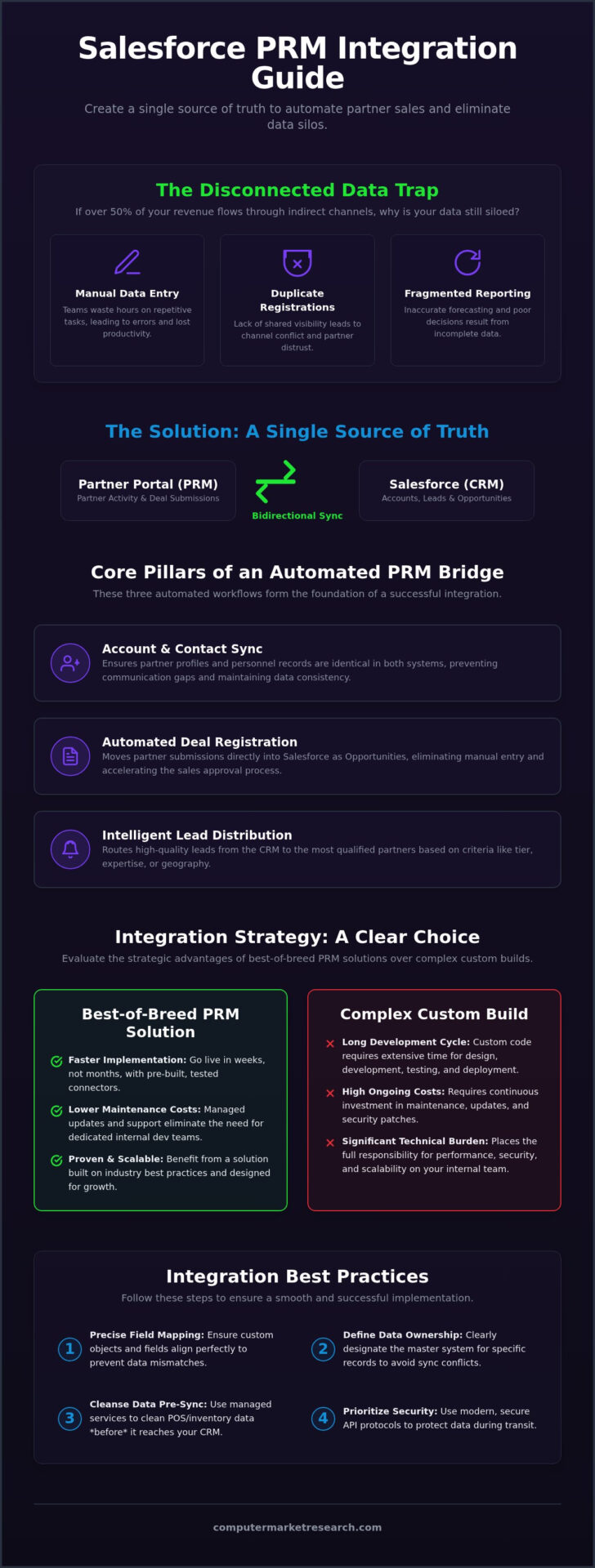
Many organizations fall into the “disconnected data trap,” where partner activity is tracked in siloed spreadsheets or legacy portals that don’t communicate with the primary CRM. This fragmentation creates operational bottlenecks and obscures the true state of the sales pipeline. By establishing a prm integration with salesforce, businesses create a single source of truth. This transparency allows direct and indirect teams to collaborate effectively rather than competing for the same accounts.
This need for a single source of truth is universal across complex industries; for instance, those in commercial real estate can discover Petram.app (Rezone) to eliminate similar data silos in property management.
To better understand the technical configuration of this bridge, watch this video on aligning lead layouts within your CRM:
The Core Components of a Salesforce PRM Bridge
A robust integration, such as the one provided by PartnerPortal™, relies on three foundational pillars of automation:
- Account and Contact Sync: This ensures that partner profiles and personnel records are identical in both systems, preventing communication gaps.
- Deal Registration: Automated workflows move partner submissions directly into Salesforce as Opportunities, accelerating the approval process.
- Lead Distribution: High-quality leads are routed from the CRM to the most qualified partners based on specific criteria like tier, expertise, or geography.
Eliminating Channel Conflict Through Real-Time Visibility
Channel conflict occurs when multiple partners or direct sales teams pursue the same lead due to duplicate deal registrations and a lack of shared visibility. Real-time updates act as a safeguard, ensuring that once a partner registers a deal, it’s immediately visible to the internal sales force. This level of transparency is essential for maintaining trust within the ecosystem. When partner activity is linked to Salesforce dashboards, leadership gains a comprehensive view of the entire channel, allowing for more accurate forecasting and data-driven decision making.
Mechanics of Bidirectional Salesforce PRM Synchronization
The technical foundation of a successful prm integration with salesforce rests on the API handshake. This process involves a secure exchange of data between your partner portal and the CRM environment. With recent updates in the Salesforce Summer ’26 release, specifically the move to Apex API version 67.0, these integrations now benefit from enhanced security protocols that run database operations in user mode by default. This ensures that your channel data remains protected while moving between platforms. A bidirectional sync is non-negotiable for modern operations; if a partner updates a deal status in their portal, your internal sales team must see that change in Salesforce immediately to maintain a single source of truth.
Effective synchronization requires mapping custom objects to align with your specific business logic. While standard Salesforce objects like Accounts and Opportunities cover basic needs, complex channel relationships often require custom fields for tracking specific certifications or regional compliance markers. By tailoring these mappings, you ensure that the lead-to-opportunity lifecycle remains automated and consistent across both systems. This level of technical alignment is a key consideration highlighted in the Gartner Market Guide for PRM, which emphasizes the need for deep CRM connectivity to drive channel performance.
Data Normalization: The Secret to a Healthy CRM
One of the most common pitfalls in channel automation is the “dirty data” problem. Raw partner data, such as Point of Sale (POS) and inventory reports, often arrives in fragmented formats that can break standard Salesforce objects if synced directly. Utilizing a robust system for Channel Data Management allows you to cleanse and normalize this information before it hits your CRM. This process transforms inconsistent partner inputs into decision-grade data, ensuring your forecasting and trend analysis are based on accurate, high-quality information rather than manual guesswork.
Automating Workflows and Triggers
Automation extends beyond simple data transfer to include sophisticated workflow triggers. You can configure the system to initiate specific actions in Salesforce when a partner achieves a milestone, such as completing a technical certification or reaching a sales tier. These triggers can send automated notifications for deal approvals or generate expiration warnings for aging leads. By removing these manual tasks, some industry professionals report that organizations can reduce the administrative burden on channel managers by 40% or more. If you are ready to see how these automations can transform your workflow, you can start your 90-day free trial to explore our integration capabilities.
Native Salesforce PRM vs. Third-Party Integration Strategies
Choosing between a native environment and a third-party application is a pivotal decision for channel leaders. While Salesforce Experience Cloud offers a familiar ecosystem, a specialized prm integration with salesforce often provides the functional depth required for complex, high-volume global programs. Native solutions are frequently perceived as the path of least resistance. However, they can lead to significant technical debt when heavy custom coding is required to mirror specialized channel workflows. In contrast, best-of-breed PRM platforms are engineered specifically for the partner lifecycle, often deploying up to three times faster than custom native builds because they utilize pre-configured channel logic.
Cost considerations extend beyond initial license fees. While native seats might seem accessible, the cumulative expense of implementation, ongoing maintenance, and specialized Salesforce administrator time can escalate quickly. User Experience (UX) also plays a decisive role in partner adoption. In 2026, approximately 62% of companies with over $25 million in ARR have adopted a PRM platform to avoid “portal fatigue.” A specialized third-party interface ensures that partners can register deals and access resources through a streamlined, intuitive front-end, rather than navigating the complexities of a generic CRM layout that was primarily designed for internal employees.
When to Choose a Best-of-Breed PRM like PartnerPortal™
Organizations with sophisticated incentive structures often find that native CRM objects lack the necessary nuance. Managing co-op, MDF, and tiered rebates requires specialized ledger capabilities that go beyond basic record-keeping. Utilizing PartnerPortal™ allows businesses to handle complex data types, such as Ship & Debit claims, without cluttering the primary CRM. This approach prevents “Salesforce Bloat,” keeping your core CRM environment clean and performant while providing partners with a powerful, dedicated toolkit for their specific operational needs.
Evaluating Integration Depth and Security
Security remains a primary concern for enterprise-grade prm integration with salesforce. As of 2026, compliance with SOC 2 Type II and GDPR is considered a baseline requirement for any external system connecting to your sales data. It’s essential to understand the technical nuances of an “integrated-with” strategy versus a “built-on” one. An API-based integration provides a layer of insulation that protects your Salesforce architecture during platform updates. This future-proofing ensures that your partner workflows remain stable even as Salesforce releases new API versions, such as the recent shift toward mandatory user-mode security for database operations.
For organizations looking to further bolster their digital defense beyond basic compliance, you can learn more about CyberOne and their specialized cybersecurity and threat detection solutions.
Best Practices for Implementing a Salesforce PRM Integration
Successful implementation of a prm integration with salesforce requires a tactical roadmap that prioritizes data integrity and user adoption. It isn’t enough to simply connect the APIs; you must align the technology with your existing business logic. Start by auditing your current Salesforce environment and mapping out existing partner workflows. This initial assessment identifies where manual processes currently fail and which data fields are critical for the synchronization.
Once the audit is complete, define your field mapping and data ownership rules. You must decide which system is the “master” for specific information to prevent conflicting updates. Before moving to the live environment, use Managed Data Services to cleanse your channel data. Raw inputs from partners often contain errors that can corrupt your CRM records. Cleansing ensures that only high-quality, decision-grade information is synced, maintaining the stability of your Salesforce architecture.
Over-customization often leads to long-term instability. While it’s tempting to build bespoke objects for every edge case, using standard Salesforce objects ensures better compatibility with future updates. You must also prioritize the partner experience. If the portal is difficult to navigate, partners won’t use it, rendering the entire integration ineffective. Finally, don’t forget to train your direct sales representatives. They need to understand how to interpret partner data within Salesforce to avoid account overlaps and foster collaboration.
Measuring Success: Integration KPIs
Quantifying the impact of your prm integration with salesforce ensures you can demonstrate ROI. Track the reduction in “Time to First Deal” for new partners, as this indicates a more efficient onboarding and registration process. Monitor the accuracy of your channel revenue forecasting within Salesforce to ensure the synced data is providing reliable insights. High partner adoption rates and frequent portal logins are also strong indicators of a healthy ecosystem. If you’re looking to modernize your channel infrastructure, you can claim your 90-day free trial to see these best practices in action.
Scaling Global Channels with PartnerPortal™ and Salesforce
Scaling a global channel requires more than just a simple connection; it requires a robust engine that handles the administrative weight of international trade. A prm integration with salesforce through PartnerPortal™ provides the infrastructure necessary to manage thousands of partners across different time zones and regulatory environments. By centralizing operations, organizations can move away from the fragmentation of legacy spreadsheets and adopt a unified strategy that drives predictable revenue. This transition is essential for Global 2000 companies that require high-level visibility into regional performance without sacrificing data accuracy.
Integrating Co-op/MDF Management directly into your sales workflow ensures that marketing funds are allocated strategically rather than reactively. When these incentive programs are synchronized with your CRM, every dollar spent can be tied back to specific partner activities and deal registrations. This level of financial transparency eliminates the “black hole” of channel spending, allowing leadership to see the direct ROI of their incentive structures. It transforms MDF from an administrative burden into a high-performance growth lever that is fully visible within your primary sales dashboards.
Managing complex Ship and Debit claims within the Salesforce ecosystem is another area where automation provides immediate stability. Manual claim processing is notoriously prone to errors that can lead to significant financial leakage. By automating the validation and reconciliation of these claims through your prm integration with salesforce, you ensure that credits are issued accurately and on time. This reliability builds trust with your partners and ensures that your financial reporting remains precise, even during high-volume periods. It is the cornerstone of the ‘Partner Smarter’ philosophy, which prioritizes strategic growth over manual data entry.
Centralizing Operations for Global Teams
Global networks demand flexibility. PartnerPortal™ supports multi-currency and multi-language requirements, ensuring that your international partners can engage with your brand in their local context. This localized experience is critical for maintaining high adoption rates across diverse regions. For a deeper look at the foundational concepts of these systems, read our guide on What Is Partner Relationship Management (PRM)? to see how these tools fit into a holistic channel strategy.
Next Steps: Auditing Your Channel Infrastructure
The year 2026 represents a turning point for channel operations. As AI-driven normalization and real-time data sync become the industry standard, legacy manual tracking methods have become an primary obstacle to growth. Organizations that fail to modernize risk losing their most valuable partners to more efficient competitors. You can take the first step toward optimization by requesting a technical consultation to evaluate your current Salesforce environment. It’s time to Partner Smarter with a CMR Strategy Session and build a clear path out of operational bottlenecks.
Modernizing Your Channel Infrastructure for 2026 and Beyond
Trusted by Fortune 500 channel leaders, PartnerPortal™ provides a native Salesforce integration for seamless deal registration without the burden of complex custom code. Our managed data services are specifically designed to eliminate 90% of manual data entry errors, ensuring that your sales dashboards reflect clean, decision-grade information. Transitioning to a modernized infrastructure allows your team to stop managing operational bottlenecks and start focusing on strategic growth and partner success.
Schedule a PartnerPortal™ Demo to See Our Salesforce Integration in Action
Your path to a more efficient, transparent channel ecosystem begins with a single step toward modernization.
For organizations requiring professional software design and IT consultancy to guide their digital transformation, Cloudbiz Technologies offers tailored solutions to ensure your infrastructure is future-ready.
Frequently Asked Questions
Is Salesforce PRM the same as Experience Cloud?
Salesforce PRM is a specialized application built on the Experience Cloud platform. While Experience Cloud provides the general framework for digital experiences, the PRM license adds channel-specific features like lead distribution and deal registration templates. It’s essentially a pre-configured solution designed specifically for partner relationships rather than a generic community portal. This allows organizations to deploy partner-specific tools without building every component from scratch.
How long does a standard PRM to Salesforce integration take?
A standard integration usually requires four to eight weeks for a complete deployment. This timeframe covers the essential stages of auditing your current CRM data, defining field mapping, and conducting thorough testing. Using a pre-built solution often allows for a faster rollout compared to complex custom builds, which can frequently take six months or longer to stabilize and fully deploy.
Can I sync custom Salesforce objects with my partner portal?
You can certainly sync custom objects to ensure the portal supports your unique business processes. A prm integration with salesforce is designed to be flexible, allowing you to map specialized records such as regional compliance markers or unique product certifications. This ensures that your partner-facing tools remain perfectly aligned with your internal data architecture, providing a seamless experience for your global network.
What is bidirectional synchronization in PRM?
Bidirectional synchronization is the two-way, real-time flow of data between your partner portal and your CRM. This ensures that when a partner registers a deal, the opportunity is instantly visible in Salesforce. Similarly, any updates made by your internal team are immediately reflected in the partner’s view, maintaining a consistent single source of truth across both platforms and eliminating data silos.
Do I need a developer to integrate PartnerPortal™ with Salesforce?
You don’t need a dedicated developer for the integration because PartnerPortal™ uses a native-level handshake. The system is engineered to connect via standard API protocols without requiring custom code. Our managed services handle the technical heavy lifting, allowing your channel managers to focus on strategic program design rather than troubleshooting software connections or managing complex development cycles.
How does integration help prevent channel conflict?
Integration eliminates conflict by providing immediate visibility into the sales pipeline. When a partner submits a new deal, the prm integration with salesforce automatically checks for existing opportunities to prevent duplicate registrations. This transparency ensures that direct sales teams and other partners aren’t competing for the same lead, which builds trust and protects your margins through automated validation rules.
Can I manage MDF and rebates through a Salesforce-integrated PRM?
You can manage Co-op/MDF and rebate programs directly through the integrated portal. Linking these financial incentives to your CRM data allows you to automate the validation of claims against actual sales performance. This removes the need for manual tracking and ensures that every incentive dollar is tied to a measurable business outcome in your Salesforce reports, improving overall program ROI.
What happens to my data if the Salesforce API changes?
Professional PRM providers monitor Salesforce’s release schedule to ensure ongoing compatibility. When API changes occur, such as the recent shift to user-mode security in version 67.0, the integration is updated to maintain stability. This proactive approach prevents data loss and ensures that your global channel operations continue to run smoothly without interruption during CRM platform updates or security setting changes.

Article by
Del Heles
Del Heles is the founder and CEO of Computer Market Research (CMR), a channel management software company he launched in 1984. With more than 40 years of experience, he’s known for helping manufacturers and distributors simplify complex partner programs through practical, customer-focused technology solutions.