

Did you know that organizations implementing automated systems typically recover between 2% and 4% of their rebate-related revenue through improved accuracy alone? Whether managing industrial components or the distribution of premium goods for brands like Royalty Hair Collections, the daily reality of managing incentives involves a constant battle against fragmented POS data and the high administrative burden of manual claim reconciliation. You likely understand the quiet frustration of knowing that overpayments and data gaps are eroding your margins, which is why more firms are turning to specialized rebate management software for manufacturers to restore financial integrity. Scaling complex channel relationships requires a level of precision that manual oversight simply cannot provide.
Key Takeaways
- Stop financial leakage by replacing error-prone manual spreadsheets with automated calculation engines designed specifically for multi-tier distribution.
- Learn how implementing rebate management software for manufacturers establishes a single source of truth for all incentive agreements and channel data.
- Discover the critical role of POS data cleansing in ensuring your organization only pays rebates on verified, accurate sales transactions.
- Follow a structured strategic roadmap to transition from legacy tracking methods to a modern, cloud-based partner portal.
- Gain decision-grade insights into channel performance that allow for real-time optimization of incentive program ROI and administrative efficiency.
Why Manufacturers Need Automated Rebate Management Software in 2026
Manufacturers in 2026 operate within high-pressure, multi-tier distribution networks where margins are thinner than ever. A traditional Rebate (marketing) strategy often serves as the primary lever for securing market share, yet managing these programs manually is becoming nearly impossible. Modern rebate management software for manufacturers is no longer just a calculation tool; it’s a specialized data engine designed to handle the technical friction between production and final sale. By automating these incentives, you turn a complex financial liability into a precise instrument for driving volume and channel loyalty.
Real-time financial reconciliation has moved from a secondary goal to a core requirement for global supply chains. Waiting weeks for claim processing isn’t just an administrative delay; it’s a strategic failure that hides the true state of your profitability. Automated platforms allow you to verify sales against specific inventory levels instantly. This ensures that incentives actually drive the desired behavior rather than just rewarding volume that would have happened anyway. In a competitive landscape, the ability to pivot incentive structures based on real-time data is what separates market leaders from those struggling with stagnant inventory.
This need for operational efficiency is particularly critical in specialized fields like healthcare. Manufacturers looking to optimize their reach in this sector can learn more about GetMedicalDevice, a dedicated B2B platform that provides access to high-quality products from leading medical brands.
The Hidden Cost of Manual Rebate Tracking
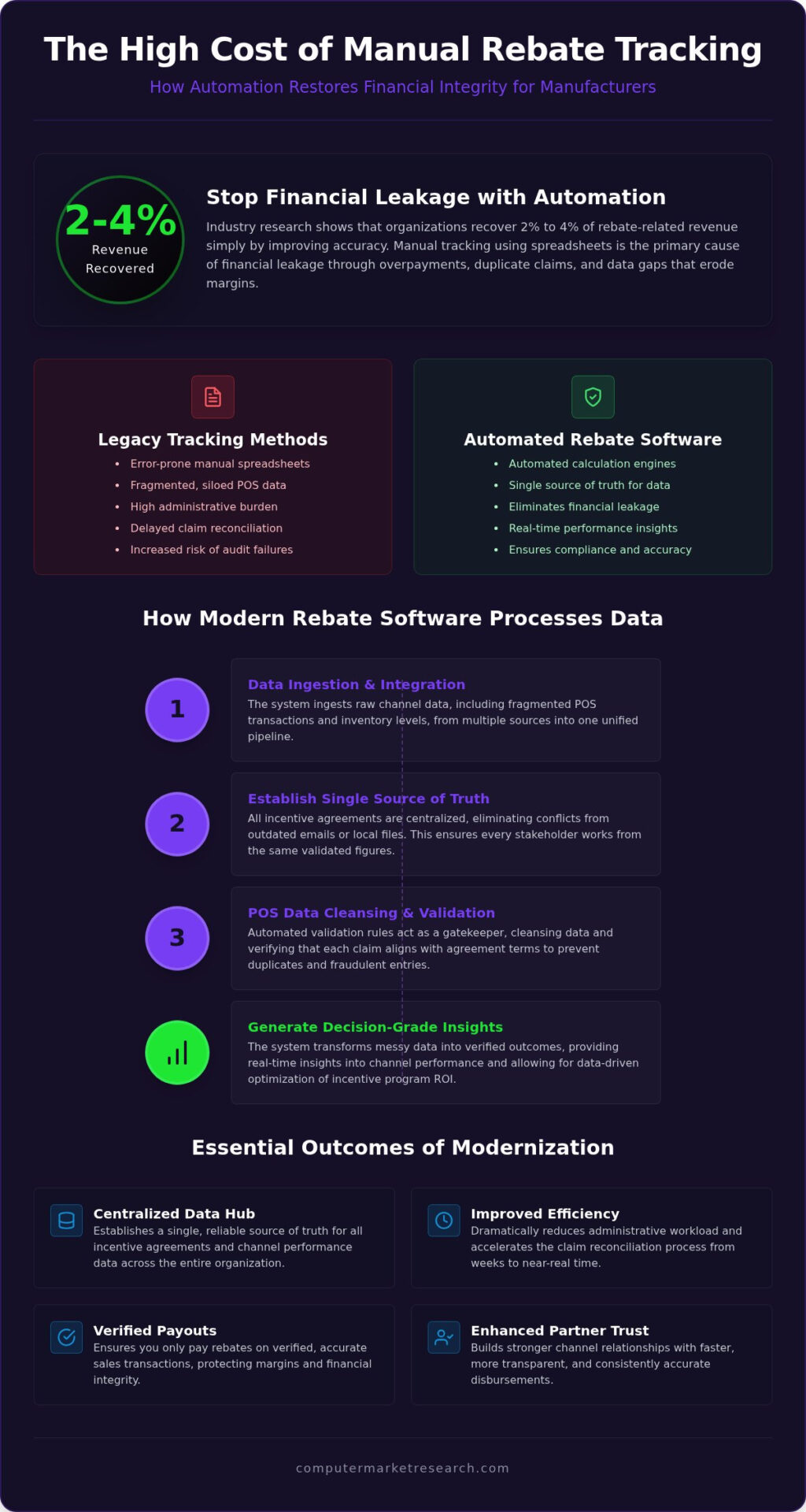
Spreadsheets are the primary culprit behind “rebate leakage.” When incentive data is siloed in fragmented files, overpayments and duplicate claims become inevitable. Industry research indicates that organizations can recover between 2% and 4% of their revenue by simply improving accuracy through automation. Beyond the immediate financial loss, manual tracking creates a significant trust gap with your partners. If distributors wait months for reconciliation, they’ll eventually prioritize competitors who offer faster, more transparent disbursements. Manual systems also increase the risk of audit failures, particularly as compliance with standards like ASC 606 is now the baseline expectation for all enterprise reporting.
Evolving Channel Complexity in Global Manufacturing
Hybrid sales models have added layers of complexity that legacy systems simply can’t handle. You might be managing direct-to-consumer efforts alongside traditional wholesale and boutique retail channels, each requiring unique incentive structures. Enterprise-grade rebate management software for manufacturers must support diverse currencies and regional compliance standards to function effectively across borders. Scalability is non-negotiable when you’re managing thousands of partner entities. Without a centralized hub like PartnerPortal™, the administrative overhead of these complex agreements eventually outweighs the strategic benefits of the incentive program itself.
Core Mechanics: How Modern Rebate Software Processes Channel Data
Success in incentive management depends on the integrity of the data pipeline. Modern rebate management software for manufacturers functions by ingesting raw channel data and transforming it into verified financial outcomes. This process begins by establishing a single source of truth where all active incentive agreements are stored. Without this centralized repository, teams often find themselves cross-referencing outdated email threads or local spreadsheets, which leads to calculation errors and missed compliance targets. A unified engine ensures that every stakeholder, from sales to finance, operates from the same set of validated figures.
Automated validation rules serve as the system’s gatekeeper. These rules verify that every claim aligns with the specific terms of the agreement, preventing duplicate submissions and fraudulent entries before they reach the finance department. As global markets shift toward greater trade policy and supply chain resilience, manufacturers need these automated safeguards to ensure that capital is deployed efficiently and only for verified performance. By moving from batch processing to real-time data ingestion, organizations can provide faster payouts, which directly improves partner satisfaction and trust.
Integrating POS and Inventory Data for Accuracy
The most significant challenge in this pipeline is the “dirty data” problem. Partners use disparate ERP systems, resulting in fragmented POS reports that don’t naturally align with your internal records. Robust POS data management solves this by normalizing raw information through automated mapping. This process aligns partner SKUs with your manufacturer product codes, ensuring that rebates are only paid on verified sales. It eliminates the manual effort of cleansing data, allowing your team to focus on strategic growth rather than administrative data entry.
From Claim Submission to Financial Reconciliation
Once data is normalized, the workflow moves into automated auditing and approval. The software evaluates claims against real-time inventory and sales levels, generating decision-grade reports that provide immediate visibility into program performance. Seamless integration with your existing ERP and CRM platforms ensures that approved rebates flow directly into financial systems for reconciliation. This transition from slow batch processing to real-time ingestion allows for faster payouts, which significantly strengthens partner relationships. If you’re ready to see how automation can stabilize your incentive programs, you might consider how to start optimizing your channel data today.
Essential Features of Rebate Management for Manufacturers
Selecting the right rebate management software for manufacturers requires looking beyond basic calculation capabilities. In 2026, enterprise-grade platforms must function as holistic channel management systems rather than simple digital ledgers. This means integrating deep data visibility with automated compliance workflows. A primary feature is role-based access control, which ensures that Finance, Sales, and Partners only interact with the data relevant to their specific functions. This structure prevents internal friction and safeguards sensitive margin information while providing each stakeholder with the tools they need to succeed.
Rigorous audit trails and automated compliance tracking protect your organization during tax season and financial audits. By maintaining a permanent, unalterable record of every claim, approval, and disbursement, the software ensures that your incentive programs meet the strict requirements of ASC 606. This level of transparency builds internal confidence and eliminates the panic often associated with manual reconciliation. Must-have features for modern manufacturing include:
- Automated claim validation against real-time POS data
- Role-based dashboards for localized and corporate stakeholders
- Multi-currency and regional tax compliance support
- Seamless ERP and CRM data synchronization
- Predictive analytics for incentive program ROI forecasting
Managing Complex Ship & Debit Programs
Manufacturers in competitive sectors like industrial parts or electronics frequently face high-risk pricing agreements. The Ship & Debit process allows distributors to sell products at a lower price to win specific deals, with the manufacturer rebating the difference later. Because these claims are often voluminous and time-sensitive, they’re prone to error and financial leakage. Utilizing specialized Ship & Debit management software automates these price protection claims, validating them against real-time inventory levels. This ensures you never overpay for a deal that didn’t actually happen, effectively stabilizing your bottom line.
Tiered Incentives and Volume-Based Rebates
Automated systems track partner progress toward tiered volume targets in real-time. This visibility creates a powerful “nudge” effect; when partners see they’re only a few units away from a higher rebate bracket on their dashboard, they’re more likely to push for that extra volume. Modern platforms provide the flexibility to manage these tiers alongside seasonal promotions or product-specific incentives. This dynamic approach allows you to steer channel behavior with precision, ensuring that your incentive spend is always aligned with current inventory goals and market demands. It’s a pragmatic way to drive growth without the administrative headache of manual spreadsheet updates.
Implementing a Rebate Platform: A Strategic Roadmap
Transitioning from spreadsheet-based tracking to an automated system is a strategic shift that requires a methodical approach. Implementing rebate management software for manufacturers involves more than just a software installation; it requires a structural overhaul of how your organization handles channel relationships. Most enterprise-grade implementations follow a 90 to 120-day roadmap. This period allows for the alignment of internal departments. Sales teams must define the incentive logic, while Finance ensures compliance with ASC 606 and IT handles the secure integration of data streams.
Success during this rollout depends on early and consistent communication. By selecting a specialized rebate management software for manufacturers, you gain the infrastructure needed to support these complex workflows without taxing your internal IT resources. The goal is to move away from the obsolescence of manual tracking and toward a system that provides stability and accuracy from day one. This proactive alignment ensures that your new platform serves as a definitive source of truth across the entire organization.
Overcoming Partner Adoption Hurdles via Portals
Friction kills partner loyalty. When distributors are forced to navigate convoluted claim processes or wait indefinitely for status updates, they naturally drift toward competitors with more transparent systems. Utilizing a user-friendly PartnerPortal™ reduces this friction by providing a centralized hub for claim submission. It offers partners real-time visibility into their own rebate status, which eliminates the need for constant follow-up emails and phone calls. Automated notifications and reminders keep partners engaged, ensuring they never miss a deadline and feel supported throughout the incentive lifecycle.
Ensuring Data Cleanliness and Normalization
Decision-grade data represents information that has been normalized, cleansed, and verified to the point where it can be used for immediate financial disbursement without further manual review. Achieving this level of precision is the most significant hurdle in implementation because raw channel data is inherently messy. The role of Managed Data Services is to offload this administrative burden, allowing your team to focus on strategy rather than data entry. These services handle the “dirty data” that often breaks automated systems. When exception data occurs, managed services provide the human expertise needed to resolve entries that don’t fit standard validation rules. This ensures your automation engine continues to run without interruption. To begin your journey toward operational stability, you can claim your 90-day free trial and see the impact of automated data cleansing firsthand.
Optimizing Manufacturing ROI with CMR PartnerPortal™
Computer Market Research (CMR) provides more than just a calculation engine; it offers a legacy of channel expertise that few competitors can match. Founded in 1984, our team has spent over 40 years refining the technical nuances of B2B data administration. This extensive history ensures that rebate management software for manufacturers isn’t just a digital tool, but a stable, enterprise-grade infrastructure built for the specific needs of Global 2000 and Fortune 500 companies. Choosing PartnerPortal™ means moving beyond generic software-only solutions and adopting a service-backed automation model that prioritizes accuracy and reliability above all else.
Adopting this unified approach represents the logical conclusion for organizations seeking to transition from spreadsheet hassle to automated precision. By integrating your incentive structures into a single, data-driven hub, you eliminate the operational bottlenecks that stifle growth. Our platform serves as a pragmatic partner in your digital transformation, offering a clear path out of the manual errors that currently erode your margins. This commitment to technical competence and stability is what allows our clients to scale their channel programs with quiet confidence.
Centralizing Incentives with a Unified Partner Portal
A fragmented partner experience often leads to disengagement and costly operational friction. By centralizing Co-op/MDF management and rebates within one system, you eliminate the confusion of multiple logins and disparate platforms. This unified approach is the core of our “Partner Smarter” philosophy, which focuses on reducing complexity for both the manufacturer and the distributor. When partners can manage every aspect of their relationship in one place, they spend less time on administration and more time driving sales for your products. It’s a systematic way to build trust through transparency and efficiency.
Managed Data Services: Eliminating the Administrative Burden
The true differentiator of our methodology lies in solving the “dirty data” problem at the source. While many platforms expect your internal teams to handle the technical burden of data onboarding, CMR provides Managed Data Services to collect, cleanse, and normalize POS information on your behalf. This allows your organization to reclaim thousands of internal man-hours previously lost to manual data entry and reconciliation. By offloading this administrative weight, you ensure that every incentive disbursement is based on verified, high-quality information. The final outcome is a streamlined operation characterized by accurate rebates, satisfied partners, and protected profit margins. This systematic approach ensures that your transition to modernized infrastructure is both seamless and measurable.
Securing Long-Term Growth Through Incentive Automation
Computer Market Research brings over 40 years of channel management expertise to every integration. Our specialized modules for Ship & Debit and POS data cleansing provide the technical depth required by Global 2000 and Fortune 500 enterprises. When you choose specialized rebate management software for manufacturers, you ensure that every incentive paid is verified and accurate. It’s time to replace operational bottlenecks with a systematic path toward growth and stability. We’re ready to help you stabilize your data and optimize your channel returns.
Request a demo of CMR’s PartnerPortal™ to automate your rebates today
Frequently Asked Questions
What is rebate management software for manufacturers?
It is a specialized data engine designed to automate the calculation, validation, and disbursement of channel incentives. Unlike general accounting tools, this software handles the unique complexities of multi-tier distribution by aligning manufacturer product codes with partner SKUs. It provides a centralized hub for managing all incentive agreements, ensuring that every claim is verified against actual sales performance before any payment is authorized.
How does rebate software prevent financial leakage in the channel?
Automation prevents leakage by replacing manual spreadsheets with standardized validation rules that catch duplicate claims and overpayments instantly. By normalizing raw POS data, the system ensures you only pay rebates on verified transactions that meet specific agreement terms. This level of precision typically allows organizations to recover a measurable portion of their rebate-related revenue that would otherwise be lost to clerical errors.
Can rebate management software integrate with my existing SAP or Oracle ERP?
Yes, enterprise-grade platforms are built to integrate seamlessly with major ERP systems like SAP, Oracle, and Microsoft Dynamics. These integrations ensure that validated rebate data flows directly into your financial records for accurate reconciliation and reporting. This connection eliminates the need for manual data entry between systems, reducing the risk of administrative errors and ensuring your financial statements reflect real-time incentive liabilities.
What is the difference between a rebate and a Ship & Debit claim?
A rebate is typically a volume-based incentive paid after a sale is completed, while a Ship & Debit claim is a price protection mechanism. Ship & Debit allows a distributor to sell a product at a lower price to win a specific deal, with the manufacturer rebating the price difference later. Managing both requires robust rebate management software for manufacturers to track these distinct agreements and validate them against real-time inventory data.
How long does it take to implement an automated rebate management system?
A standard implementation for a large organization typically ranges from 90 to 120 days. This timeline includes the initial data cleansing phase, internal alignment between Sales and Finance, and the technical integration of existing ERP data streams. While the transition from legacy spreadsheets requires a methodical approach, this structured roadmap ensures the platform is stable and provides decision-grade insights from the moment it goes live.
How do I ensure my channel partners actually use the rebate portal?
Partner adoption is driven by reducing the technical friction involved in claim submission and tracking. Providing a user-friendly portal that offers real-time visibility into rebate status and earnings naturally encourages partners to engage with the system. Automated notifications for upcoming deadlines and tier-attainment nudges further improve the partner experience, making the portal a valuable tool for their own business planning rather than just an administrative requirement.
What are the benefits of using managed data services for rebate processing?
Managed data services offload the technical burden of collecting and cleansing raw partner data, which is often fragmented or incomplete. By letting experts handle data normalization, your internal teams can focus on strategic program design rather than manual data entry. This service ensures that exception data is resolved by professionals who understand manufacturing nuances, maintaining the integrity of your automation engine and ensuring every rebate is based on accurate information.
Is rebate management software suitable for small manufacturing firms?
While enterprise solutions are often tailored for large organizations, smaller firms with complex distribution networks can benefit significantly from increased accuracy and efficiency. If your team spends excessive man-hours reconciling manual claims or dealing with data discrepancies, automation provides a clear path to scalability. Implementing a systematic platform early allows a growing manufacturer to establish stable channel relationships and avoid the operational bottlenecks common with legacy tracking methods.

Article by
Del Heles
Del Heles is the founder and CEO of Computer Market Research (CMR), a channel management software company he launched in 1984. With more than 40 years of experience, he’s known for helping manufacturers and distributors simplify complex partner programs through practical, customer-focused technology solutions.