

Scaling your global market reach shouldn’t mean losing sight of your data. While many organizations successfully utilize external partners to grow, they often find themselves buried under fragmented reporting and manual reconciliations. Understanding what is a two-tier distribution model is the foundation of modern B2B growth, yet the true strategic advantage comes from mastering the data flow between those tiers. You’ve likely experienced the frustration of inaccurate POS reports or the administrative burden of manual rebate processing that slows down your momentum.
This 2026 strategic guide promises to help you master the mechanics of two-tier distribution so you can maintain total visibility across complex indirect sales channels. We’ll show you how to achieve massive market reach without ballooning your SG&A costs or sacrificing data integrity. By the end of this article, you’ll know how to automate complex incentive programs and ensure your leadership team operates from a single source of truth, turning your distribution network into a transparent engine for performance.
Key Takeaways
- Learn how the two-tier structure offloads financial and logistical burdens by leveraging distributors as intermediaries for your reseller network.
- Discover how global enterprises achieve rapid market expansion into SME segments without the overhead of maintaining local sales offices.
- Gain a clear understanding of what is a two-tier distribution model and why demand signal opacity often hinders its overall efficiency.
- Identify the critical pillars for success, including the transition from manual tracking to standardized, automated POS data collection and cleansing.
- Explore how centralizing partner management through modern infrastructure like PartnerPortal™ eliminates operational bottlenecks and drives measurable channel performance.
What Is a Two-Tier Distribution Model? Definition and Structure
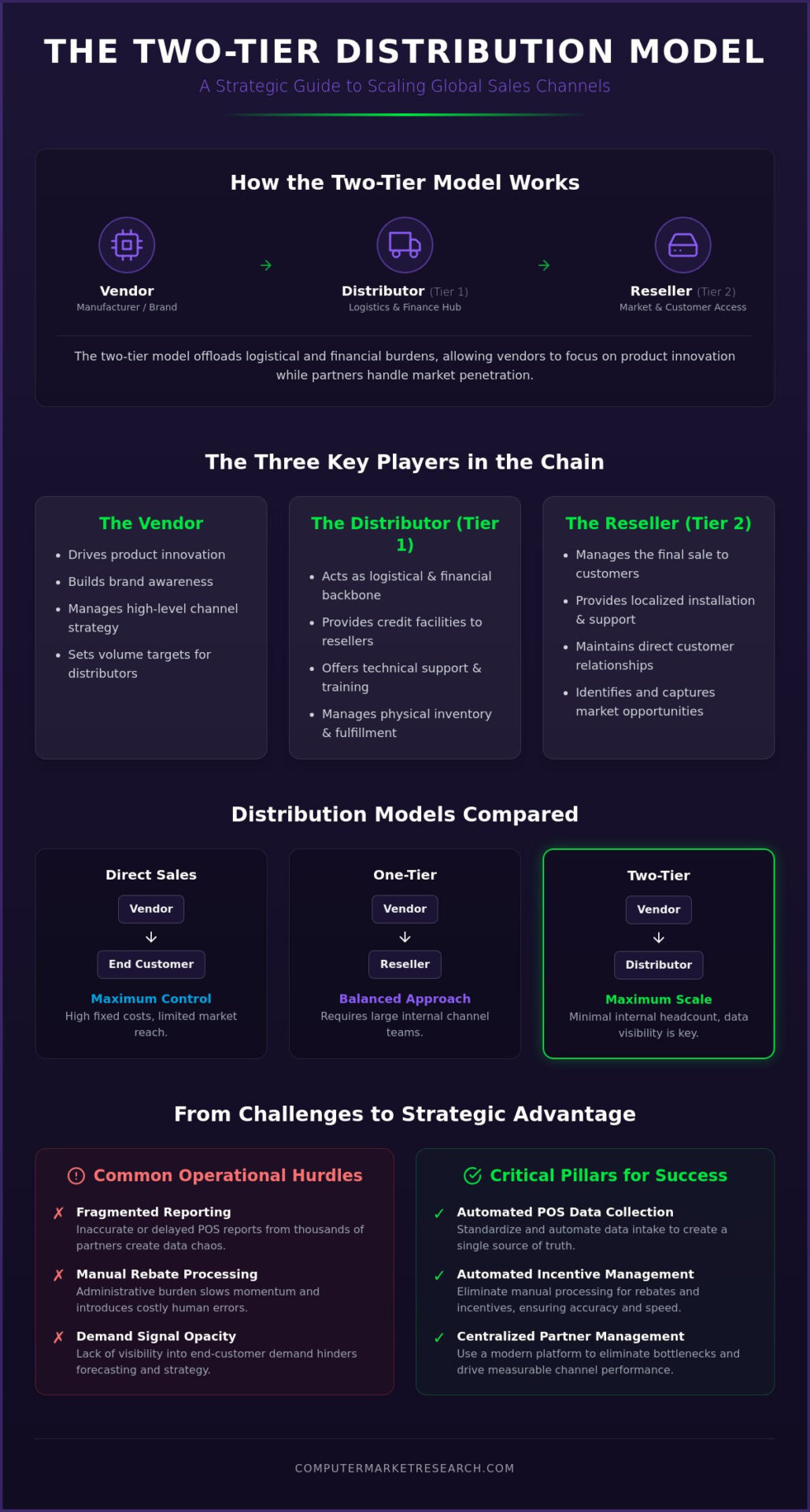
A two-tier distribution model is an indirect sales strategy where a manufacturer, or vendor, sells products to a distributor (Tier 1), who then sells to a network of resellers or value-added resellers (Tier 2). This structure is essential for companies aiming for high-volume growth without a corresponding spike in operational costs. By leveraging the intermediary layer, vendors can focus on core competencies while the distribution network handles the heavy lifting of market penetration. In 2026, the two-tier distribution model remains the definitive standard for scaling global ICT and enterprise hardware brands efficiently.
To better understand how these layers interact within the broader context of Distribution (marketing), it’s helpful to visualize the flow of goods and information. The primary distinction in this model lies in the division of management responsibilities. The vendor maintains a direct relationship with the distributor, focusing on high-level strategy and volume targets. The distributor manages the vast reseller population, handling the day-to-day interactions that would otherwise overwhelm a manufacturer’s internal teams.
To better understand this concept, watch this helpful video:
The Three Key Players in the Two-Tier Chain
Each participant in the chain has a distinct role that ensures the system functions smoothly and reaches the intended market segment. Understanding what is a two-tier distribution model requires looking at the specific contributions of each player:
- The Vendor: They drive product innovation and brand awareness. Their focus is on the long-term channel strategy rather than individual transaction logistics or localized support.
- The Distributor (Tier 1): These partners act as the logistical and financial backbone. They provide credit facilities to resellers, technical support, and the physical infrastructure needed to move products across diverse regions.
- The Reseller/VAR (Tier 2): Resellers are the feet on the street. They manage the final sale, provide localized installation, and maintain the direct relationship with the end customer.
How Two-Tier Differs from One-Tier and Direct Sales
Choosing the right model depends on your desired balance between control and scale. Direct sales offer maximum control and higher margins but come with high fixed costs and limited reach into smaller markets. A one-tier model, where the vendor sells directly to resellers, allows for closer partner ties but requires massive internal channel management teams to handle the volume. The two-tier model provides maximum scale with minimal internal headcount. It offloads the logistical and financial burden of managing thousands of individual reseller relationships, though it requires sophisticated systems to maintain visibility over the data moving through the tiers.
Why Global Enterprises Choose Two-Tier Distribution Strategies
Global enterprises often reach a point where direct sales teams become a liability rather than an asset for growth. The cost of maintaining a physical presence in every emerging market is prohibitive for most balance sheets. This is precisely why leaders ask, what is a two-tier distribution model, when planning for aggressive international expansion. Just as Dorhyan assists fund managers with the regulatory structuring needed for global market access, a two-tier model enables vendors to tap into established ecosystems without the massive capital expenditure of local offices.
Distributors provide a critical financial service by acting as ‘bankers’ for the channel. They offer credit terms to thousands of small resellers, a task that most corporate finance departments aren’t equipped to handle due to risk profiles and administrative overhead. This liquidity allows the channel to move faster and capture opportunities that would otherwise be lost to more agile competitors. Speed to market is another undeniable benefit. It’s much more efficient to sign one agreement with a distributor who already manages 5,000 active partners than it is to recruit, onboard, and vet those partners individually over several years.
Achieving Rapid Market Scale and Geographic Reach
Distributors don’t just move boxes; they provide the local infrastructure necessary for a professional brand presence. They facilitate entry into new territories by providing established logistics networks and localized technical support. This includes handling complex RMA (Return Merchandise Authorisation) processes that would otherwise require the vendor to set up regional repair centers. Utilizing a two-tier model allows for 10x market penetration compared to single-tier structures by removing the friction of local operations. This scale is achieved by leveraging the distributor’s existing relationships and cultural knowledge within specific regions.
Reducing Selling, General, and Administrative (SG&A) Costs
Financial efficiency is the cornerstone of this strategy. Managing 10 distributor invoices is significantly cheaper than processing 10,000 individual reseller transactions across fifty different countries. By outsourcing warehousing, shipping, and inventory management to Tier 1 partners, vendors can maintain a lean internal channel team focused on high-level growth. This drastic reduction in SG&A costs allows organizations to reinvest precious capital into R&D and core product development, ensuring the brand stays ahead of the innovation curve while the channel handles the logistics.
As these layers of distribution grow, the complexity of tracking performance increases. You might find it beneficial to explore automated data management solutions to ensure your strategy remains grounded in accurate, real-time insights.
The Hidden Challenges: Managing Data in a Multi-Layered Channel
While the benefits of scale are undeniable, the distance between the manufacturer and the end user creates significant operational risks. The primary challenge when implementing what is a two-tier distribution model is the phenomenon known as demand signal opacity; this is the specific state of not knowing who the end-user is or exactly what they purchased. This occurs when a vendor loses sight of the product once it reaches the distributor’s warehouse. Without a direct line of sight into downstream transactions, you’re essentially operating in a “Black Box” environment. You know what you sold to your Tier 1 partners, but you’re blind to which resellers are moving stock or which end users are ultimately consuming your products.
Data fragmentation complicates this issue. Every distributor uses unique reporting formats for Point of Sale (POS) and inventory data. One partner might send a clean CSV while another provides a convoluted Excel file with non-standardized SKU names. Manually reconciling these disparate data sets is a recipe for error. It leads to inaccurate forecasting and financial leakages, particularly in “Ship & Debit” programs. If you can’t verify Tier 2 sales data with absolute precision, you’ll likely overpay on price protection claims and rebates, directly eroding your bottom line.
The Visibility Gap: Why Vendors Lose Sight of the End User
The “Black Box” effect does more than just obscure sales figures; it cripples your ability to plan. Inaccurate data flows lead to poor production forecasting, causing either costly stockouts or excessive inventory that requires aggressive discounting to clear. Marketing strategies also suffer when you don’t know who is actually buying your products. Implementing a robust Channel Data Management (CDM) strategy is the only way to bridge this gap. It turns fragmented reports into decision-grade insights that allow your leadership team to act with confidence rather than intuition.
Channel Conflict and Demand Signal Opacity
Without clear visibility, vendors often find themselves in the middle of destructive price wars. Channel conflict arises when multiple partners chase the same deal, leading to pricing drops that devalue your brand. Effective deal registration is critical here. It protects partner margins and ensures vendor integrity by providing a systematic way to track opportunities from the moment they arise. Visibility also prevents “inventory bloat,” a condition where distributors overstock products because they lack real-time Tier 2 demand signals, eventually leading to massive channel returns and financial instability.
Critical Operational Pillars for a Successful Two-Tier Model
Success in a multi-layered channel depends on more than just signing the right partners. Once you understand what is a two-tier distribution model from a structural perspective, the focus must shift to the operational pillars that prevent data decay. A unified Partner Relationship Management (PRM) strategy is the first requirement. This strategy shouldn’t stop at the distributor level. It must extend to the resellers who drive actual end-user demand. Without a centralized framework, your visibility into Tier 2 performance remains anecdotal at best.
Manufacturers must also mandate automated POS data collection. Relying on distributors to manually submit reports is an outdated practice that introduces unacceptable levels of risk. Standardizing these reports ensures that you receive cleansed, actionable information that can be used for financial planning and inventory management. This systematic approach is the only way to maintain a lean channel team while managing thousands of downstream relationships.
POS and Inventory Data Normalisation
Raw data from distributors is notoriously messy. Each partner uses different naming conventions, date formats, and SKU identifiers. This makes it nearly impossible to track ROI or inventory levels accurately across the whole network. Data cleansing is the only way to transform this noise into actionable intelligence. By removing duplicates and correcting address errors, you ensure that your production forecasting and marketing spend are based on reality. Many leaders automate this through Channel Data Management Systems to eliminate the errors inherent in manual spreadsheet management.
Automating MDF and Incentive Programs for Tier 2 Partners
Incentives are the fuel for channel growth, but they often get stuck at the distributor tier. To ensure Market Development Funds (MDF) reach the resellers who actually move product, you need a transparent distribution model. A centralized Co-op/MDF platform allows you to track fund utilization and claim validity in real time. This level of oversight ensures compliance and auditability, preventing the financial leakage that occurs when funds are allocated without proof of performance.
Standardizing Ship & Debit processes is another critical pillar. Without a rigorous, automated system for validating price protection and rebates, you risk fraudulent claims that erode distributor profitability and vendor margins alike. High-quality data is the only defense against these operational bottlenecks. Ready to modernize your channel operations? Claim your 90-day free trial to see how automated data management can transform your visibility.
Optimising Two-Tier Distribution with Computer Market Research
Computer Market Research (CMR) serves as the vital bridge between a vendor’s high-level strategy and the distributor’s ground-level execution. While the structural definition of what is a two-tier distribution model is straightforward, the operational reality is often plagued by data silos and manual errors. CMR provides the technical infrastructure needed to transform these complex relationships into a streamlined, high-performance revenue engine. By replacing legacy tracking methods with automated systems, your organization can finally move past the bottlenecks that stifle indirect channel growth.
Integrating Ship & Debit management is essential for ensuring that every dollar spent on the channel is verified and profitable. Without this level of oversight, vendors often lose significant margin to unverified or duplicate claims. CMR’s system automates the validation process, ensuring that rebates and price protections are only paid out against accurate, confirmed Tier 2 sales data. This precision protects your bottom line while maintaining a transparent, trust-based relationship with your Tier 1 partners.
Centralising Partner Relationships via PartnerPortal™
The PartnerPortal™ platform provides a single pane of glass for both Tier 1 and Tier 2 partners. This centralization is critical for eliminating the silo effect that often occurs when information is trapped between different layers of distribution. By providing a unified interface, vendors can reduce friction through self-service onboarding and automated lead distribution. Real-time performance dashboards allow every partner in the chain to track their progress against KPIs, ensuring total alignment with your broader market objectives.
Leveraging Managed Data Services for Decision-Grade Insights
Building an internal team to handle the constant influx of messy distributor reports is an inefficient use of resources. Outsourcing these tasks to CMR’s Managed Data Services is a more cost-effective way to achieve decision-grade insights without increasing your internal headcount. Our experts handle the heavy lifting of POS data cleansing, turning fragmented spreadsheets into actionable sales intelligence that your executive team can rely on for forecasting. This process ensures that your understanding of what is a two-tier distribution model shifts from a theoretical concept to a data-driven competitive advantage. It’s time to move beyond the limitations of manual tracking and embrace a modernized infrastructure. Partner Smarter with CMR to transform your distribution model into a transparent, scalable asset for your organization.
Modernizing Your Indirect Sales Infrastructure for 2026
Implementing a robust indirect channel is the most efficient way to capture global market share without the burden of excessive internal overhead. Understanding what is a two-tier distribution model is only the first step toward achieving sustainable growth. To truly succeed, you must eliminate the visibility gaps that lead to demand signal opacity and financial leakage. By automating your POS data collection and incentive programs, you transform a complex logistical network into a transparent, high-performance revenue engine.
Computer Market Research brings over 40 years of channel management expertise to your organization. Trusted by Fortune 500 and Global 2000 enterprises, we provide the decision-grade data accuracy required to manage multi-layered channels with total confidence. Our Managed Data Services ensure your strategy is always backed by cleansed, actionable intelligence rather than fragmented distributor reports. It’s time to replace manual processes with a modernized infrastructure that supports your scale.
Streamline your two-tier operations with CMR PartnerPortal™ and take full control of your channel data today. Your path to operational excellence is clear, and we’re here to help you navigate it with precision.
Frequently Asked Questions
What is the difference between one-tier and two-tier distribution?
The fundamental difference lies in the number of intermediaries between the vendor and the end-user. In a one-tier model, the manufacturer sells directly to the reseller. Conversely, what is a two-tier distribution model involves an additional layer where the vendor sells to a distributor who then sells to resellers. This extra tier offloads the logistical and financial burden of managing thousands of individual reseller relationships to the distributor.
Why do vendors use a two-tier distribution model instead of selling direct?
Vendors prioritize this model to achieve massive market reach without the high SG&A costs of a direct sales force. Distributors act as the bankers of the channel, providing credit to resellers that manufacturers often can’t. This structure allows for rapid expansion into new geographic regions. It’s a strategic choice to trade a portion of the margin for the scale and speed that a distributor’s established network provides.
What are the biggest risks of a two-tier distribution strategy?
Data opacity and channel conflict are the most significant risks in this structure. When vendors don’t have a direct line of sight into Tier 2 sales, they struggle with inaccurate production forecasting and inventory bloat. This visibility gap often leads to price wars between partners chasing the same end-user. Without automated systems to track these transactions, financial leakages in rebate and incentive programs become inevitable.
How can I maintain visibility of end-customers in a two-tier model?
Maintaining visibility requires moving beyond manual spreadsheets and adopting automated data collection. When you define what is a two-tier distribution model for your organization, you must include a requirement for standardized POS reporting from your distributors. This allows you to track end-user transactions and inventory levels in real-time. By centralizing this data, you eliminate the black box effect and ensure your marketing spend is directed toward productive partners.
What is the role of a distributor in two-tier distribution?
Distributors serve as the operational backbone of the channel by managing logistics, warehousing, and inventory. They provide essential credit lines to resellers and handle technical support and RMA processing. By acting as the primary point of contact for the Tier 2 reseller network, they allow the vendor to maintain a lean internal team. Their role is to ensure product availability and financial liquidity across the entire distribution chain.
How does PRM software support two-tier distribution management?
PRM software like PartnerPortal™ provides a single pane of glass for managing complex multi-tier relationships. It automates critical tasks such as deal registration, lead management, and performance tracking. By centralizing these functions, the software eliminates the communication silos that often plague indirect channels. This ensures that both distributors and resellers have the resources and data they need to drive revenue and remain aligned with vendor goals.
What is POS data normalization and why is it important for channel vendors?
Normalization is the process of standardizing fragmented sales data from multiple distributors into a single, clean format. Raw distributor reports are often riddled with errors, duplicate entries, and inconsistent SKU names. It’s important because it provides the decision-grade accuracy required for financial reconciliations and Ship & Debit validation. Without normalization, vendors can’t trust their analytics and risk overpaying on incentive claims due to poor data quality.
Can small businesses benefit from a two-tier distribution model?
Small businesses can certainly benefit if they need to scale quickly across diverse regions without building local infrastructure. It provides immediate access to a distributor’s established reseller base and logistical capabilities. However, small vendors must be careful to implement automated systems early. If they don’t have the tools to track POS data or manage MDF, they risk losing their already thin margins to administrative errors and lack of visibility.

Article by
Del Heles
Del Heles is the founder and CEO of Computer Market Research (CMR), a channel management software company he launched in 1984. With more than 40 years of experience, he’s known for helping manufacturers and distributors simplify complex partner programs through practical, customer-focused technology solutions.