

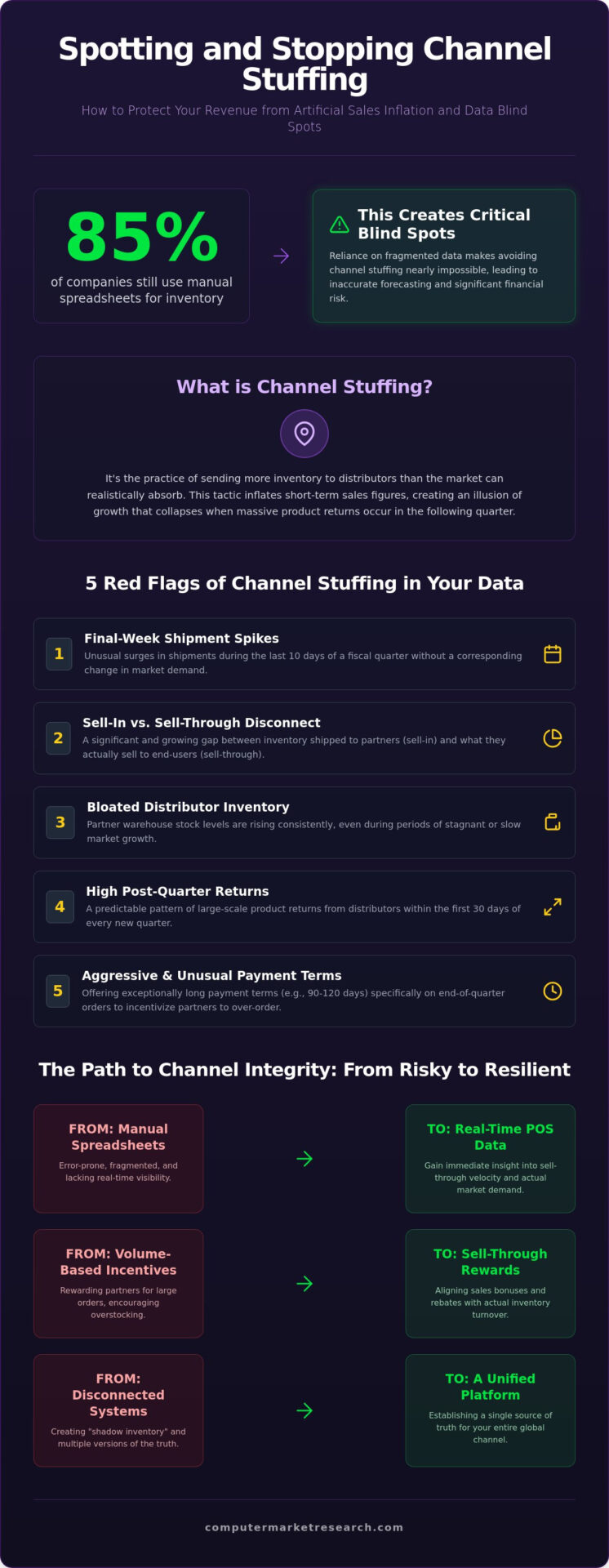
Despite the availability of sophisticated B2B data systems in 2026, 85% of companies still rely on manual spreadsheets as their primary inventory tool. This reliance on fragmented information makes avoiding channel stuffing nearly impossible when quarterly targets loom and partner pressure mounts. When your visibility into actual sell-through data is obscured by legacy processes, you risk more than just inaccurate forecasting; you risk your brand’s regulatory standing and long-term financial stability.
You’re likely familiar with the quiet anxiety of Q1, where high product return rates often reveal that last year’s record-breaking finish was merely an exercise in artificial sales inflation. It’s a common frustration for operations leaders who want to move away from manual errors and toward a system of absolute inventory accuracy. This guide provides a clear path out of these operational bottlenecks by showing you how to implement data-driven strategies that protect your revenue. You’ll learn how to establish a transparent channel data pipeline, align partner incentives with actual market demand, and leverage modern infrastructure to ensure your growth is both ethical and sustainable.
Key Takeaways
- Understand why oversupplying distributors creates a cycle of short-term gains followed by massive Q1 returns that don’t support long-term ROI.
- Learn to identify critical data anomalies, such as late-quarter shipment spikes, which are essential for avoiding channel stuffing and maintaining regulatory compliance.
- Discover how to restructure sales bonuses and tiered rebates to reward actual inventory turnover rather than simple order volume.
- Transition away from manual spreadsheets to real-time POS data collection so you’re closing the gap between sell-in and sell-through visibility.
- See how centralizing partner management within a unified platform eliminates shadow inventory and establishes a single source of truth for your global channel.
What Is Channel Stuffing and Why Does It Threaten Your ROI?
Channel stuffing occurs when a manufacturer sends more inventory to its distributors than the market can realistically absorb. This tactic is frequently used to inflate short-term sales figures for quarterly reports, creating a temporary spike in revenue that lacks a foundation in actual demand. However, understanding What Is Channel Stuffing reveals a deeper failure of data integrity and ethical governance. By “stuffing” the channel, companies create an illusion of growth that eventually collapses under the weight of excessive returns, leading to a “revenue hangover” in the following period.
Public companies face significant legal risks under GAAP and SEC regulations for this practice. It is fundamentally a form of improper revenue recognition because the sale is not final if the product is destined to sit in a warehouse and eventually be returned. Beyond the legalities, the reputational damage is severe. Trust with partners erodes when they are pressured to take on inventory they cannot move. This strain leads to long-term channel instability and undermines the specialized industry relationships required for sustained growth.
To better understand this concept, watch this helpful video:
The Mechanics of Trade Loading
Manufacturers often use deep discounts or extended payment terms to “push” inventory, a process known as trade loading. While legitimate bulk ordering can provide economies of scale, deceptive trade loading occurs when the manufacturer knows the distributor cannot sell the goods. Trade loading is the intentional clogging of a distribution channel to meet internal quotas. This creates a massive disconnect between reported sales and actual market demand, effectively borrowing revenue from the future to satisfy current expectations.
Financial and Operational Consequences
The financial impact of these practices extends to Days Sales Outstanding (DSO) and accounts receivable. When distributors cannot sell the product, they cannot pay the manufacturer; this leads to bloated receivables and compromised cash flow. There are also significant hidden costs in reverse logistics and processing returns during Q1. Perhaps most dangerously, this practice masks true market demand. When production planning relies on “sell-in” figures rather than “sell-through” data, the entire supply chain becomes misaligned. Avoiding channel stuffing is essential for maintaining operational efficiency and ensuring that production levels reflect real-world consumption. Implementing robust channel data management systems is often the first step toward reclaiming this visibility and protecting your ROI.
5 Red Flags: How to Identify Channel Stuffing in Your Data
Detecting artificial sales inflation requires a shift from viewing partners as simple customers to seeing them as extensions of your own supply chain. Avoiding channel stuffing starts with recognizing the data patterns that precede a Q1 revenue collapse. When your internal reporting shows record-breaking shipments in the final week of a fiscal quarter, but market conditions haven’t changed, you’re likely looking at a red flag rather than a genuine sales victory.
- Final-Week Shipment Spikes: Watch for unusual surges in outbound logistics during the last 10 days of a reporting period; to mitigate the costs of these spikes, you might explore Freight Forwarding Service Fees.
- Sell-In/Sell-Through Disconnect: A significant gap between what you ship to partners and what they sell to end users indicates “shelf-warming” inventory.
- Bloated Distributor Inventory: Rising stock levels at partner warehouses during periods of stagnant market growth suggest oversupply.
- Post-Quarter Return Patterns: A consistent trend of large product returns within the first 30 days of a new quarter.
- Aggressive Payment Terms: Granting 90-day or 120-day terms on end-of-quarter orders specifically to entice partners into over-ordering.
Analyzing Sell-In vs. Sell-Through Metrics
Relying solely on sell-in data creates a dangerous blind spot because it treats a warehouse transfer as a final sale. To maintain channel health, you must monitor the inventory-to-sales ratio, which serves as a primary indicator of market absorption. If this ratio climbs while end-user demand remains flat, your channel is becoming congested. Integrating channel data management systems allows you to bridge this gap by capturing real-time POS data directly from your partners, ensuring your revenue recognition matches reality.
Spotting Anomalies in Partner Behaviour
Not all partners participate in stuffing for the same reasons. Some “cherry-pick” excess stock specifically to hit rebate tiers, regardless of their ability to move the product. You should monitor partner warehouse capacity against their historical order volumes to identify these anomalies. Automated alerts can flag any order that exceeds historical sell-through averages by a specific percentage, allowing you to intervene before the inventory becomes a liability. To see how these alerts function in a live environment, you can start a free trial of our channel visibility tools and begin cleaning your data pipeline today.
Aligning Incentives to Discourage Artificial Sales Inflation
Corporate culture often dictates behavior through the structures it rewards. If sales representatives are compensated solely on what they “push” out the door, the risk of artificial inflation remains high. Avoiding channel stuffing requires a fundamental shift in how performance is measured. By moving sales bonuses from “Sell-In” volume to “Sell-Through” performance, you align your internal team’s success with actual market demand. This shift ensures that the revenue reported is supported by end-user consumption rather than distributor warehouse capacity.
Beyond sales bonuses, you should implement tiered rebate structures that prioritize inventory turnover. Rewarding a partner for how quickly they move stock, rather than how much they buy at once, creates a healthier ecosystem. For high-volume distributors, establishing “Clean-Room” auditing processes provides an extra layer of transparency. These audits allow for a neutral third party to verify that inventory levels match reported sales; this effectively eliminates the “shadow inventory” that often hides the early stages of a stuffing problem. This strategic alignment is the most effective operational method for avoiding channel stuffing in the long term.
The Role of Deal Registration Software
Implementing PartnerPortal™ allows you to validate demand before a single unit is manufactured. Deal registration ensures every large order is tied to a verified end-user opportunity, preventing partners from over-ordering on speculation. This system also stops multiple partners from claiming the same sale, which often leads to double-counting and inflated forecasts. For a broader look at how these systems integrate into your strategy, read our guide on What Is Partner Relationship Management (PRM)? A Complete Guide.
Modernizing Rebate and MDF Programs
Traditional volume-based incentives often backfire by encouraging partners to take on more stock than they can handle. Modernizing your co-op/MDF management involves shifting toward performance-based demand creation. Instead of rewarding a large purchase, use these funds to support marketing activities that drive end-user sales. To provide a final layer of protection, you should implement clawback provisions for any products returned within 90 days. This financial safeguard ensures that your incentives reward sustainable growth rather than temporary, artificial spikes in your books.
Leveraging Real-Time Inventory Visibility for Clean Data
Legacy processes are the primary enablers of artificial sales inflation. When organizations rely on manual spreadsheets to track global distribution, they create a systemic blind spot that is easily exploited during high-pressure reporting periods. Spreadsheets are static, prone to manual entry errors, and become obsolete the moment a partner makes a sale. For operations leaders serious about avoiding channel stuffing, transitioning to an automated, cloud-based environment is the only way to maintain financial integrity and operational control.
This shift toward digital precision is a cross-industry standard; for example, in the AEC sector, studiobimarq.com provides the BIM and VDC consultancy required to replace manual drafting with integrated, error-free digital models.
The implementation of daily or weekly Point of Sale (POS) data collection provides the granular visibility needed to verify that shipments match actual market consumption. Cloud-based SaaS platforms normalize this data, ensuring that information from disparate partner systems is consolidated into a single, actionable format. This transparency allows for the creation of inventory aging reports. By identifying stock that has remained unmoved for extended periods, managers can pinpoint where the channel is being congested before those items are eventually returned as losses in the following quarter.
Automating POS and Inventory Reporting
Automating the collection of POS and inventory data from a global partner network removes the friction of manual reporting and eliminates the opportunity for data manipulation. For a detailed look at the technical requirements of this transition, refer to CMR’s channel POS and ship-debit whitepaper. Real-time inventory visibility allows channel managers to cap orders based on actual stock-on-hand, preventing partners from over-extending their warehouse capacity. When you have an accurate view of what is currently on the shelf, you can ensure that sales targets are met through market demand rather than inventory loading.
The Power of Managed Data Services
Decision-grade accuracy is only possible when data is cleansed and normalized across all regions. Managed data services handle the complex task of reconciling different part numbers, currencies, and reporting formats into a unified dataset. This prevents the double-counting of sales that often occurs when products move between regional distributors. For a deeper dive into these processes, see our guide on Channel Data Management (CDM): The Definitive Guide to Decision-Grade Insights. By outsourcing these technical workflows, operations leaders can focus on strategy rather than troubleshooting manual errors. If you’re ready to modernize your data pipeline and protect your revenue, you can access our automated inventory management tools for a 90-day trial period.
How CMR PartnerPortal™ Automates Channel Integrity in 2026
Technology provides the structural guardrails that corporate policy alone cannot enforce. While shifting incentive structures is a vital step, avoiding channel stuffing requires a centralized infrastructure to monitor compliance in real time. PartnerPortal™ eliminates “shadow” inventory by bringing undocumented deals and fragmented data into a single, unified dashboard. This creates a “single source of truth” across your global channel, ensuring that every stakeholder, from regional managers to finance directors, operates from the same validated dataset.
The platform ensures that your revenue recognition remains beyond reproach by integrating POS data directly with incentive processing. This means that rebate payouts and bonuses only occur on verified end-user sales, removing the motivation for partners to stockpile products. By implementing automated inventory caps and “smart” order approval workflows, the system proactively prevents the over-extension of credit or stock. These automated checks act as a first line of defense, flagging any transaction that deviates from historical sell-through patterns before the order is ever fulfilled.
- Verified Payouts: Incentive payments are strictly tied to confirmed POS data, eliminating the risk of paying for “stuffed” inventory.
- Dynamic Caps: Automated limits prevent partners from ordering stock that exceeds their demonstrated market demand.
- Workflow Automation: Smart approval processes flag end-of-quarter anomalies for manual review by operations leaders.
- Global Transparency: A centralized view removes the data silos that typically hide revenue-recognition risks.
Centralizing Channel Operations
Modern channel management requires a move away from fragmented legacy tools. CMR’s Channel Sales Management Software streamlines the entire partner lifecycle, from initial onboarding to ongoing performance tracking. By hosting these operations within a unified portal, you reduce the administrative burden associated with manual data reconciliation. Centralization ensures that every partner interaction is documented, providing the audit trail necessary for regulatory compliance and internal accountability.
Achieving Long-Term Strategic Growth
Moving from reactive damage control to proactive management fundamentally improves your overall channel ROI. When you replace manual errors with automated integrity, you build stronger, more trust-based relationships with your partners. They benefit from clearer expectations and more reliable incentive payouts, while you benefit from a stable, predictable revenue stream. Transparency is the most effective tool for avoiding channel stuffing and reclaiming control over your distribution network. If you are ready to move beyond the cycle of artificial inflation and focus on genuine market expansion, it is time to Partner Smarter with Computer Market Research.
Securing Your Channel Integrity for 2026 and Beyond
Computer Market Research has been at the forefront of B2B data administration since 1984, providing the technical competence needed to manage complex industry relationships. Our comprehensive cloud-based SaaS suite is trusted by Fortune 500 and Global 2000 companies to eliminate operational bottlenecks and establish a single source of truth. You can replace fragmented manual workflows with a modernized system that guarantees accuracy and stability across your global channel. Take the first step toward a cleaner, more reliable data pipeline today. Request a Demo of PartnerPortal™ to Secure Your Channel Integrity and begin your journey toward ethical, data-driven growth.
Channel Growth and Integrity FAQs
Is channel stuffing illegal for private companies?
Channel stuffing is illegal for private companies if it involves fraudulent misrepresentation to stakeholders. While private firms don’t report to the SEC, using inflated sales figures to secure bank financing or attract venture capital constitutes wire or bank fraud. Legal frameworks focus on the intent to deceive lenders, partners, or potential buyers about the company’s actual financial performance and market absorption. To ensure your business maintains the financial integrity required for successful mergers and acquisitions, check out Pinnacle Global Advisory.
How does channel stuffing affect a company’s stock price?
Artificial sales inflation typically triggers a temporary stock price increase followed by a severe correction. When the inevitable wave of product returns hits in the following quarter, the company must often restate earnings or lower guidance. This volatility erodes investor confidence and often leads to class-action securities litigation. Long-term shareholder value depends on sustainable, demand-driven revenue rather than short-term reporting maneuvers, a principle reflected by Tyrian Trade in their mission to establish a trust layer for financial markets through verified participation.
What is the difference between channel stuffing and trade loading?
Trade loading refers to the logistical “push” of inventory through deep discounts or extended payment terms. Channel stuffing is the broader strategic practice of using those shipments to prematurely recognize revenue in financial reports. While trade loading is an operational tactic, stuffing is a reporting violation. Both practices result in a clogged channel that prevents new, profitable products from reaching the end user.
Can channel stuffing happen accidentally due to poor data visibility?
Accidental oversupply is a frequent consequence of using manual spreadsheets and legacy tracking methods. Without real-time visibility, managers often authorize shipments based on optimistic forecasts that don’t reflect current market absorption. This lack of transparency creates an unintentional stuffing scenario where inventory builds up at partner sites simply because the manufacturer didn’t have the data to stop the flow of goods.
How do I explain the risks of channel stuffing to my sales team?
Sales teams respond best when risks are framed in terms of their future earnings and territory stability. Explain that avoiding channel stuffing prevents a revenue hangover where massive returns in Q1 cancel out their previous bonuses. Emphasize that pushing excess stock ruins partner trust and makes it harder to sell legitimate new products later in the year when the channel is already congested.
What are the best KPIs to track to ensure channel health?
Focus on the inventory-to-sales ratio and sell-through velocity to gauge actual market health. You should also monitor the return-to-sales percentage and Days Sales Outstanding (DSO) specifically for channel partners. If these metrics deviate from historical norms during the final weeks of a quarter, it indicates that the distribution network is being used as a storage facility rather than a sales pipeline.
How does Partner Relationship Management (PRM) software prevent stuffing?
PRM software establishes a single source of truth by linking shipment data to verified end-user opportunities. By mandating deal registration for large orders, the system ensures that every unit shipped is destined for a specific customer. This automation removes the guesswork from order approvals and prevents partners from over-ordering based on speculative demand or the desire to hit rebate tiers.
What should I do if I suspect my distributors are over-stocking?
Initiate a data audit using POS Data Management tools to compare current stock levels against actual sales. If you identify a significant disconnect, you should immediately adjust partner incentives to focus on demand generation rather than volume. Intervening early with automated inventory caps helps clear the backlog and restores the flow of high-quality information. Avoiding channel stuffing requires this proactive approach to maintain long-term partner relationships.

Article by
Del Heles
Del Heles is the founder and CEO of Computer Market Research (CMR), a channel management software company he launched in 1984. With more than 40 years of experience, he’s known for helping manufacturers and distributors simplify complex partner programs through practical, customer-focused technology solutions.