

How much revenue is your organization losing to the gap between partner spreadsheets and your actual financial bottom line? Relying on fragmented information leads to more than just administrative headaches; it creates a persistent ceiling on your global growth. Most channel leaders recognize the frustration of reconciling inaccurate POS data or manually processing complex rebate claims that never seem to align. It’s a systemic drain on resources that prevents your team from focusing on strategic expansion.
Modern saas for channel management has evolved far beyond basic partner portals. Today’s platforms serve as a sophisticated engine for automated operations, turning messy data into decision-grade transparency. This guide explores how to eliminate manual bottlenecks by implementing centralized systems for MDF and incentive tracking. You’ll learn how to leverage automation to ensure data integrity and gain the real-time visibility necessary to scale your channel ROI in 2026. We will examine the shift toward cloud-based infrastructure and the specific workflows required to maintain a competitive, high-performance partner network.
Key Takeaways
- Understand why manual spreadsheet tracking is obsolete and how cloud-based automation stabilizes indirect sales cycles.
- Learn how deal registration and Co-op/MDF management modules protect partner margins while automating marketing fund allocation.
- Identify the technical processes for normalizing POS data within saas for channel management to eliminate inaccurate reporting.
- Evaluate selection criteria for enterprise scalability, focusing on seamless connectivity with existing CRM and ERP infrastructure.
- Discover how centralized platforms like PartnerPortal™ provide the transparency required to scale global channel revenue effectively.
What is SaaS for Channel Management?
A What is SaaS for Channel Management? framework refers to a specialized cloud infrastructure built to handle the complexities of third-party sales. It isn’t just a database. It’s a systematic approach to automating indirect sales, partner relationships, and financial incentives. For Global 2000 companies, relying on manual spreadsheets is no longer a viable strategy. These legacy processes are prone to human error and lack the transparency needed for accurate financial reporting. By implementing saas for channel management, organizations can centralize the partner lifecycle from onboarding to performance tracking, effectively removing operational bottlenecks that stifle growth.
Modern saas for channel management centralizes the entire partner lifecycle, providing a steady, reliable path for scaling revenue through external networks. It ensures that every transaction is documented and every incentive is accurately calculated without the need for manual intervention.
To better understand how this technology transforms the sales process, watch this helpful video:
The Evolution of Channel Management Systems
We’ve seen a transition from basic partner portals to comprehensive, integrated SaaS ecosystems. In the past, channel management was reactive. Leaders would wait for end-of-month reports that were often already outdated. Modern platforms provide real-time visibility, allowing for a shift to proactive management. This transition ensures that data and relationships are handled within the same environment. It’s no longer enough to just manage a partner’s contact info; you must also manage the data they generate.
Who Benefits from Channel Management Software?
This technology is essential for any business where indirect sales represent a significant portion of total revenue.
- Manufacturers: These companies often manage thousands of global entities. Automation ensures that inventory levels and POS data remain accurate across all regions.
- Enterprise Leaders: Fortune 500 companies use these tools to protect their margins and ensure that channel ROI is clearly visible to stakeholders.
- Operations Professionals: Teams can stop wasting hours on manual claim processing. By using a centralized partner management system, they can focus on high-level strategy instead of data entry.
The goal is to create a clear path out of the chaos of fragmented information. Modern systems provide the stability and precision required to scale a global channel effectively.
Core Modules of a Modern Channel Management System
A robust architecture for saas for channel management relies on specialized modules that address specific operational friction points. While many platforms offer basic enablement, true enterprise solutions focus on the financial and transactional integrity of the partnership. This aligns with Gartner’s definition of PRM, which emphasizes the optimization of business processes between a manufacturer and its indirect channel partners. By compartmentalizing functions like deal registration and lead management, companies ensure every interaction is tracked and every margin is protected from internal competition.
Effective systems don’t just store data; they enforce rules that prevent channel conflict. When a partner registers a deal, the system locks that opportunity to protect their investment of time and resources. This level of control is essential for maintaining trust in a global network. Without these guardrails, your most valuable partners might hesitate to share their pipeline, leading to a lack of visibility that can’t be fixed by simple portal access.
Automating Financial Incentives and MDF
Manual claim verification is a primary source of friction in partner relationships. Automation reduces processing time significantly, turning weeks of administrative work into minutes of systematic validation. Integrating market development funds into your broader sales strategy ensures that marketing spend is directly tied to measurable partner performance. This creates a transparent audit trail, satisfying both internal compliance requirements and partner expectations for timely reimbursement. It’s a pragmatic way to drive better behavior through performance-based rewards.
Advanced Transactional Controls
Financial transparency is often lost in complex “Ship & Debit” processes. Modern systems utilize ship and debit management software to automate price protection and claim reconciliation. This prevents overpayments and ensures that distributors are accurately compensated for price fluctuations in real time. Beyond financial claims, tracking inventory levels across global networks provides the data needed for precise production planning. When you see real-time stock levels, you can pivot your strategy before a shortage impacts your market share. If your current manual processes are creating bottlenecks, it might be time to see how automation stabilizes your operations. You can explore these modules firsthand with a trial to evaluate their impact on your specific workflows.
Lead management and rebates round out the core ecosystem. Automated lead distribution ensures that high-quality opportunities reach the partners best equipped to close them. Meanwhile, performance-based rebates incentivize the specific sales behaviors that align with your corporate goals. These modules work together to create a disciplined, results-driven environment where both the manufacturer and the partner can thrive without the constant threat of manual error.
The Data Integrity Gap: POS and Inventory Management
Raw partner reports are often riddled with inconsistencies, from varying SKU names to mismatched date formats. This “dirty data” makes high-level decision-making impossible for most organizations. Without a systematic way to normalize these inputs, saas for channel management becomes just another repository for unusable information. Precision matters. Organizations need more than just a place to store files; they need a process that transforms raw data into a reliable source of truth.
POS Data Management automates the collection and normalization of point-of-sale data across disparate partner systems. This ensures that every line item reflects actual market activity rather than administrative guesswork. Gaining real-time inventory visibility is equally critical. It prevents the dual risks of stockouts and overstocking, which directly impact the bottom line. When inventory levels are transparent, production planning moves from reactive to proactive. Decisions are based on facts, not forecasts built on flawed logic.
Managed Data Services for Global Enterprises
Many global enterprises find that the administrative burden of data cleansing is too high for internal teams to manage effectively. Outsourcing these tasks to experts ensures that data is scrubbed of errors before it enters the system. Channel data management is the foundation of accurate reporting, providing the structural integrity required for complex global operations. Utilizing channel data management systems allows operations teams to offload manual entry and focus on strategic partner growth.
Decision-Grade Insights vs. Basic Reporting
There’s a significant difference between vanity metrics and decision-grade insights. Basic reporting might show you total sales, but it doesn’t tell you if a specific rebate program is actually driving the desired behavior. Normalized data allows for precise rebate and commission calculations, ensuring that you aren’t overpaying based on flawed reports. It’s about protecting your margins. Predictive analytics take this a step further. By analyzing historical sales patterns alongside current inventory levels, you can forecast demand with much higher accuracy. This level of intelligence is what ultimately drives channel ROI and sustainable revenue growth in a competitive landscape.
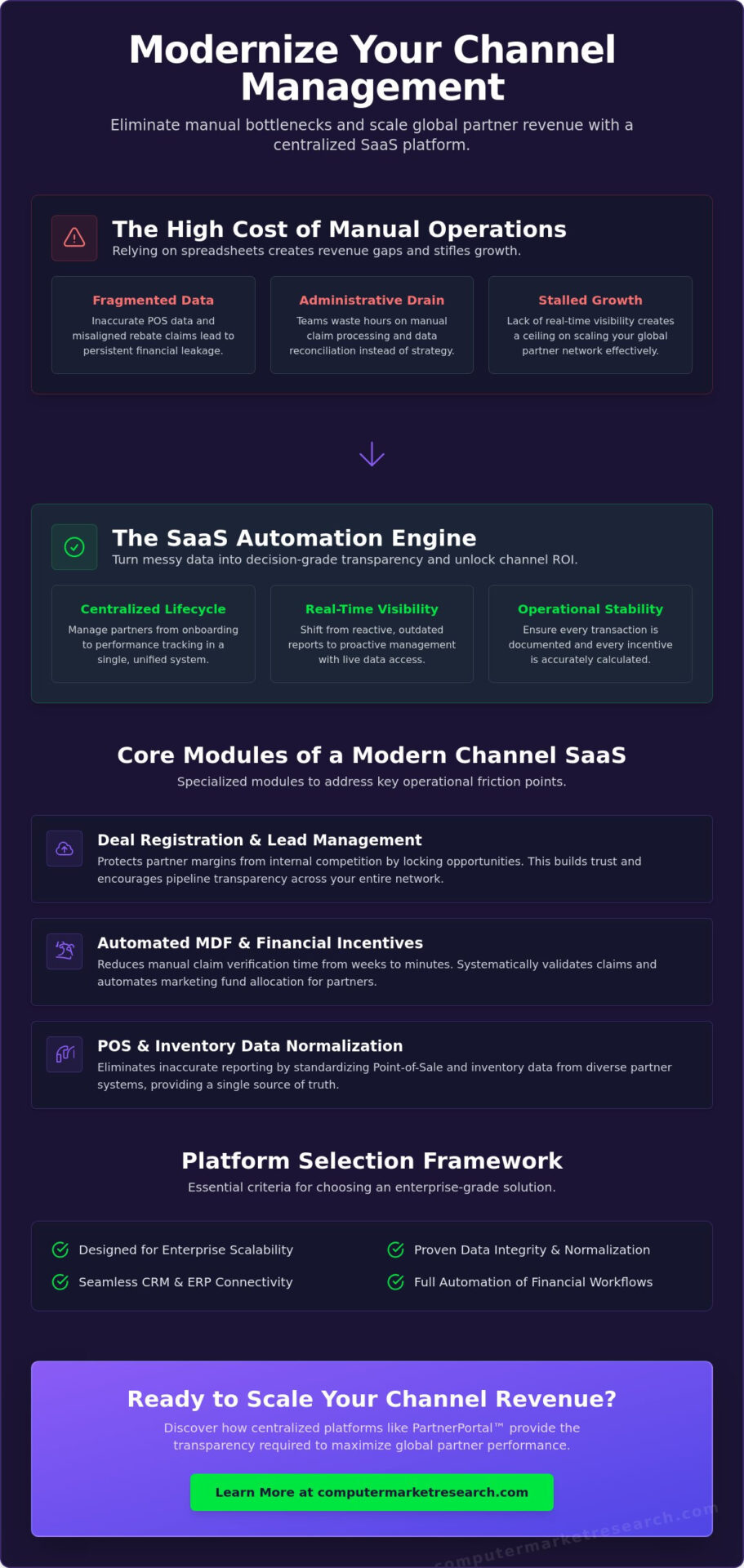
Selection Framework: Choosing the Right SaaS Platform
Selecting the right saas for channel management requires a fundamental shift from feature-focused checklists to deep architectural evaluation. For a Global 2000 enterprise, the platform must process millions of transactions across thousands of partners without compromising data integrity. It isn’t just about a portal; it’s about a robust engine that enforces business rules and ensures financial accuracy. Security and compliance aren’t optional extras. Any viable solution must meet rigid standards like SOC 2 and GDPR to protect sensitive partner and customer information in an increasingly regulated global market.
Finding the balance between customization and configuration is a critical decision point. Rigid, out-of-the-box solutions often fail to accommodate unique B2B workflows, while overly customized systems become expensive to maintain. A pragmatic approach favors a highly configurable platform that allows you to mirror your specific incentive programs and reporting structures without writing custom code for every minor change. This flexibility ensures the system grows alongside your channel rather than becoming a bottleneck.
Technical Integration and Ecosystem Compatibility
A modern platform must function as a “single source of truth” for your indirect sales channel. This requires more than just basic connectivity. It demands bi-directional data flow between your partner relationship management system and your existing CRM infrastructure. Without this synchronization, your sales and operations teams will continue to work in silos, leading to lead duplication and financial discrepancies. Robust API availability ensures the platform can integrate deeply with ERP systems for real-time inventory and ship-and-debit reconciliation. If your current tools don’t offer this level of connectivity, you can start a free trial to test enterprise-grade integration.
Evaluating Vendor Expertise and Support
Technical capability is only half the equation. Industry experience in B2B data administration is a significant differentiator. You need a partner who understands the nuances of complex incentive programs and the data integrity challenges discussed in previous sections. Implementation shouldn’t be a DIY project. Professional services for branding and workflow mapping ensure the platform aligns with your corporate identity and operational goals. Managed services provide an additional layer of stability, offloading the burden of data cleansing and ensuring your reporting remains decision-grade. Choosing a vendor with a proven track record in your specific industry reduces the risk of project failure and accelerates your path to automated growth.
PartnerPortal™: The Enterprise Standard for Channel SaaS
Centralizing global operations requires a platform built on technical stability and a deep understanding of complex B2B relationships. PartnerPortal™ addresses the specific operational bottlenecks that prevent organizations from reaching their full potential. By serving as a comprehensive saas for channel management, the platform replaces fragmented manual workflows with a single, authoritative environment. Computer Market Research has designed this system to eliminate the administrative friction associated with indirect sales, ensuring that every partner interaction is documented and every financial claim is validated with precision.
The core strength of PartnerPortal™ lies in its integrated architecture. Unlike disparate tools that require manual data bridging, this system combines Co-op/MDF Management, Rebates & Incentives, and POS Data Management into a unified workflow. This integration ensures that the data integrity gap discussed earlier is closed, providing a clear path to improved ROI. When financial controls and performance data exist in the same ecosystem, leadership can make strategic decisions with total confidence in the underlying information. It’s a systematic approach to accelerating indirect sales growth by removing the obstacles of human error and legacy infrastructure.
Why Global 2000 Companies Trust PartnerPortal™
Managing the channel structures of Fortune 500 enterprises demands a level of scalability and accuracy that generic portals can’t provide. Global 2000 companies rely on PartnerPortal™ because it offers a proven track record of handling high-volume, multi-regional partner networks. The platform provides the stability necessary for long-term growth, moving beyond simple communication to become a holistic discipline for data administration. Operations teams can finally escape the cycle of reactive troubleshooting and move toward a proactive, results-driven strategy. You can explore the PartnerPortal™ solution to see how these enterprise-grade features align with your specific organizational goals.
Getting Started with Automated Channel Management
The transition from manual tracking to an automated saas for channel management is a structured journey. It begins with a configuration phase where workflows are mapped to your unique business rules, followed by a seamless global rollout. Efficiency gains are often immediate. By automating the verification of marketing funds and sales incentives, teams can redirect their focus toward high-value partner enablement. This transformation isn’t just about software; it’s about building a modernized infrastructure that supports sustainable expansion. If you’re ready to move beyond the limitations of spreadsheets, contact our experts to partner smarter today. We provide the technical competence and industry expertise required to turn your channel into a high-performance revenue engine.
Future-Proofing Your Global Channel Operations
The transition from legacy manual processes to a modernized infrastructure is the only logical step for a growing organization. By prioritizing data integrity and automated financial transparency, you position your channel for sustainable, global growth. High-quality saas for channel management ensures that your operations remain stable even as partner networks become more complex. You’ve seen how automated POS data cleansing and a comprehensive suite including MDF, Rebates, and Deal Registration create a foundation of precision.
Many Fortune 500 and Global 2000 companies already trust this systematic approach to eliminate operational bottlenecks and protect margins. It’s time to move beyond the limitations of fragmented spreadsheets and embrace the clarity of decision-grade insights. You can Request a Demo of PartnerPortal™ to experience how automated workflows transform your indirect sales revenue. Taking this step ensures your team can focus on strategic partner growth rather than administrative recovery. Your path to a scalable, high-performance channel starts with the right data infrastructure.
Frequently Asked Questions
What is the difference between PRM and SaaS for channel management?
PRM is a subset of the broader SaaS ecosystem. While PRM focuses on relationship workflows, modern saas for channel management includes deep transactional data, financial incentive processing, and POS normalization. It provides a holistic infrastructure for the entire partner lifecycle. This comprehensive approach ensures that relationship management and data administration work together to drive revenue.
Can channel management software integrate with my current CRM?
Yes, enterprise-grade platforms offer seamless bi-directional integration with leading CRM systems. This ensures that leads, accounts, and deal status stay synchronized across both environments. It eliminates the need for manual data entry and prevents information silos between sales and operations teams. Maintaining a single source of truth is critical for scaling global partner networks.
How does SaaS automate the management of Market Development Funds (MDF)?
Automation streamlines the entire fund lifecycle from allocation to claim verification. The system enforces business rules to validate marketing activities against pre-approved criteria. This reduces administrative overhead and ensures that partners receive reimbursements faster while maintaining a transparent audit trail for compliance. Automated workflows turn weeks of manual reconciliation into a systematic, real-time process.
Is SaaS for channel management suitable for small businesses or just large enterprises?
While large enterprises often require the most complex configurations, cloud-based saas for channel management is highly scalable for growing businesses. Small and medium enterprises benefit from the same data integrity and automation features to establish a disciplined foundation early. It prevents the operational bottlenecks that typically arise from manual spreadsheet tracking as your partner network expands.
What are the security standards for cloud-based partner portals?
Cloud-based portals must adhere to rigorous global standards like SOC 2 Type II and GDPR. These certifications ensure that sensitive partner and transaction data are protected through encryption and strict access controls. Maintaining high security standards is essential for Global 2000 companies managing international distribution networks. This infrastructure provides the reassurance needed to share proprietary sales information across a cloud network. To ensure your organization is prepared for any security eventuality, learn more about CyberOne and their comprehensive incident response capabilities.
How does POS data management improve channel sales forecasting?
Normalizing POS data provides a clear view of actual market demand at the end-user level. By converting raw partner reports into decision-grade information, organizations can identify sales trends and inventory needs with higher precision. This shift from reactive to proactive planning significantly improves the accuracy of channel sales forecasting. It allows leaders to pivot strategies based on facts rather than guesswork.
What is the typical implementation timeline for a channel management system?
The timeframe for implementation depends on the scale of your global network and the depth of required digital integrations. A methodical rollout typically involves a structured journey from workflow configuration and data mapping to final validation. This ensures that the system is fully aligned with your corporate standards before a full global launch. Professional services teams work in parallel with your operations staff to manage the shift from manual tracking to a modernized infrastructure.
How does deal registration software prevent channel conflict?
Deal registration software prevents conflict by granting exclusive rights to a specific opportunity once a partner registers it. The system automatically checks for duplicates and enforces rules to protect the partner’s investment in a lead. This transparency builds trust and ensures that margins are protected across the entire indirect sales channel. It creates a disciplined environment where partners feel confident sharing their pipeline.

Article by
Del Heles
Del Heles is the founder and CEO of Computer Market Research (CMR), a channel management software company he launched in 1984. With more than 40 years of experience, he’s known for helping manufacturers and distributors simplify complex partner programs through practical, customer-focused technology solutions.