

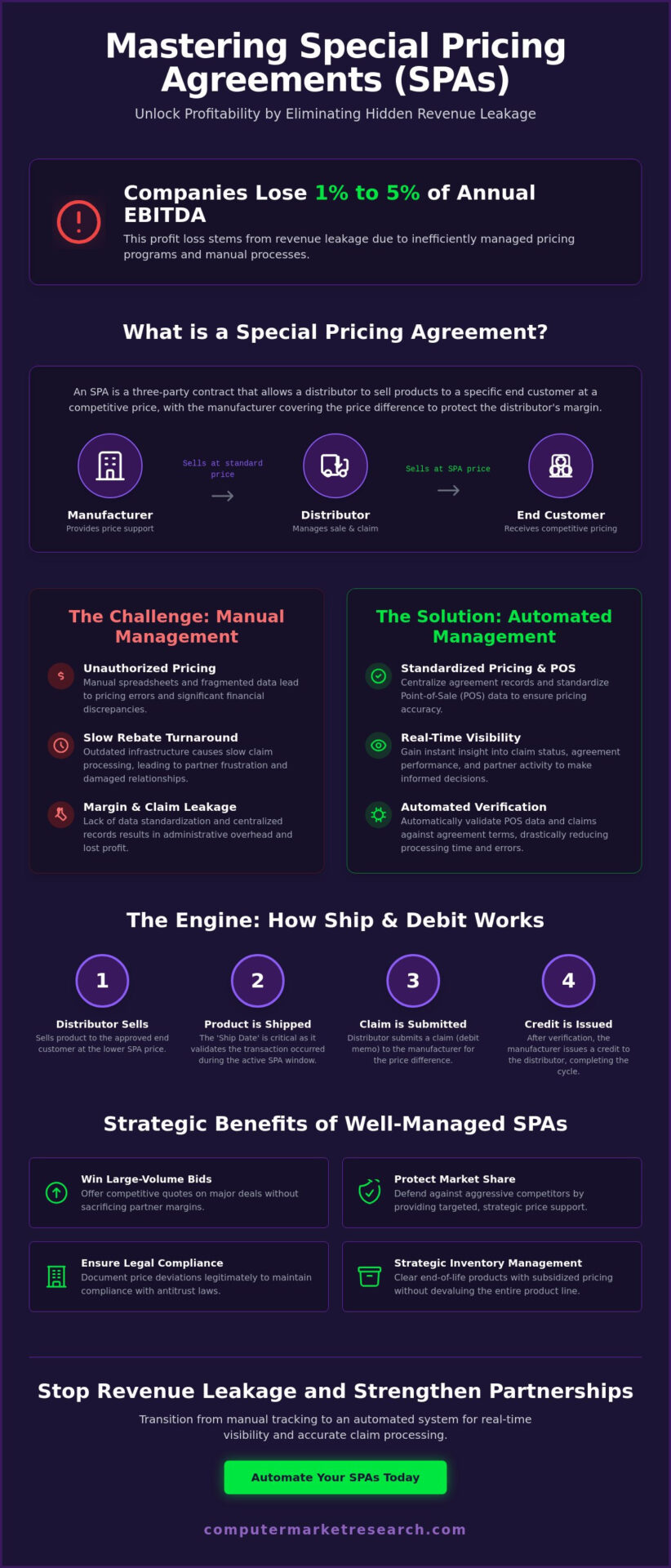
Did you know that companies often lose between 1% and 5% of their annual EBITDA because of revenue leakage from inefficiently managed programs? For many B2B leaders, understanding what are special pricing agreements spa is less about a dictionary definition and more about identifying where their profit is quietly disappearing. While these customized contracts are vital for maintaining a competitive edge in the 2026 market, the traditional reliance on manual spreadsheets and fragmented data frequently results in unauthorized pricing and significant financial discrepancies.
You’re likely all too familiar with the administrative burden of processing claims and the partner frustration that stems from slow rebate turnaround times. It’s a common industry pain point that originates from outdated, manual infrastructure. This guide will help you master the complexities of these agreements and demonstrate how to eliminate margin leakage through automated channel management. We’ll examine the path toward standardized pricing, real-time visibility into claim status, and the automated verification of POS data to ensure your bottom line remains protected and your partnerships stay strong.
Key Takeaways
- Gain a clear understanding of how Special Pricing Agreements allow partners to meet competitive market prices without sacrificing their own profitability.
- Master the technical definition of what are special pricing agreements spa to better navigate the complexities of modern B2B contract negotiations.
- Learn to bridge the gap between sales and settlement by optimizing the Ship & Debit process for faster, more accurate claim processing.
- Discover how standardizing POS data and centralizing agreement records can reduce margin leakage and administrative overhead.
- See how transitioning from manual tracking to automated systems like PartnerPortal™ creates real-time visibility and strengthens channel relationships.
Defining Special Pricing Agreements in B2B Channels
A Special Pricing Agreement (SPA) is a targeted contract between a manufacturer and a distributor that establishes a unique price for specific products destined for a particular end customer. This three-party relationship is the cornerstone of B2B channel sales. It ensures that while the distributor purchases at a standard rate, they can sell at a competitive market price without eroding their own profitability. Manufacturers use these agreements to provide financial support for specific opportunities that fall outside the standard price list.
Understanding what are special pricing agreements spa requires recognizing their status as exception-based instruments. They aren’t intended for every transaction. Instead, they serve as a strategic response to unique market pressures or high-volume opportunities. Without these agreements, distributors might find themselves unable to compete on price, leading to lost deals and weakened channel loyalty. The manufacturer-distributor-end customer triangle relies on data transparency to function. The manufacturer needs to know exactly which end customer received the discount to prevent fraud. The distributor needs assurance that the manufacturer will reimburse them for the margin gap. This balance is why SPAs are rarely handled through standard ERP price lists; they require a separate, more flexible layer of administration.
To better understand how these agreements function in real-world scenarios, watch this helpful video:
Common Synonyms for SPAs in the Industry
Terminology often shifts depending on your specific vertical. In the high-tech sector, “SPA” is the standard. However, industrial or medical manufacturing professionals might refer to them as “Sales Support,” “Contract Pricing,” “Special Price Quotes,” or “Deviation Agreements.” While the names vary, they all point to the same financial mechanism: a manufacturer-backed price reduction for a specific end-user sale. These variations often reflect how different industries prioritize either the sales quote or the financial contract aspect of the deal.
The Role of SPAs in Channel Strategy
SPAs are critical for winning large-volume bids where standard margins would make the quote uncompetitive. By offering targeted price support, manufacturers help their partners protect market share against aggressive competitors who might be undercutting the list price. These agreements also provide a structured way to maintain legal compliance and antitrust laws by documenting legitimate, non-discriminatory price deviations based on specific deal criteria. Beyond competition, SPAs act as a tactical tool for inventory management, allowing manufacturers to clear end-of-life products through subsidized pricing without devaluing the entire product line. Efficiently managing these agreements often involves ship and debit management software to ensure every claim is verified and paid accurately.
The Mechanics: How SPAs and Ship & Debit Work Together
While the contract defines the terms, the execution of these deals happens through a process known as Ship & Debit. This mechanism is the engine of the Quote-to-Cash cycle in B2B channels. The practical execution of what are special pricing agreements spa relies entirely on this workflow to ensure financial reconciliation. In this model, the distributor sells a product to an end customer at the discounted SPA rate and then requests a credit from the manufacturer to cover the difference between their acquisition cost and the agreed-upon special price.
Timing is critical. Claim validity often hinges on the Ship Date rather than the Order Date. Manufacturers prioritize the Ship Date because it provides concrete evidence that the inventory moved during the active agreement window. If a distributor places an order on the last day of an agreement but doesn’t ship the product for three weeks, the claim might be rejected. This distinction is a frequent source of friction and margin leakage in manual systems. When managers ask what are special pricing agreements spa from an operational perspective, the answer is almost always found in the efficiency of the Ship & Debit cycle.
The Ship & Debit Workflow Step-by-Step
- Agreement creation and authorization: The manufacturer and distributor negotiate terms for a specific end-customer deal, assigning a unique contract number.
- Sale to the end-user: The distributor ships the goods at the lower, SPA-contracted price, recognizing a temporary margin loss on their books.
- Submission of the claim: The distributor submits a ‘Debit’ request, typically as part of a weekly POS report, referencing the specific SPA contract.
- Verification and credit: The manufacturer validates the sale against the agreement terms and issues a credit memo to the distributor.
Why Verification is the Hardest Part
The primary obstacle to smooth claim settlement is data accuracy. Manufacturers must match incoming Point of Sale (POS) data against specific SPA contract numbers to prevent overpayment. This task becomes exponentially difficult when dealing with partial shipments or customer returns. If a customer returns half of an order, the previously issued credit must be reversed or adjusted. Legacy systems often fail to track these granular changes, leading to financial discrepancies that favor one party over the other.
Price protection also adds a layer of complexity. If the manufacturer drops the general list price during the SPA period, the value of the ‘debit’ might change. Managing these variables through spreadsheets is a recipe for error. To maintain control over these complex financial flows, many organizations adopt specialized ship and debit management software to automate the verification process. If you’re looking to eliminate these manual bottlenecks, you can start streamlining your claims process today to see immediate efficiency gains.
Strategic Benefits and Common SPA Management Challenges
Implementing a robust SPA program does more than just lower a price. It transforms the manufacturer-distributor relationship into a strategic partnership. When a manufacturer provides competitive price support, they foster deep partner loyalty. Distributors are far more likely to prioritize brands that offer the financial flexibility needed to win tight bids. Research indicates that approximately 40% to 60% of a distributor’s bottom-line profit is derived from manufacturer rebate programs, which include these agreements. Beyond loyalty, these contracts provide manufacturers with invaluable visibility into end-user pricing and emerging market trends. This data allows for more precise forecasting and strategic product positioning.
However, the operational reality often involves significant hurdles. The high administrative burden of manual claim processing remains a primary obstacle for many organizations. Without automation, the time required to verify each transaction leads to slow rebate turnaround times, which can frustrate even the most loyal partners. There’s also the persistent financial risk of double-dipping. This occurs when a distributor inadvertently claims an SPA credit on top of a standard volume rebate for the same unit, leading to unintended margin erosion.
The Hidden Cost of Margin Leakage
Margin leakage occurs when profit is lost due to unverified, overpaid, or fraudulent claims. It’s often the silent killer of channel profitability. It is estimated that companies lose 1% to 5% of their realized EBITDA each year due to revenue leakage from inefficiently managed programs. When teams rely on manual spreadsheets, they frequently resort to best guess approvals just to clear a backlog of pending claims. This lack of precision is why understanding what are special pricing agreements spa from a risk perspective is so vital. If you can’t verify that a sale actually met the agreement criteria, you’re essentially giving away profit. Implementing specialized Ship and Debit Management Software is the most effective way to prevent this leakage by automating the validation of every line item against your active contracts.
Channel Conflict and SPA Compliance
Compliance is the foundation of a healthy channel. Unauthorized or poorly monitored SPAs can inadvertently fuel gray market activity, where products intended for a specific end-user are diverted elsewhere. This creates internal competition and devalues the brand. Maintaining a rigorous audit trail is essential for both regulatory and financial compliance. Transparent data builds trust. When manufacturers and distributors share a single source of truth regarding agreement status and claim history, the potential for conflict drops significantly. A clear, data-backed process ensures that every participant knows the rules and sees that they are applied fairly across the entire network.
Best Practices for Modern Special Pricing Administration
Managing high-volume channel incentives requires more than just a basic understanding of what are special pricing agreements spa; it demands a disciplined operational framework. Efficiency begins with centralization. Moving away from siloed spreadsheets and toward a single source of truth prevents the version control issues that often lead to overpayments. Organizations that standardize their processes can realize a 2% to 5% improvement in profit margins by simply eliminating administrative errors. These gains are only possible when data flows through a structured system rather than an inbox.
To achieve these results, consider these four pillars of modern administration:
- Centralize all SPA contracts in a unified database to ensure cross-departmental alignment.
- Standardize the POS reporting format for every distributor to simplify data ingestion.
- Implement automated validation rules that flag discrepancies before credits are issued.
- Establish clear SLAs for claim approval to maintain partner trust and cash flow.
The Necessity of Data Cleansing
Raw POS data is rarely ready for immediate processing. It’s often dirty, containing inconsistent part numbers, misspellings of customer names, or truncated addresses. If you attempt to match this raw information against your agreements, the system will trigger endless false rejections. Managed Data Services play a critical role here by normalizing this information, ensuring that ‘Corp A’ and ‘Corporation A’ are recognized as the same entity. Utilizing robust Channel Data Management Systems allows you to cleanse and enrich this data automatically, transforming fragmented inputs into actionable financial records that drive accuracy.
Integrating SPAs with Your PRM Strategy
Your partner portal shouldn’t just be for training materials. It’s the ideal entry point for SPA requests and claim tracking. By integrating these agreements into your broader PRM strategy, you give partners real-time visibility into their claim status. This transparency reduces the volume of ‘where is my credit?’ inquiries and builds long-term confidence. Additionally, the data gathered from these transactions should inform your future MDF and incentive programs. If certain product categories consistently require SPAs to move, it may signal a need for more permanent price adjustments or targeted marketing support. Modernizing these workflows ensures that your channel remains agile and your margins stay protected.
If your current process feels like a bottleneck, it’s time to modernize your infrastructure. You can start your 90-day free trial today to see how automated validation can secure your margins and improve partner satisfaction.
Automating SPAs with CMR’s PartnerPortal™ Platform
PartnerPortal™ serves as the centralized hub for all channel operations, effectively replacing the obsolete manual methods that hinder B2B performance. While previous sections detailed the strategic importance of these contracts, true efficiency is only achieved when the administrative burden is removed. Understanding what are special pricing agreements spa is the first step, but CMR’s platform provides the infrastructure to execute them without the risk of human error. By automating the entire Ship & Debit claim lifecycle, the system ensures that every transaction is validated against real-time POS data and authorized contracts.
This level of automation provides real-time visibility into channel inventory, allowing managers to see exactly where their products are and at what price they’re moving. CMR positions itself as the expert partner in eliminating legacy spreadsheet dependencies, offering a clear path out of operational bottlenecks. Instead of chasing fragmented information, your team can focus on high-value strategic decisions backed by accurate, verified data. The transition from manual workflows to a modernized system is the only logical step for organizations looking to scale their channel operations in 2026.
Key Features of CMR’s Ship & Debit Module
The Ship & Debit module is designed for precision and speed. It handles the complex matching of POS line items to specific, authorized SPA contracts automatically, ensuring that financial reconciliation is both fast and accurate. Key capabilities include:
- Automated matching of POS lines to authorized SPA contracts, ensuring that only valid sales receive credit.
- Instant identification of duplicate or invalid claims to prevent overpayment and margin erosion.
- Seamless integration with your existing ERP and CRM systems to maintain a unified data ecosystem without manual data entry.
Beyond Software: Managed Data Services
Technology alone isn’t always enough to solve the problem of dirty data. Managed Data Services are essential for organizations that realize that knowing what are special pricing agreements spa is only half the battle. CMR handles the heavy lifting of data collection and normalization, ensuring that the information entering your system is clean and usable. We take raw, inconsistent inputs from various distributors and transform them into Decision-Grade Insights. This process ensures that C-suite executives have access to high-quality information that reflects the true state of the channel. By consistently emphasizing modern infrastructure and reliability, CMR helps you transition from reactive claim processing to proactive channel management.
If you’re ready to secure your margins and strengthen your partner relationships, it’s time to move beyond manual tracking. Schedule a demo of PartnerPortal™ today to transform your SPA management and reclaim your lost EBITDA.
Securing Your Channel Margins in 2026
Navigating the complexities of B2B incentives requires a shift from reactive manual tracking to proactive automation. By now, you understand that defining what are special pricing agreements spa is only the first step toward operational excellence. The real value lies in synchronizing your Ship & Debit workflows and ensuring every claim is backed by cleansed, verified POS data. This approach doesn’t just stop margin leakage; it builds a foundation of trust with your distributors through faster turnaround times and transparent communication.
With over 40 years of channel management expertise, CMR provides the stability and technical competence needed to manage these complex relationships. Our cloud-based SaaS infrastructure offers real-time visibility that legacy systems simply can’t match. It’s why Fortune 500 and Global 2000 companies trust PartnerPortal™ to handle their most critical data administration tasks. You don’t have to let manual errors dictate your profitability any longer. Take the first step toward a more efficient, data-driven channel today. Optimize Your Channel Pricing with CMR’s PartnerPortal™ and reclaim your competitive edge.
Frequently Asked Questions
Is a Special Pricing Agreement the same as a rebate?
No, although an SPA is technically a form of rebate, its application is much more specific. Standard rebates typically reward total purchase volume over a set period. In contrast, an SPA is a surgical tool designed for a single end-customer deal at a negotiated price. This specificity makes SPAs harder to track but more effective for winning competitive bids without devaluing your entire catalog.
How do Special Pricing Agreements prevent margin leakage?
These agreements prevent margin leakage by creating a rigid verification framework for every transaction. By defining exact pricing for specific end-users, manufacturers stop unauthorized discounts from eroding profit. Automated systems facilitate this by matching POS data against contract terms in real time. This ensures that credits are only issued for valid sales, preventing the 1% to 5% EBITDA loss commonly caused by manual processing errors.
What is the difference between an SPA and a Ship & Debit claim?
An SPA is the legal contract, while Ship & Debit is the financial process used to settle it. The agreement sets the rules, including which products and customers are eligible for a discount. The Ship & Debit claim is the distributor’s request for reimbursement after they’ve sold the goods at that lower price. Essentially, the SPA is the “why” and the Ship & Debit claim is the “how.”
Can SPAs be used for both products and services?
How often should SPA contracts be reviewed for compliance?
You should review SPA contracts for compliance continuously using automated validation, supported by deeper quarterly audits. Continuous monitoring identifies immediate discrepancies in shipping dates or part numbers. Quarterly reviews help you assess if the agreement still aligns with current market trends or if the end-customer’s needs have changed. This regular cadence prevents gray market diversion and ensures your channel strategy remains effective and legally compliant.
What data is required to validate an SPA claim?
Validating a claim requires the specific SPA contract number, detailed Point of Sale (POS) records, and the end-customer’s unique identifier. You must confirm the ship date falls within the contract’s active window and that the quantities don’t exceed authorized limits. Because raw data is often inconsistent, cleansing part numbers and customer names is a critical step to ensure the claim matches the original agreement exactly.
Why do manufacturers use SPAs instead of just lowering the wholesale price?
Manufacturers use these agreements to compete on specific high-volume deals without devaluing their entire product line. Lowering the wholesale price across the board would destroy general market margins and trigger unnecessary price wars. Learning what are special pricing agreements spa allows brands to offer targeted support where it’s needed most. This tactical approach protects the standard list price while giving partners the flexibility to win price-sensitive bids.
How does automation speed up the SPA approval process?
Automation speeds up approvals by replacing manual spreadsheet matching with instant, rule-based validation. When a partner submits their POS data, the system automatically verifies it against the terms of the agreement. This eliminates the administrative bottlenecks that cause slow rebate turnaround times. Partners get their credits faster, which improves their cash flow and strengthens their loyalty to your brand, all while reducing your internal overhead.

Article by
Del Heles
Del Heles is the founder and CEO of Computer Market Research (CMR), a channel management software company he launched in 1984. With more than 40 years of experience, he’s known for helping manufacturers and distributors simplify complex partner programs through practical, customer-focused technology solutions.