

What if the incentives designed to motivate your global partners are actually eroding their trust? When fluctuating exchange rates create discrepancies in rebates or when your team spends hours manually calculating MDF across dozens of local currencies, your operational efficiency suffers. Reliable multi-currency support in prm software is no longer a luxury for international brands. It’s a fundamental requirement for financial accuracy and partner retention. You likely recognize that manual tracking and fragmented data are the primary obstacles to your growth in an increasingly complex global economy.
This guide helps you master the complexities of global channel finance by leveraging automated systems that handle FX calculations with precision. We’ll show you how to achieve real-time global ROI visibility while ensuring transparent, local-currency payouts that keep your partners engaged. We will examine the impact of the November 2026 ISO 20022 payment standards and provide a structured roadmap for modernizing your financial workflows to drive stability and performance across every region.
Key Takeaways
- Modernize your financial operations by replacing error-prone manual spreadsheets with automated systems that maintain accuracy across global partner ecosystems.
- Leverage multi-currency support in prm software to integrate real-time exchange rate APIs, ensuring partner payouts remain transparent and consistent regardless of location.
- Master the automation of Co-op/MDF management to eliminate manual conversion errors and enforce local budget caps effectively.
- Normalize fragmented POS data from dozens of countries into a single source of truth for clear global ROI visibility and better decision-making.
- Utilize PartnerPortal™ to centralize deal registration and incentives, building stronger partner trust through reliable, local-currency operations.
The Financial Complexity of Global Channel Management
As we move through 2026, the distinction between local and global business has effectively vanished. Companies are scaling faster than ever, often managing partner networks that span dozens of countries and currencies simultaneously. This rapid expansion exposes a critical weakness in legacy infrastructure. Relying on Partner Relationship Management (PRM) systems that lack native multi-currency capabilities leads to significant friction. When your financial data is fragmented, you lose the precision required to maintain a competitive edge. This section explores why the transition from manual tracking to automated systems is the only logical step for growing organizations.
To better understand how multi-currency management functions within a modern financial framework, watch this helpful video:
Why Single-Currency Systems Fail International Programs
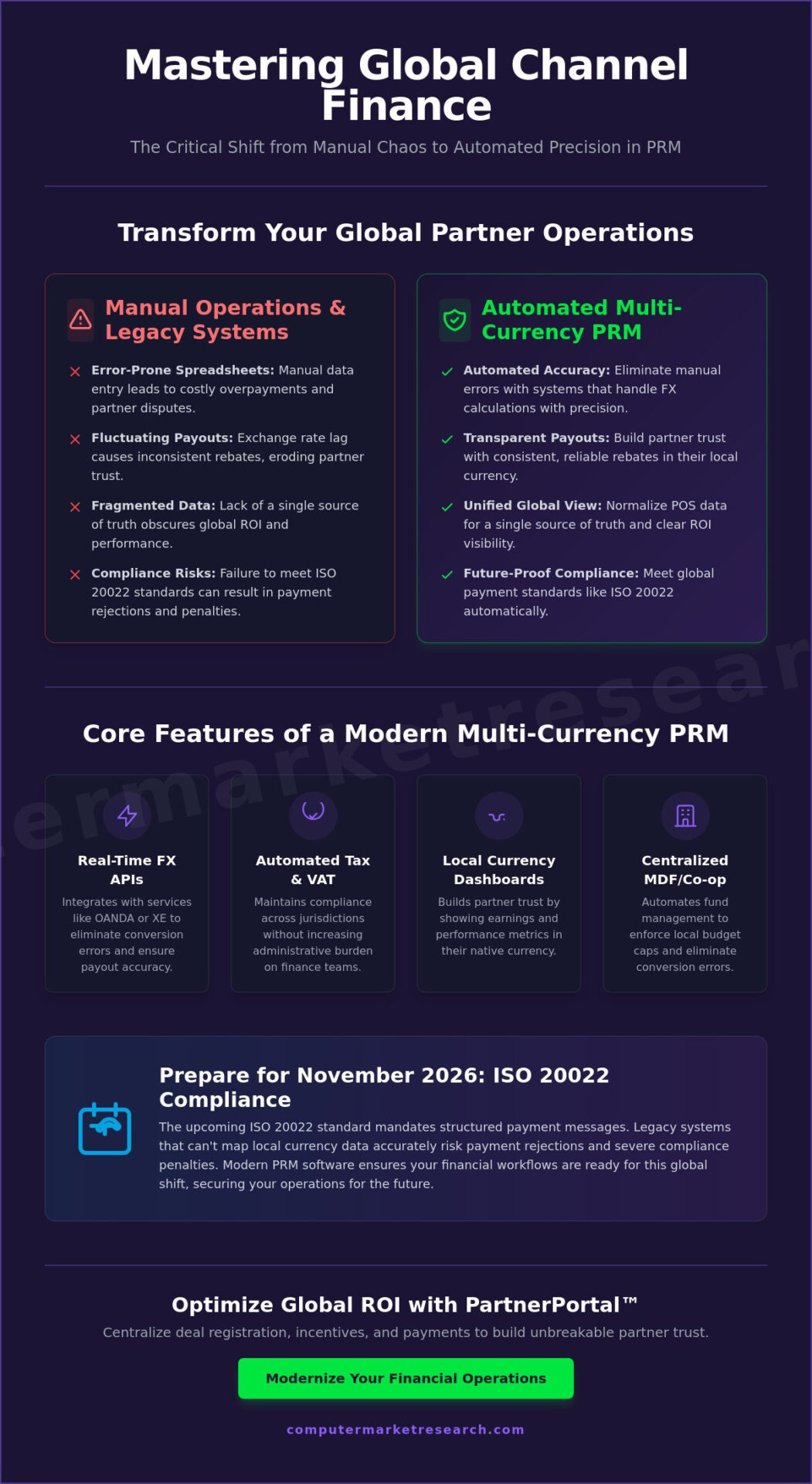
Many organizations fall into the “Base Currency” trap, where all global transactions are forced into a single home currency for reporting. This approach alienates international partners who must deal with the volatility of exchange rates on their end. If a partner in the EU sees their rebates fluctuate wildly because of an FX lag in your system, their trust in your program diminishes. Beyond partner loyalty, there are serious regulatory risks. By November 2026, ISO 20022 standards require structured payment messages. Systems that can’t accurately map local currency data to these global standards risk payment rejections and compliance penalties. Margin erosion is another silent threat; without real-time tracking, you may find your global profitability is lower than your reports suggest due to outdated conversion rates.
The Hidden Costs of Manual Exchange Rate Calculations
Manual workarounds are the primary obstacles to channel growth. Finance teams often spend hundreds of hours every quarter manually verifying exchange rates and updating spreadsheets. This isn’t just a waste of talent; it’s a liability. A single data entry error in a multi-million dollar incentive program can lead to massive overpayments or, conversely, underpaid partners who may choose to leave your ecosystem. The lack of multi-currency support in prm software also creates a visibility gap. You can’t optimize global performance if you’re waiting weeks for a manual roll-up of international sales data. This delay prevents leadership from making the agile adjustments needed to capture emerging market opportunities. Adopting PartnerPortal™ allows businesses to centralize this data, ensuring that every transaction is recorded with technical competence and absolute accuracy.
Core Features of Multi-Currency Support in PRM Software
PRM multi-currency support is the automated handling of foreign exchange (FX) for global channel operations. It’s more than a simple conversion tool; it’s a comprehensive financial layer that ensures every transaction, from deal registration to incentive payout, is executed with precision. To effectively navigate currency exchange risks, modern systems integrate directly with real-time exchange rate APIs such as OANDA or XE. This level of technical depth eliminates the operational bottlenecks caused by manual data entry and fragmented tracking methods. If you’re ready to modernize your infrastructure, you can explore our automated solutions with a free trial.
A robust system also provides automated tax and VAT handling for international payouts. This is critical for maintaining compliance across different jurisdictions without increasing the administrative burden on your finance department. By providing partners with local currency dashboards, you offer a level of transparency that builds long-term trust. Partners can see their earnings and performance metrics in their own currency, which removes the guesswork and friction typically associated with international programs.
Dynamic Exchange Rate Integration and Real-Time Updates
For data to be considered “decision-grade,” exchange rates must refresh at a frequency that matches your transaction volume. Most global organizations require at least daily updates, though high-volume environments may opt for real-time polling. You must also consider the role of “Fixed” versus “Floating” rates. While floating rates reflect current market conditions, fixed rates are often negotiated in partner agreements to provide financial stability over a specific quarter. Effective multi-currency support in prm software allows you to manage both types simultaneously while ensuring total consistency with your corporate ERP system. This synchronization prevents the data silos that often lead to financial discrepancies.
Multi-Currency Reporting for Global Channel Visibility
Leadership requires a consolidated view of global sales, typically presented in a single “Home” currency. However, regional managers need the ability to drill down into specific countries to view performance in local denominations. This dual-view capability allows for a nuanced understanding of market trends that a single-currency report would obscure. You can identify which regions are truly growing and which are merely benefiting from favorable currency swings. Multi-currency PRM serves as the essential foundation for global ROI tracking by normalizing diverse financial data into actionable corporate intelligence. This structured approach ensures that your global strategy is based on accurate, verifiable information rather than estimates.
Automating Global Rebates and MDF Across Borders
Managing global incentives requires a shift from reactive accounting to proactive fund management. When organizations scale into new territories, the manual administration of rebates and market development funds (MDF) often becomes the primary obstacle to growth. Relying on legacy systems that treat currency as an afterthought leads to “ghost” overages and frustrated partners. Robust multi-currency support in prm software transforms these financial hurdles into strategic advantages by automating the entire lifecycle of a claim. This automation ensures that your financial commitments remain predictable even when exchange rates are not.
Managing Co-op and MDF Funds in Local Currencies
Allocating Co-op/MDF funds effectively requires that partners see their available balances in their own local currency. If a partner in Japan is forced to view their marketing budget in USD, they face the constant risk of under-utilizing funds or overspending due to daily rate fluctuations. This uncertainty often leads to the “use it or lose it” dilemma where funds are left on the table because the partner is unsure of their exact purchasing power. By setting budget caps in local currencies, you prevent these discrepancies before they occur. The system should automatically adjust regional sales performance data into fund allocations, allowing for a seamless approval workflow that respects local financial realities while maintaining corporate oversight.
Streamlining Global Incentive Payouts and Tax Compliance
The final stage of the incentive lifecycle is often the most fraught with delay. Streamlining the path from claim to payment is essential for maintaining high partner satisfaction scores. Modern systems integrate directly with cross-border wire transfer services and digital wallets to reduce the “payout gap” that often plagues international programs. This technical competence extends to tax compliance as well. Automated platforms generate tax-compliant invoices for global partners, ensuring that VAT and local tax requirements are met without manual intervention from your finance department.
Centralizing these complex workflows within PartnerPortal™ provides a single source of truth for all global incentive tracking. It eliminates the need for fragmented spreadsheets and ensures that every rebate and MDF payout is documented with precision. This structured approach doesn’t just save time; it builds a foundation of reliability that encourages partners to invest more deeply in your brand. When partners know their payouts are accurate and timely, they’re more likely to prioritize your products over competitors who still struggle with manual conversion headaches.
Overcoming Data Fragmentation in Multi-Currency POS Reporting
Managing point-of-sale (POS) data from a global partner network is a significant technical hurdle. When you receive reports from 50 or more countries, the volume of unrefined data can paralyze your operations. Every region uses different reporting standards, leading to a fragmented view of your actual market performance. Robust multi-currency support in prm software must go beyond simple conversion. It must act as a normalization engine that resolves these discrepancies at the source, ensuring that your corporate leadership views a single, accurate version of the truth.
Normalizing Global Sales Data for Accurate Forecasting
True global visibility requires more than just changing a currency symbol. You have to reconcile different date formats, units of measure, and regional tax variations to create a coherent dataset. Analyzing historical FX rates is particularly critical for year-over-year growth analysis. Without this historical context, a surge in local sell-through might actually be a byproduct of currency devaluation rather than real market growth. Data normalization is the essential secret sauce that converts raw, fragmented regional reports into a unified language for corporate strategic planning. This process allows you to identify inventory imbalances across global regions. For instance, you might discover that while one region appears to be over-performing in local currency, they’re actually sitting on aging stock that needs to be reallocated. Establishing a single source of truth ensures these insights are caught before they impact your bottom line.
The Role of Managed Data Services in Financial Accuracy
Internal manual processing of global data is rarely sustainable for growing organizations. The administrative burden of cleansing and verifying thousands of rows of partner data often leads to burnout and oversight. Leveraging managed data services provides immediate relief to your finance and operations departments. Professional data normalization ensures that your Ship & Debit claims are based on accurate, verified sales data, preventing the overpayments that erode margins. This transition from manual workflows to modernized systems is the only logical step for an organization that values order and performance.
Achieving decision-grade insights requires a level of technical precision that legacy spreadsheets can’t provide. When your data is professionally managed, you gain the confidence to make high-stakes investments in emerging markets. This systematic approach eliminates the operational bottlenecks that prevent you from scaling your channel programs effectively. If you’re ready to resolve your data fragmentation issues, claim your 90-day free trial to see how professional normalization improves your financial accuracy.
Optimizing Global ROI with PartnerPortal™
Consolidating the technical layers discussed in previous sections into a single operational core is the final step in global channel maturity. PartnerPortal™ serves as this definitive hub, integrating financial precision with day-to-day channel activities. By providing robust multi-currency support in prm software, organizations can eliminate the common friction points of channel conflict through transparent, multi-currency deal registration. This ensures that every partner, regardless of their geographical location or local denomination, feels their contributions are tracked and rewarded fairly. It’s a systematic approach that builds trust through technical competence rather than general promises.
Scaling a partner program often leads to a linear increase in administrative headcount, but automation breaks this cycle. Real-time visibility into global inventory and sales pipelines allows leadership to make data-driven decisions without waiting for manual roll-ups from regional offices. This efficiency gain ensures that your operational costs remain stable even as your partner ecosystem expands into new emerging markets. You gain the ability to manage complex global networks with a lean, focused team that prioritizes strategy over manual data entry.
Centralizing Global Operations into a Single Source of Truth
A unified experience is essential for keeping international partners engaged and productive. Integrating your PRM with existing global CRM infrastructure and enterprise resource planning systems creates a seamless data flow that prevents the formation of information silos. This integration ensures that lead management and opportunity tracking are consistent across all territories. Reducing friction in the onboarding process is equally vital; a localized portal allows new international partners to become productive faster by providing training and resources in their own context. This structured onboarding sets the tone for a professional, performance-based relationship from day one.
Future-Proofing Your Channel with AI-Driven FX Management
As we look toward the remainder of 2026, predictive analytics are becoming the standard for managing channel spend. AI-driven systems can now analyze currency trends to forecast how FX fluctuations will impact your global incentive budgets. This foresight allows you to adjust your strategy proactively, maintaining a high ROI even in volatile economic conditions. Automating these complex global calculations is the only way to ensure long-term financial stability. To take the next step in your digital transformation, you can Partner Smarter with Computer Market Research’s automated solutions. Transitioning to a modernized infrastructure is the most logical path for any organization focused on order, precision, and measurable business outcomes.
Securing Your Global Competitive Advantage in 2026
Transitioning from manual, fragmented tracking to a unified digital infrastructure is a critical step for organizations scaling across international borders. By centralizing your operations, you effectively eliminate the operational bottlenecks that lead to partner friction and eroded margins. Integrating robust multi-currency support in prm software ensures that your financial reporting remains accurate while building deep trust with your global network through transparent, local-currency payouts. This systematic approach transforms channel finance from a source of frustration into a strategic asset.
Since 1984, we’ve specialized in helping Fortune 500 and Global 2000 companies achieve this level of technical precision. Our comprehensive modules for Co-op/MDF and POS data management are engineered to deliver Decision-Grade data insights that empower your leadership to make high-stakes investments with absolute confidence. The obsolescence of legacy spreadsheets is an opportunity to modernize your infrastructure and drive sustainable growth. If you’re ready to master the complexities of global channel management, Request a Demo of PartnerPortal™ for Global Channel Management and start your 90-day free trial. Computer Market Research provides the systematic path out of operational bottlenecks, ensuring your global strategy is built on a foundation of reliability and performance.
Frequently Asked Questions
What is the benefit of multi-currency support in PRM software?
The primary benefit is the elimination of manual conversion errors that lead to payment discrepancies. By providing multi-currency support in prm software, organizations can offer partners localized financial dashboards. This transparency builds long-term loyalty and ensures that global reporting reflects real-time market conditions rather than outdated estimates. It also reduces the administrative burden on finance departments by streamlining the claim-to-payment lifecycle across diverse regions.
How does PRM software handle fluctuating exchange rates?
Modern systems handle fluctuations by integrating directly with real-time exchange rate APIs such as OANDA or XE. These integrations allow for daily or even hourly updates to ensure that rebates and MDF allocations remain accurate. You can also implement fixed rates for specific contract periods to provide financial predictability. This technical precision prevents margin erosion and ensures that both the vendor and the partner are operating on the same financial data.
Can PRM systems integrate with my existing ERP for currency data?
Yes, sophisticated PRM platforms are designed to synchronize with corporate ERP systems like SAP, NetSuite, or Oracle. This integration ensures that the currency data used for partner incentives matches your internal accounting records. Maintaining this consistency is essential for accurate global sales forecasting and tax compliance. It effectively removes the data silos that often occur when disparate systems use different exchange rate sources.
Is multi-currency support necessary for small partner programs?
If your program includes even a single international partner, automated currency handling is a necessity. Manual workarounds are the primary obstacles to growth; they introduce risks that can be catastrophic for smaller organizations. Starting with a scalable infrastructure allows you to expand into new markets without increasing your operational headcount. It ensures your financial foundation is stable from day one, preventing future operational bottlenecks as you scale.
How does multi-currency support improve partner relationships?
It improves relationships by ensuring that partners receive accurate, timely payouts in their local currency. When partners can track their earnings without performing their own manual conversions, they develop greater trust in your program. This transparency reduces the number of payment disputes and administrative inquiries. It signals to your partners that you are a pragmatic, data-focused partner who values their time and professional focus.
What are the common challenges when managing global channel incentives?
The most common challenges include data fragmentation in POS reporting and the manual burden of calculating MDF across different currencies. Organizations often struggle with inconsistent date formats and units of measure that complicate global ROI tracking. Additionally, managing cross-border tax compliance and VAT requirements manually is a significant liability. Technical multi-currency support in prm software resolves these issues by normalizing data into a single source of truth.
How does PartnerPortal™ handle international tax compliance for payouts?
PartnerPortal™ automates the generation of tax-compliant invoices for global partners, ensuring that local VAT and tax requirements are met. The system integrates with digital wallets and cross-border payment gateways to streamline the actual transfer of funds. This automation reduces the risk of regulatory penalties and ensures that payouts are handled with technical competence. It effectively alleviates the specific frustrations of business leaders dealing with complex international tax laws.
Can I set different exchange rates for different partner tiers?
Yes, flexible PRM systems allow you to configure exchange rate settings based on partner tiers or specific regional agreements. While many organizations prefer real-time floating rates, some use fixed rates for top-tier partners to guarantee incentive values during periods of market volatility. This level of control allows you to customize your financial strategy to meet the specific needs of your most valuable partners while maintaining overall corporate profitability.

Article by
Del Heles
Del Heles is the founder and CEO of Computer Market Research (CMR), a channel management software company he launched in 1984. With more than 40 years of experience, he’s known for helping manufacturers and distributors simplify complex partner programs through practical, customer-focused technology solutions.