

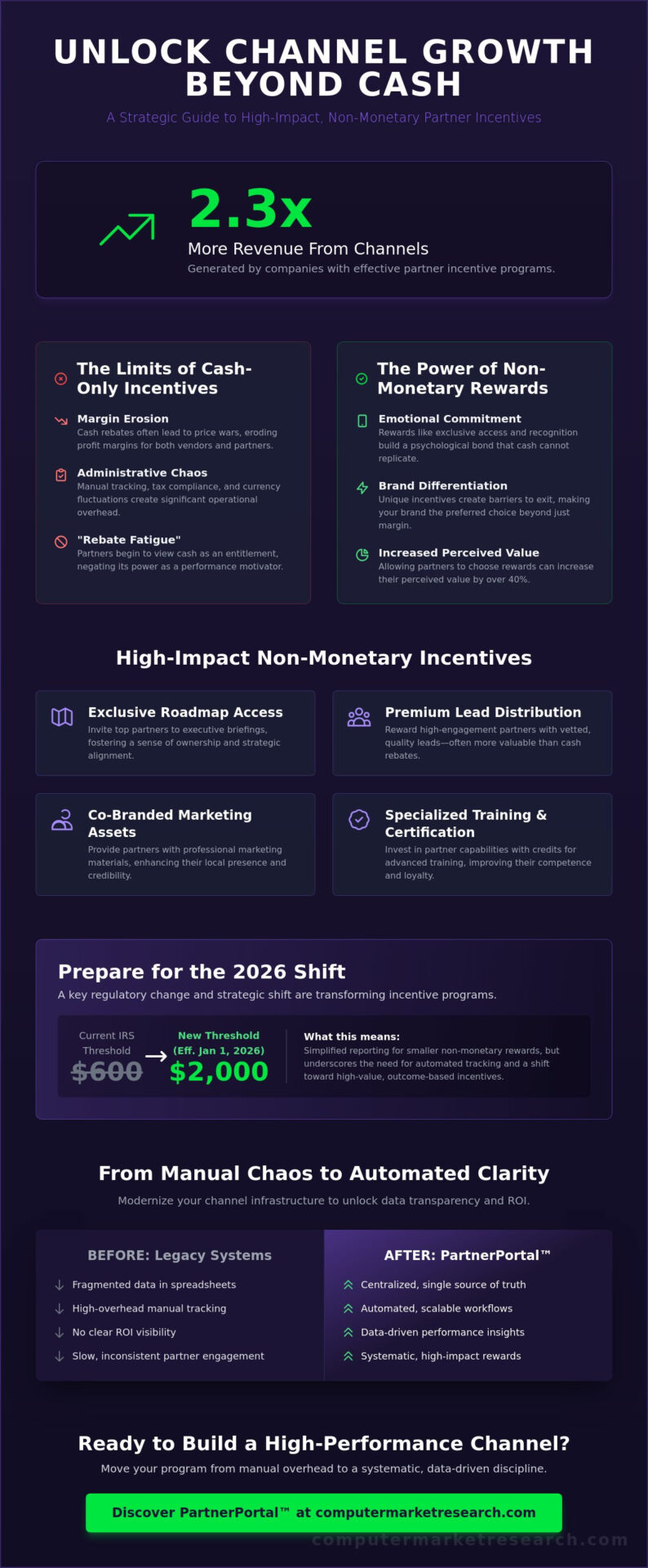
Companies with effective partner incentive programs generate 2.3 times more revenue from their channel than those without, yet many organizations still rely on eroding margins to buy loyalty. You likely recognize that cash rebates are becoming prohibitively expensive and often fail to build long-term commitment. Managing non-monetary incentives for channel partners often feels like a trade-off between partner engagement and administrative chaos. It’s frustrating to track ROI when your data is fragmented across manual spreadsheets and legacy systems. This strategic guide shows you how to capture partner mindshare using high-impact rewards that go beyond simple cash payouts.
We’ll examine the 2026 shift toward outcome-based incentives and the impact of the new $2,000 IRS reporting threshold for non-monetary rewards. You’ll discover how to transition from transactional relationships to a model built on verified partner achievements. We’ll also preview how modern infrastructure like PartnerPortal™ automates these complex workflows to ensure scalability and data transparency. This approach moves your program away from manual overhead and toward a systematic, data-driven discipline that rewards performance without sacrificing your bottom line.
Key Takeaways
- Learn why non-monetary incentives for channel partners outperform traditional rebates by building emotional commitment and long-term brand preference.
- Identify high-impact rewards, such as exclusive roadmap access and co-branded marketing assets, that prioritize partner growth over simple transactions.
- Discover how to segment your incentives based on partner personas to ensure rewards resonate with both firm-level owners and individual sales reps.
- Establish measurable KPIs and automated workflows to eliminate the manual overhead typically associated with tracking non-cash programs.
- Modernize your channel infrastructure by centralizing all reward types within a single system to improve data transparency and ROI visibility.
Beyond Cash: Why Non-Monetary Incentives Drive Channel Loyalty
Companies with effective partner incentive programs generate 2.3 times more revenue from their channel than those without. This performance gap highlights a critical shift in how successful vendors manage their ecosystems. Traditional cash-based models often lead to “rebate fatigue,” where partners view financial incentives as a standard component of their margin rather than a motivator for growth. By integrating non-monetary incentives for channel partners, you move beyond transactional interactions and start building genuine mindshare.
This short video explains the fundamental shift toward value-based partner rewards:
Staying top-of-mind requires more than just a competitive commission. It demands a strategy that offers status, specialized access, and professional development. These rewards create a psychological bond that cash simply cannot replicate. When you provide a partner with exclusive roadmap access or executive briefings, you’re investing in their long-term capability. This approach stabilizes your ecosystem by ensuring your brand is the preferred choice even when competitors attempt to buy loyalty with higher percentages.
The Hidden Costs of Purely Monetary Programs
Relying exclusively on cash incentives creates several operational bottlenecks. First, it often triggers margin erosion as partners use rebates to lower end-user prices, sparking destructive price wars. Second, these incentives frequently fall into the “expected bonus” trap. Partners begin to view them as entitlements, which negates their effectiveness as a performance driver. There is also the burden of administrative complexity. Managing cross-border currency fluctuations and tax compliance adds significant overhead. Effective January 1, 2026, the information reporting threshold for non-monetary incentives has increased from $600 to $2,000 for Forms 1099-NEC and 1099-MISC. While this simplifies reporting for smaller rewards, manual tracking remains a primary obstacle to growth.
Strategic Advantages of Non-Cash Rewards
Shifting to non-cash rewards allows you to differentiate your brand in a crowded partner relationship management landscape. These incentives allow you to create barriers to exit by embedding your brand into the partner’s operational DNA. For instance, providing specialized training or certification credits aligns partner behavior with high-value activities that improve their technical competence. Research shows that letting partners choose their reward type can increase the perceived value of the reward by over 40%. By managing these through a centralized partner portal, you ensure data transparency and workflow refinement. This flexibility ensures your program remains relevant across diverse global markets without the constant pressure to increase cash payouts.
5 High-Impact Non-Monetary Incentives for Channel Partners
- Exclusive Roadmap Access: Inviting top-tier partners to executive briefings and product roadmap discussions fosters a sense of ownership. When partners understand your long-term vision, they can align their own business strategies accordingly.
- Premium Lead Distribution: High-quality, vetted leads are often more valuable than a percentage-based rebate. Prioritizing partners who demonstrate high engagement ensures that your best opportunities are handled by your most capable representatives.
- Market Intelligence and Benchmarking: Providing access to specialized data helps partners understand their performance relative to the broader market. Benchmarking reports allow them to identify specific areas for improvement, such as closing rates or product mix optimization.
- Co-branded Marketing Assets: Professional marketing support reduces the partner’s administrative burden. By offering high-quality, customizable collateral, you ensure brand consistency while helping partners accelerate their own lead generation efforts.
- VIP Support Tiers: Access to dedicated channel account managers or priority technical support reduces friction. Eliminating operational bottlenecks allows partners to serve their customers more effectively, which reinforces your brand as their preferred vendor.
To optimize how you manage these diverse rewards, you can partner smarter by modernizing your tracking systems and eliminating manual data entry.
Enablement as a Reward: Training and Certification
Enablement functions as a high-value reward when structured correctly. You can build partner capability through specialized “Learn and Earn” modules that reward technical mastery with increased visibility. Many organizations now use market development funds to subsidize these education tracks. This ensures that partners have the skills required to sell complex solutions. A certified partner workforce is a long-term asset for any manufacturer, as it directly correlates with higher customer satisfaction and lower support costs.
Recognition and Status-Based Incentives
Recognition remains a powerful psychological driver. Program benefits like advisory board seats or “Partner of the Year” awards signal exclusivity and competence to the broader market. When you publicize these success stories, you drive mutual brand equity. Tiered status levels provide a clear path for growth. This encourages partners to invest more deeply in your ecosystem to reach the next level of support and visibility. These status-based rewards create a sense of prestige that financial rebates alone cannot achieve.
Strategic Alignment: Matching Rewards to Partner Personas
Effective management of non-monetary incentives for channel partners requires a granular understanding of the diverse motivations within your ecosystem. A common operational error is treating the partner organization as a monolithic entity. In reality, the incentives that drive a firm’s principal are often entirely different from those that motivate a frontline sales representative. Aligning your channel incentive programs with specific personas ensures that rewards are relevant, impactful, and data-driven.
Volume-based resellers typically prioritize rewards that increase their operational efficiency and lead flow. They value market intelligence and co-branded assets that accelerate their sales cycle. Conversely, specialized value-added partners often seek technical enablement and roadmap influence. These partners invest heavily in expertise; therefore, they value rewards that reinforce their status as subject matter experts. You must also consider the “Reward Lifecycle.” Early-stage partners require heavy enablement and training, while mature partners demand strategic recognition and advisory roles to maintain their commitment.
Incentivizing the Partner Principal vs. the Sales Rep
Firm-level rewards focus on the health and growth of the partner’s business. These include co-op funds, market access, and premium lead distribution. These assets help the partner principal scale their operations and improve their bottom line. Rep-level rewards, however, should target individual professional development and recognition. Training certifications and public accolades build the rep’s personal brand and technical mastery. It’s critical to balance these rewards to avoid conflict. If a rep is motivated to sell a specific product for personal recognition while the principal’s goals are focused elsewhere, it creates friction that undermines the partnership.
Vertical-Specific Incentive Strategies
Tailoring your approach to specific industries prevents your program from becoming generic and ineffective. Technical partners in high-compliance sectors may value lab access or early software builds more than marketing support. Retail-focused partners might prioritize inventory management insights or POS data transparency. Utilizing robust channel data management allows you to identify these preferences through behavioral analysis. By tracking which rewards are most frequently claimed by different verticals, you can develop a persona-based incentive matrix. This systematic approach ensures that every non-monetary reward serves a documented business purpose and drives measurable partner engagement.
How to Implement and Track Non-Monetary Incentive Programs
Operationalizing non-monetary incentives for channel partners requires a shift from manual tracking to a systematic, data-driven workflow. Without a clear structure, high-impact rewards often lose their motivational value due to administrative friction. You must define specific, measurable KPIs for every “earning” action, such as completing a certification module or submitting a verified lead. Integrating these actions directly with deal registration data ensures that rewards are tied to actual pipeline activity rather than just administrative tasks.
Transparency is essential for maintaining partner trust. Program rules should be clearly documented within your portal to prevent frustration regarding eligibility or reward timing. Modern systems are moving toward a “claimless” model where achievements are automatically logged and rewarded. This eliminates the need for partners to submit manual proof of performance. Regular audits are also necessary to ensure that your incentive spend aligns with current corporate objectives and continues to drive the desired ROI.
The Role of Automation in Incentive Management
Relying on manual spreadsheets to track non-cash points is a primary obstacle to growth. Automation allows you to replace fragmented information with real-time dashboards that show partners exactly where they stand in their reward journey. These digital interfaces provide the confidence that partners value, knowing their efforts are being accurately recorded. Automated fulfillment of digital rewards, such as access keys for specialized software or training credits, ensures instant gratification. This immediate feedback loop reinforces positive behavior much more effectively than quarterly manual reconciliations.
Measuring the ROI of Non-Monetary Spend
Calculating the true value of non-cash rewards involves correlating participation with hard sales growth and deal volume. You can use POS data management to validate that partners receiving these incentives are actually increasing their market share or improving their product mix. Tracking partner retention rates and lifetime value (LTV) provides a clearer picture of long-term ecosystem stability. When rewards are managed as a holistic discipline rather than a series of one-off gifts, the business benefit becomes measurable. To see how these automated workflows can transform your operations, you can start your 90-day free trial and modernize your incentive tracking today.
Modernizing Incentive Management with CMR PartnerPortal™
Transitioning from a manual, spreadsheet-heavy environment to a modernized infrastructure is the final step in securing channel loyalty. Managing non-monetary incentives for channel partners alongside traditional financial rebates requires a centralized system that ensures data integrity. Fragmented information and manual errors are the primary obstacles to scaling a global program. By utilizing CMR PartnerPortal™, you consolidate all incentive types into a single, authoritative source of truth. This centralization provides the quiet confidence that your data is accurate and your partners are rewarded fairly.
Complex global programs often struggle with varying regional requirements and diverse reward structures. A unified platform simplifies these complexities by providing real-time visibility into partner performance across different territories. This transparency allows you to adjust incentives on the fly based on current market conditions or shifting corporate goals. When your incentive data is integrated with your broader channel strategy, you eliminate the operational bottlenecks that typically plague legacy systems. This systematic approach ensures that every non-monetary reward is backed by “decision-grade” data, allowing for precise financial tracking and performance auditing.
Automated Tracking for Non-Monetary Rewards
Modernizing your workflow means replacing manual tracking with configurable modules designed for specific partner achievements. Whether you’re tracking technical certifications, lead performance, or status-tier progression, automation ensures that no partner effort goes unrecorded. These systems offer seamless integration with your existing CRM and ERP architectures, creating a unified data ecosystem. This level of technical competence reduces the administrative burden on your channel team, allowing them to focus on strategic relationship building rather than data entry. Automated fulfillment also ensures that digital access keys and training credits are delivered instantly, maintaining the momentum of partner engagement; when your program includes physical items, you can explore Express Shipping from Parcel International to ensure global delivery is just as seamless.
Driving ROI Through Better Data Visibility
The ultimate business benefit of a modernized portal is the ability to turn raw channel data into actionable incentive strategies. Providing partners with a professional, branded interface for growth reinforces your position as a preferred vendor. When partners see a clear path to status-based rewards and exclusive access, their commitment to your brand increases. This transparency builds trust and encourages long-term alignment that isn’t purely transactional. High-quality information leads to better returns, ensuring that your incentive spend is always optimized for maximum impact. To transform your current approach, schedule a demo of PartnerPortal™ and discover a clear path out of operational bottlenecks.
Modernizing Your Channel Strategy for 2026
The transition from transactional rebates to value-based engagement is essential for organizations seeking sustainable growth. Commitment isn’t bought with rebates alone. By prioritizing high-impact non-monetary incentives for channel partners, you move beyond margin-eroding tactics and start building genuine loyalty. This strategy requires a disciplined approach to persona alignment and a commitment to data transparency. When rewards are treated as a holistic business discipline, the result is a more resilient and profitable ecosystem.
Computer Market Research was founded in 1984 and brings decades of specialized channel expertise to every digital integration. As a cloud-based SaaS provider trusted by Fortune 500 and Global 2000 organizations, we offer the stability required to scale complex programs globally. Accuracy drives results. Our systems eliminate the operational bottlenecks caused by manual tracking, providing a clear path toward optimized partner performance.
Optimize Your Incentives with CMR PartnerPortal™
You now have the strategic framework and the technological path to transform your channel relationships into a high-performance engine for long-term success.
Frequently Asked Questions
What are the best non-monetary incentives for channel partners?
The most effective rewards focus on professional growth and competitive advantage rather than simple gifts. High-impact options include exclusive access to product roadmaps, premium lead distribution, and advanced technical certifications. Partners also value market intelligence reports and VIP support tiers that reduce their operational friction. These assets provide unique business value that cash cannot replicate, helping to secure long-term mindshare.
How do you measure the ROI of non-monetary incentive programs?
You measure ROI by correlating reward participation with specific growth metrics like deal volume and closing rates. Effective tracking requires integrating incentive data with POS data management systems to validate behavior changes at the transaction level. Monitoring partner retention and lifetime value (LTV) helps determine if these rewards are building ecosystem stability. This data-driven approach ensures your incentive spend is an investment in performance rather than an unmanaged expense.
Can non-monetary incentives replace cash rebates entirely?
Non-monetary rewards work best as a strategic complement to cash rather than a complete replacement. While cash handles basic transactional motivation, non-monetary incentives for channel partners drive professional alignment and brand preference. Balancing both ensures you remain competitive on margins while building the emotional commitment required for long-term loyalty. A hybrid model prevents rebate fatigue and differentiates your program in a crowded market.
What is the biggest challenge in managing non-cash rewards?
Administrative overhead and manual tracking errors are the primary obstacles for most organizations. Tracking diverse rewards like training credits or advisory board seats across global territories often leads to fragmented information and partner frustration. Modernizing your infrastructure with an automated platform is the only logical step to ensure data transparency and scalability. Without automation, the complexity of managing diverse reward types often outweighs the business benefit.
How does a Partner Portal help with non-monetary incentives?
A Partner Portal centralizes the “earn-and-claim” workflow, allowing partners to track their progress through real-time dashboards. It automates the fulfillment of digital rewards and ensures that data integrity is maintained for auditing purposes. This systematic approach reduces manual administrative tasks by providing a professional, branded interface for all partner interactions. It creates a sense of order and competence that builds trust with your most valued partners.
Are non-monetary incentives taxable for channel partners?
Yes, non-monetary rewards are generally considered taxable income by the IRS. Effective January 1, 2026, the information reporting threshold for these incentives has increased from $600 to $2,000 for Forms 1099-NEC and 1099-MISC. This change simplifies compliance for smaller rewards, though organizations must still track cumulative values accurately. You should always consult with a tax professional to ensure your specific program meets current regulatory requirements.
How often should I update my channel partner incentive program?
You should conduct a comprehensive review of your program at least annually to ensure alignment with shifting market conditions. Analyzing participation data through your portal helps identify which non-monetary incentives for channel partners are losing impact or relevance. Frequent updates based on real-time performance data allow you to pivot strategies before partner engagement begins to decline. This keeps your program fresh and maintains your position as a preferred vendor.

Article by
Del Heles
Del Heles is the founder and CEO of Computer Market Research (CMR), a channel management software company he launched in 1984. With more than 40 years of experience, he’s known for helping manufacturers and distributors simplify complex partner programs through practical, customer-focused technology solutions.