

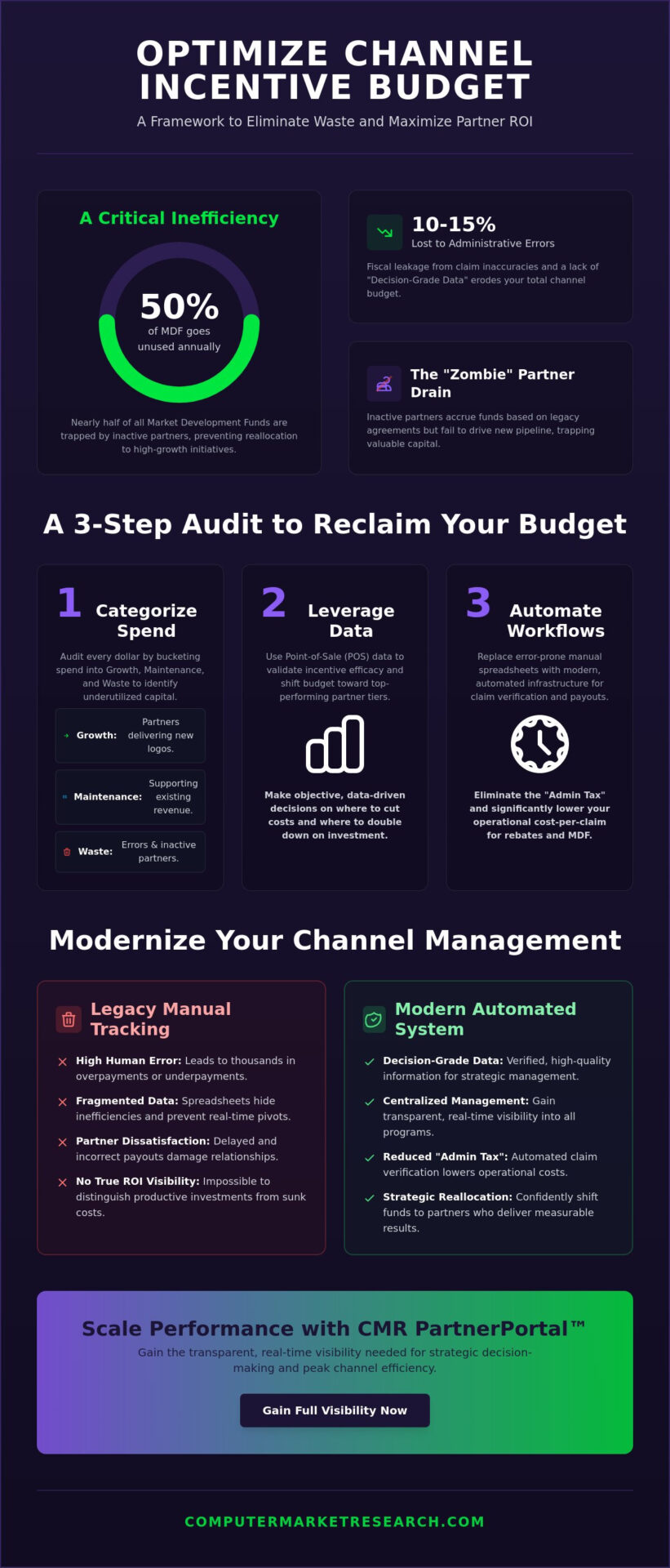
Did you know that nearly 50% of available Market Development Funds (MDF) go unused every single year? This statistic underscores a widespread inefficiency in B2B channel management that prevents many organizations from reaching their true growth potential. When your budget is tied up by “zombie” partners who don’t sell, optimizing your channel incentive budget becomes more than a marketing goal; it’s a technical necessity for maintaining a competitive edge. You likely recognize the frustration of dealing with manual claim errors and fragmented data that obscure your true return on investment.
This article provides a disciplined framework to move your organization away from legacy processes and toward a high-performance model. Efficiency is no longer optional. We will show you how to identify budget leaks, reallocate funds to your most productive partners, and automate your Rebates & Incentives for peak efficiency. By following this structured approach to Co-op/MDF Management, you can significantly reduce administrative overhead and drive a measurable increase in partner-led revenue.
Key Takeaways
- Categorize your current spend into Growth, Maintenance, and Waste buckets to pinpoint where your capital is being underutilized.
- Leverage POS data to validate incentive efficacy and shift budget toward partner tiers that consistently deliver measurable results.
- Implement a systematic approach to optimizing your channel incentive budget by replacing error-prone manual tracking with modern, automated infrastructure.
- Eliminate the “Admin Tax” by automating claim verification, which significantly lowers your operational cost-per-claim for rebates and MDF.
- Utilize CMR PartnerPortal™ and its Managed Data Services to gain the transparent, real-time visibility needed for strategic decision-making.
The Reality of Channel Incentive Budget Waste in 2026
Channel incentive budget optimization isn’t merely a cost-cutting exercise; it’s a systematic reallocation of resources designed to ensure every dollar drives measurable growth. In many B2B organizations, financial transparency remains elusive, with teams often losing 10-15% of their total budget to administrative errors and claim inaccuracies. This fiscal leakage typically stems from a lack of “Decision-Grade Data,” which is the verified, high-quality information required to move beyond guesswork and into strategic management. Without this foundation, you can’t accurately distinguish between productive investments and sunk costs.
To better understand the impact of tracking ROI on your channel spend, watch this helpful video:
When you’re optimizing your channel incentive budget, you must confront the drain caused by “zombie” partners. These are entities that accrue funds based on historical volume or legacy agreements but fail to execute active marketing campaigns or drive new pipeline. Research indicates that nearly 50% of available Market Development Funds (MDF) go unused each year, often because they’re tied up by these inactive partners. This stagnation traps capital that could be better utilized by high-performing partners who are ready to scale. Modernizing your approach requires identifying these bottlenecks and reclaiming that budget for high-growth initiatives.
Identifying Common Budget Leaks
Budget leaks often manifest as overpayments triggered by inaccurate POS data reporting. When sales data isn’t normalized, vendors frequently pay out rebates on returns or transactions that don’t meet program criteria. Additionally, unclaimed MDF funds create significant accounting “cliff” risks, where unspent capital must be reconciled at the end of a fiscal period, disrupting long-term financial planning. Redundant incentive programs also pose a threat, as they frequently reward partners for sales they would have completed without any additional financial motivation.
The Impact of Legacy Manual Tracking
Relying on manual spreadsheets is a primary obstacle to modern channel growth. These static documents hide inefficiencies and prevent teams from making real-time pivots when market conditions shift. The human error inherent in manual rebate calculations can lead to thousands of dollars in overpayments or, conversely, partner dissatisfaction due to delayed or incorrect payouts. To transition toward a more efficient model, business leaders should focus on Maximizing Channel ROI through automated validation and centralized data management. This shift ensures that your infrastructure supports your strategy rather than hindering it.
Step-by-Step Audit of Your MDF and Rebate Spending
A rigorous audit is the only reliable method for optimizing your channel incentive budget. This process requires a comprehensive review of all active programs to ensure capital is flowing toward high-yield activities. You should begin by categorizing every dollar of spend into three distinct buckets: Growth, Maintenance, and Waste. Growth funds represent investments in partners who consistently deliver new logos; Maintenance funds support steady, existing revenue streams; and Waste accounts for the 10-15% of budget typically lost to errors or inactive partners. According to recent industry data, 24% of organizations do not know where their MDF was spent, making this categorization a critical first step for financial accountability.
Setting clear benchmarks is essential to distinguish between high-performers and underperforming incentives. Analyze the participation rate of each fund against its actual conversion rate. If a program has high participation but fails to generate a proportionate lead-to-opportunity ratio, it’s likely an “underperforming” asset. Establishing these metrics allows you to make objective decisions about where to cut costs and where to double down on investment.
Auditing Market Development Funds (MDF)
Effective MDF auditing requires evaluating the lead-to-opportunity ratio for all partner-led marketing initiatives. Beyond financial tracking, you must verify compliance to ensure funds are used strictly for approved branding and lead-generation activities. Utilizing automated co-op/MDF management systems ensures that every claim is validated against your specific program guidelines. For a deeper look at aligning these funds with your broader corporate goals, consult our MDF Strategic Guide.
Evaluating Volume Rebates and SPIFFs
Rebates only provide value if they drive incremental volume. You must determine if these incentives are changing partner behavior or simply rewarding sales that would have occurred regardless. Additionally, assess the “shelf-life” of your SPIFFs. These short-term incentives often lose effectiveness over time as they become viewed as expected compensation rather than a performance motivator. Watch for “gaming” behaviors, such as partners manipulating order timing to hit specific rebate tiers without actually increasing total market share. If you’re ready to modernize your tracking methods, you can explore a data-driven trial to see how automation clarifies these performance metrics.
Data-Driven Strategies for Incentive Reallocation
Once you’ve completed a thorough audit of your current spend, the next phase in optimizing your channel incentive budget involves implementing “Dynamic Reallocation.” Traditionally, channel teams set budgets annually, but this static approach fails to account for shifting market demands or sudden partner performance spikes. By moving funds in-quarter, you can pivot resources toward emerging opportunities as they happen. This agility is particularly effective when targeting “High-Potential, Low-Engagement” partners. These are entities with the infrastructure to sell your products but who haven’t yet committed fully to your brand. Reallocating funds to provide them with specialized incentives can yield a higher marginal return than increasing spend on partners who have already reached their saturation point.
The Role of POS and Inventory Visibility
Maintaining visibility into regional stock levels is vital for ensuring incentive efficacy. Real-time inventory data prevents the common mistake of over-incentivizing products that are already overstocked in the channel, which often leads to unnecessary price erosion. By utilizing specialized channel sales management software, you can cross-reference POS data with your incentive payouts. This process verifies that rebates are reaching the intended end-users rather than being absorbed as margin by the partner. This level of transparency ensures that every dollar spent on Rebates & Incentives is directly linked to a verified transaction, eliminating the guesswork that often plagues manual tracking systems.
Segmenting Partners by Performance ROI
Efficiency in the channel typically follows the 80/20 rule, where the top 20% of your partners generate 80% of your revenue. While these high-performers deserve priority, a data-driven strategy also focuses on creating “Incentive Pathways” for mid-tier partners. These pathways provide a structured route for partners to earn higher incentive rates by demonstrating specific growth behaviors, such as completing certifications or hitting volume milestones. To measure success, you must track Partner ROI, which is defined as the ratio of incentive spend to net revenue generated by that specific partner. Focusing on this metric allows you to stop subsidizing underperformers and start scaling the relationships that provide the best financial return. This systematic reallocation transforms your budget from a fixed cost into a flexible engine for growth.
Modernizing Workflows to Reduce Administrative Costs
The “Admin Tax” is an often invisible drain on corporate resources. It represents the collective hours your operations team spends manually verifying claims, cross-referencing spreadsheets, and correcting human errors. This administrative burden is a primary obstacle to optimizing your channel incentive budget, as it forces high-value employees to act as data entry clerks rather than strategic analysts. When your team is bogged down in reactive processing, they lack the bandwidth to identify the performance trends or budget leaks that compromise your ROI.
Shifting to automated workflows significantly reduces the cost-per-claim for both rebates and MDF. Automation doesn’t just save time; it improves the Partner Experience (PX). Partners who receive faster, more accurate payouts are more likely to prioritize your brand over competitors who struggle with manual delays. By 2026, 62% of companies with annual recurring revenue exceeding $25 million have adopted platform-based management to stay competitive. This transition allows your organization to move from reactive claim processing to proactive program management, where data informs every decision.
Eliminating Manual Claim Verification
Manual verification is inherently flawed and prone to disputes. Automated validation rules act as a first line of defense, preventing fraudulent or duplicate claims from ever entering the system. This precision reduces the friction between vendors and partners, shortening the dispute cycle from weeks to hours. For example, specialized ship and debit management software ensures that price protection claims are validated against real-time sales data automatically. This level of accuracy protects your margins while maintaining partner trust through consistent, error-free payouts.
Centralizing Incentives in a Single Portal
“Portal Fatigue” is a significant threat to partner engagement. If a partner must navigate multiple disconnected systems to register a deal, claim MDF, or check a rebate status, they’ll often abandon the process entirely. Centralization is the only effective solution. A single hub like PartnerPortal™ provides a unified login for all incentive activities, ensuring higher budget uptake. Real-time dashboards allow both vendors and partners to track budget availability and performance metrics simultaneously. To see how these automated workflows can transform your operations, you can start a 90-day free trial today. This modernization ensures your infrastructure finally supports your strategic goals.
Scaling Performance with CMR PartnerPortal™
CMR PartnerPortal™ serves as the central nervous system for your channel strategy. It provides the granular visibility required for optimizing your channel incentive budget by consolidating fragmented data into a single, actionable view. While previous sections of this guide highlighted the strategic need for audits and reallocation, this platform provides the actual infrastructure to execute those changes. It acts as the definitive bridge between raw, unorganized information and a high-performance, optimized spend model. By centralizing your operations, you eliminate the data silos that typically lead to budget waste and administrative friction.
Dirty data remains a primary obstacle to achieving a high ROI. CMR’s Managed Data Services resolve this challenge by cleaning and normalizing POS data automatically before it enters your workflow. This ensures that your Rebates & Incentives are always calculated based on accurate, verified transactions rather than flawed or duplicate partner reports. The modular nature of the CMR platform allows your organization to address immediate needs first. You can start by modernizing your Co-op/MDF Management and then seamlessly scale into more complex areas like Ship & Debit or Lead Management as your ecosystem matures.
Automated ROI Tracking and Reporting
The platform generates real-time reports on fund utilization, allowing you to see exactly where every dollar is allocated at any given moment. Predictive insights further enhance your control by identifying which programs are likely to overspend or underperform before they impact your quarterly results. The “One-Click Audit” capability allows you to generate comprehensive compliance and performance reports instantly, saving your team days of manual reconciliation. This transition from manual tracking to automated reporting ensures that your financial data is always audit-ready and strategically relevant.
A Strategic Partnership for Global Growth
CMR brings decades of experience supporting Fortune 500 and Global 2000 companies in managing complex, multi-tiered channel structures. Our cloud-based SaaS model is specifically designed to handle the scale of global partner ecosystems, ensuring that your incentive programs remain consistent and accessible across different regions and currencies. This modernization is the final step in moving away from the obsolescence of legacy manual tracking and toward a future of technical precision. You can optimize your channel spend today with CMR to secure a measurable path toward increased partner-led revenue and operational stability.
Securing a High-Performance Channel Future
The transition from legacy manual tracking to automated infrastructure is no longer a luxury for B2B organizations. By identifying budget leaks through rigorous audits and utilizing real-time POS data for dynamic reallocation, you can ensure that every dollar of your Rebates & Incentives spend drives incremental growth. Modernizing your workflows eliminates the hidden costs of human error and allows your team to focus on strategic partner management rather than repetitive claim verification. These steps transform your incentive programs from a fixed expense into a scalable engine for market expansion.
As you move toward optimizing your channel incentive budget, technical precision is the only path to sustainable ROI. Computer Market Research (CMR) provides the stability and accuracy required for this transition, backed by 40+ years of channel management expertise. Trusted by Fortune 500 companies, our cloud-based automation is built to handle the complexities of global partner ecosystems. You don’t have to navigate these operational bottlenecks alone. Our systematic approach provides the clarity needed to reward performance accurately and consistently.
Request a Demo of CMR PartnerPortal™ to see how our specialized platform can stabilize your data and accelerate your partner-led revenue.
Frequently Asked Questions
How do I calculate the ROI of my channel incentive budget?
You calculate ROI by dividing the net revenue generated by a specific partner or program by the total incentive spend allocated to it. This metric, often referred to as Partner ROI, allows you to compare the efficiency of different incentive models across your entire ecosystem. By tracking this ratio continuously, you can identify which programs are high-yield and which are merely draining resources without contributing to your bottom line.
What is the most common reason for channel budget waste?
The most common cause of waste is the lack of visibility into fund utilization, which leads to nearly 50% of available MDF going unused each year. This stagnation often happens because funds are tied up by “zombie” partners who accrue budget but never execute active campaigns. Without a systematic way of optimizing your channel incentive budget, these funds remain stagnant instead of being reallocated to high-performers who can drive immediate results.
How can automation reduce the administrative cost of incentives?
Automation reduces administrative overhead by implementing validation rules that process claims without human intervention. This shift significantly lowers the cost-per-claim and eliminates the “Admin Tax” associated with manual data entry and spreadsheet reconciliation. By automating your Rebates & Incentives, you also reduce the dispute cycle time, as partners receive accurate, data-backed payouts faster than they would through manual workflows.
Can I optimize my budget without real-time POS data?
Optimizing your budget without real-time POS data is highly ineffective because you lack the verification needed to prevent overpayments. POS data serves as the single source of truth for validating that a sale actually occurred before an incentive is paid. Without this visibility, you risk rewarding transactions that don’t meet program criteria or over-incentivizing products that are already overstocked in the channel, leading to unnecessary margin erosion.
What is the difference between MDF and Co-op funds in budget planning?
MDF is typically a discretionary, front-end fund used for strategic market development, while Co-op funds are earned by partners based on their historical purchase volume. In budget planning, you should prioritize MDF for high-growth opportunities and new market entry where you need to stimulate demand. Co-op funds are better suited for maintaining established revenue streams and rewarding long-term partner loyalty through predictable, volume-based rebates.
How often should I audit my channel partner incentives?
You should audit your channel partner incentives at least once per quarter to allow for the dynamic reallocation of funds. While an annual review is necessary for broad strategy, quarterly audits help you identify underperforming funds before they impact your yearly ROI. This frequent cadence ensures your budget remains agile and responsive to shifting market conditions or sudden spikes in partner performance that require immediate capital.
What are the risks of manual rebate management in 2026?
Manual rebate management carries high risks of financial leakage and partner churn, which averages 23% annually for B2B companies. Spreadsheet-based tracking is prone to calculation errors that lead to significant overpayments or delayed payouts that frustrate your most productive partners. These legacy processes create a lack of transparency that makes it impossible to pivot your strategy based on accurate, real-time performance data.
How does a Partner Portal help with budget transparency?
A Partner Portal provides a centralized hub where both vendors and partners can view real-time budget availability and claim statuses. Systems like PartnerPortal™ use dashboards to display fund utilization and performance metrics, ensuring both parties are aligned on financial goals. This transparency builds trust and encourages partners to use their allocated funds more effectively, as they can see exactly how their sales actions impact their incentive earnings.

Article by
Del Heles
Del Heles is the founder and CEO of Computer Market Research (CMR), a channel management software company he launched in 1984. With more than 40 years of experience, he’s known for helping manufacturers and distributors simplify complex partner programs through practical, customer-focused technology solutions.