

Recent data from Digital Applied indicates that deals involving a partner overlay now achieve a 3.6 times higher win rate than direct sales. Yet, many organizations fail to capitalize on this because their legacy processes create unnecessary hurdles for their collaborators. If you want to understand how to become a partner of choice in 2026, you must look beyond traditional relationship management. The most successful vendors are those who prioritize operational transparency and ease of use over the fragmented, manual systems that currently dominate the industry.
You’re likely aware that high administrative burdens and lack of clarity in incentive payouts are the primary drivers of partner churn. These friction points erode trust and push your most valuable allies toward competitors with more efficient systems. This article provides a clear path to transforming your channel operations into a high performance ecosystem. We’ll examine how automating your PartnerPortal™ and refining your Rebates & Incentives programs can help you secure a larger share of partner mindshare while eliminating the lead management bottlenecks that hinder growth.
Key Takeaways
- Transition from a transactional vendor to a strategic ally by prioritizing ease of business and operational reliability.
- Learn how to become a partner of choice by auditing your current partner experience to identify and eliminate administrative bottlenecks.
- Centralize your channel ecosystem within a branded PartnerPortal™ to replace manual spreadsheets with automated, real-time data management.
- Accelerate trust and mindshare by automating Rebates & Incentives and Co-op/MDF Management for total financial transparency.
- Optimize your infrastructure to support the shift toward outcome-based programs and high-performance, service-led partner relationships.
Defining the Partner of Choice in Modern Channel Ecosystems
A Partner of Choice (PoC) is the vendor that channel partners prioritize not because of the lowest price, but because of the lowest friction. In 2026, partners are managing more vendors than ever; they naturally gravitate toward those who simplify their daily operations. Understanding how to become a partner of choice requires a shift from viewing partners as simple resellers to viewing them as integral components of your extended enterprise. This status isn’t granted by a contract; it’s earned through consistent operational excellence and a commitment to removing the barriers that prevent partners from selling effectively.
The distinction between a transactional vendor and a strategic partner is stark. Transactional relationships focus on volume and discounts; they are easily replaced. Strategic partners focus on mutual growth through strategic alliances that leverage shared data and specialized expertise. This shift is driven by the need for mindshare, which is the limited mental and operational bandwidth a partner allocates to a specific brand. If your administrative processes are cumbersome, you lose that mindshare to competitors who offer a smoother experience. Being the easiest vendor to do business with is now a primary competitive advantage.
To better understand this concept, watch this helpful video:
The Evolution of Strategic Partnering
The transition to SaaS and cloud models has fundamentally altered partner expectations. In the past, loyalty was often built on long-standing personal relationships. Today, that has been replaced by data-driven collaboration. Partners in 2026 value vendors who provide real-time visibility into their performance and inventory. This evolution means that ecosystem health depends on mutual investment in technology rather than just occasional sales incentives. Modern partners expect a centralized digital environment, such as a PartnerPortal™, to manage their business effectively.
Rational vs. Emotional Elements of Choice
Choice isn’t purely logical, but it starts with rational factors. A partner won’t commit to your brand if the math doesn’t work. Rational elements include clear profitability, speed of technical support, and the accuracy of incentive payouts. These are the table stakes. Once these operational foundations are secure, emotional elements like brand alignment and perceived reliability come into play. Trust is built when a vendor consistently delivers on its promises through automated, error-free systems. You can’t scale a relationship on good vibes alone if your manual tracking methods are failing.
Building the Operational Foundation for Strategic Alliances
Developing a “Fit for Partnering” model requires more than a cultural shift; it demands an enterprise-level infrastructure capable of supporting complex, multi-directional relationships. While many organizations treat partner status as an emotional or cultural goal, the reality is that operational readiness dictates your success. To understand how to become a partner of choice, you must first establish a technical foundation that removes manual errors and fragmented data from the equation. High-quality information is the only reliable way to build stability in a large-scale channel ecosystem.
At the center of this foundation is the PartnerPortal™. This system acts as the central nervous system for all interactions, providing a unified interface where data flows seamlessly between your organization and your partners. By integrating this portal with your existing CRM and ERP data, you create a single source of truth. This integration ensures that inventory levels, pricing, and contract terms remain consistent across all touchpoints, preventing the operational bottlenecks that typically plague manual workflows. When data transparency is prioritized, you eliminate the friction that often leads to partner frustration and churn.
Systems and Processes Over Personalities
Individual relationships often serve as the starting point for channel growth, but they rarely scale within Global 2000 environments. When a program relies on the charisma of a few account managers, it becomes vulnerable to turnover and inconsistent execution. Standardized onboarding and training protocols ensure that every partner receives the same high level of support, regardless of who manages the account. For a deeper look at these foundational structures, you can explore our resource on What is Channel Management?
Transparency as a Competitive Advantage
Data transparency is the most effective tool for building long-term partner trust. When partners have real-time visibility into lead status, payment cycles, and POS data, they can make informed decisions about where to invest their resources. Without this visibility, “shadow” channel conflict arises, as partners feel they are competing against hidden internal sales efforts or other favored collaborators. Providing instant access to performance metrics through an automated system eliminates this uncertainty and is a critical step in learning how to become a partner of choice in a crowded market. If you’re ready to modernize your infrastructure, you can start optimizing your channel data today.
Overcoming Friction: Why Manual Processes Kill Partner Trust
Manual tracking methods represent the single greatest threat to partner loyalty. While spreadsheets might seem cost-effective initially, they introduce a level of human error that undermines the entire channel ecosystem. If you want to understand how to become a partner of choice, you must recognize that partners don’t just want good margins; they want operational reliability. Slow processing for Rebates & Incentives or delayed Co-op/MDF Management approvals create financial uncertainty for your collaborators. When a partner has to wait months for a payout due to manual verification cycles, they’ll inevitably look for a more modernized vendor who prioritizes their cash flow. Cash flow matters, and for organizations looking to scale their operations while establishing better financial terms, check out The CEO Creative.
Many organizations claim to have solved this through a digital portal, yet they find adoption remains low. This is often due to UX friction; if a portal is harder to use than a spreadsheet, partners will revert to old habits. Effective Channel Data Management ensures that the information within these systems is accurate and actionable. Without decision-grade insights, partner payouts become inconsistent, leading to disputes that consume valuable account management time and erode the trust built during the onboarding phase. Complexity is the enemy.
The Hidden Cost of Administrative Burden
Top-tier partners are increasingly selective about the vendors they support. They calculate the “friction score” of every relationship, weighing the administrative burden against the potential revenue. Every hour a partner spends reconciling a lead or chasing an MDF claim is an hour they aren’t selling your products. Automation reduces this cost to serve, making your program more profitable for the partner without requiring you to lower your prices. It’s a pragmatic path toward improving your share of mindshare and wallet.
Eliminating Channel Conflict via Automation
Channel conflict is a direct result of poor visibility and slow communication. Automated deal registration prevents “double-teaming” by providing immediate feedback on lead ownership. When rules of engagement are coded into your software, they become impartial and enforceable. Conflict stops here. Additionally, using robust Ship and Debit management ensures that pricing remains fair and transparent across the board. This systematic approach to fairness is a cornerstone of how to become a partner of choice in a competitive global market.
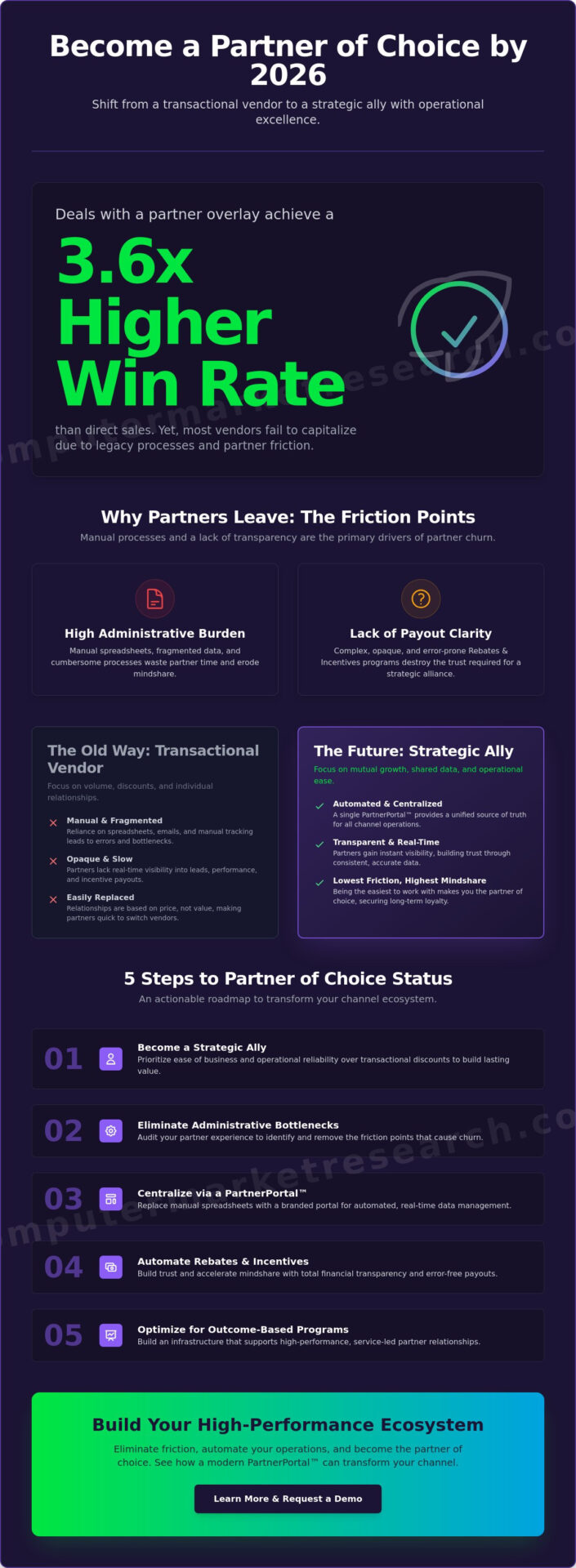
Five Steps to Achieving Partner of Choice Status in 2026
Transitioning from a transactional vendor to a strategic ally requires a methodical commitment to operational excellence. If you’re evaluating how to become a partner of choice, you must move beyond occasional incentives toward a structured framework that prioritizes partner profitability. This five-step roadmap provides a clear path to modernizing your channel infrastructure and securing long-term loyalty through data-driven performance.
- Step 1: Audit your partner journey. Identify high-friction touchpoints where manual processes cause delays. These often occur during onboarding or claim submissions.
- Step 2: Centralize all interactions. Move away from fragmented email chains by consolidating all partner resources into a single, branded PartnerPortal™.
- Step 3: Automate financial incentives. Streamline the administration of Market Development Funds to ensure partners aren’t bankrolling your marketing efforts while waiting for reimbursement.
- Step 4: Implement real-time data sharing. Provide partners with immediate visibility into POS and inventory data to help them manage stock levels and capitalize on local market demand.
- Step 5: Reward performance with clear KPIs. Use objective metrics such as Partner Contribution Margin and lead-to-close ratios to reward partners who deliver strategic value rather than just high volume.
Excellence in Onboarding and Enablement
Reducing the “time to first deal” is a critical metric for any growing channel program. Automated training paths ensure that new partners gain the knowledge they need without overwhelming your internal support teams. By providing “just-in-time” marketing assets through Through Channel Marketing Automation, you allow partners to launch campaigns quickly and accurately. Enablement is the strategic removal of barriers to sales. When you simplify the path to revenue, you naturally become the preferred vendor for high-performing agencies and distributors.
Incentivizing the Right Partner Behaviors
Modern channel programs are moving beyond simple volume-based rebates to “behavioral” incentives that drive strategic alignment. You can use specialized Channel Incentive Programs to reward activities like technical certifications, customer success milestones, or new market penetration. Payout predictability is a vital component of this strategy; when a partner knows exactly when and how they’ll be paid, their trust in your organization increases. If you’re ready to eliminate the uncertainty of manual incentive tracking, you can claim your 90-day free trial to begin automating your financial workflows.
Leveraging PartnerPortal™ to Scale Your Strategic Value
The transition from a manual channel program to a high-performance ecosystem depends on the infrastructure you provide to your collaborators. While previous sections identified the theoretical requirements, the actual execution of how to become a partner of choice relies on a centralized SaaS environment. Computer Market Research (CMR) provides a platform specifically engineered to eliminate the operational bottlenecks that drive partner churn. By consolidating fragmented data streams into a unified interface, you replace the chaos of spreadsheets with a disciplined, scalable workflow. This shift ensures that your organization remains the preferred vendor for partners who value precision and reliability.
A centralized platform does more than just organize documents; it serves as a single source of truth for the entire relationship. When you integrate onboarding, MDF management, and rebate tracking into one environment, you provide the stability that Global 2000 companies require. Customizing this portal to reflect your brand’s unique identity reinforces your status as a sophisticated partner. It signals to your channel that you’ve invested in their success by providing the tools they need to operate without friction. High-quality information becomes the bedrock of your strategic value.
Automating the Partner Journey from Lead to Rebate
The partner experience within the PartnerPortal™ is designed to be intuitive and outcome-focused. Automated deal registration is a critical feature; it protects partner margins by providing instant lead protection and preventing internal sales conflict. This transparency builds the long-term loyalty necessary for sustained growth. For busy marketing teams, the platform offers “one-click” MDF claims, which significantly reduces the time spent on administrative tasks. When you simplify these financial interactions, you remove the most common barriers to a productive partnership.
Real-Time Performance Tracking and Analytics
Secure Your Status as a Partner of Choice
The path to channel leadership in 2026 is paved with operational reliability. We’ve explored how shifting from manual spreadsheets to automated systems eliminates the friction that drives your best partners away. By centralizing your workflows and providing real-time transparency into financial incentives, you move beyond transactional interactions. You build a strategic ecosystem that thrives on accuracy and speed. Modern partners don’t just want a vendor; they want a stable platform for growth.
Learning how to become a partner of choice requires a commitment to infrastructure modernization. Computer Market Research has already automated over 500 Global 2000 channel programs, providing real-time visibility into more than $10 billion in channel revenue. Our systems eliminate 90% of manual data cleansing, allowing your operations team to focus on strategic growth rather than administrative recovery. It’s time to replace legacy obstacles with a high-performance infrastructure that respects your partners’ time and professional focus.
Ready to become a Partner of Choice? Explore PartnerPortal™ today.
The future of your channel is data-driven. You have the tools to build a high-trust, high-performance ecosystem that attracts and retains the industry’s most valuable partners.
Frequently Asked Questions
What does ‘Partner of Choice’ mean in a B2B channel context?
It refers to the vendor that channel partners prioritize above all others because of operational reliability and ease of business. While price and product are always factors, a Partner of Choice is defined by the lack of friction in their daily interactions. Partners allocate more mindshare and resources to these vendors because they provide a predictable, automated environment that minimizes administrative burden and maximizes sales efficiency.
How can I measure if I am a partner of choice for my resellers?
You can measure this status by analyzing partner mindshare and wallet share alongside specific operational metrics. Key indicators include the percentage of a partner’s total revenue generated by your products and the speed at which they respond to your lead management system. High retention rates and frequent use of your PartnerPortal™ also signal that you’ve achieved this status. If partners are proactively registering deals, you’re likely their preferred collaborator.
Does a partner portal really improve partner loyalty?
A well-implemented PartnerPortal™ improves loyalty by centralizing resources and reducing the time partners spend on manual administrative tasks. Loyalty in the modern channel is often a byproduct of efficiency. When a portal provides instant access to Deal Registration and inventory data, it eliminates the frustrations that typically lead to partner churn. However, the portal must be intuitive; a complex system with poor UX can actually damage trust.
What are the biggest barriers to becoming a partner of choice?
The primary barriers are manual processes and a lack of data transparency. Spreadsheets and fragmented email chains create operational bottlenecks that frustrate top-tier partners. If your Rebates & Incentives processing is slow or your lead management is opaque, partners will perceive you as difficult to work with. These friction points act as a tax on the relationship, eventually driving partners toward competitors with more modernized, automated infrastructure.
How does automating MDF help me become a partner of choice?
Automating Co-op/MDF Management helps you understand how to become a partner of choice by ensuring partners receive reimbursements quickly and accurately. Manual MDF approvals often lead to long payment cycles that strain a partner’s cash flow. By using an automated system, you provide financial predictability and demonstrate that you value the partner’s marketing efforts. This transparency builds the high-trust foundation necessary for a long-term strategic alliance.
Is it possible to be a partner of choice while having channel conflict?
Channel conflict is inevitable in complex ecosystems, but your status depends on how you resolve it. Clear, software-enforced rules of engagement are essential for maintaining trust during disputes. When you use automated Deal Registration to protect partner margins fairly, you show that your program values integrity over short-term internal gains. Consistent, data-driven conflict resolution prevents minor issues from eroding the overall relationship and keeps you as the preferred vendor.
How long does it take to see ROI from becoming a partner of choice?
Operational ROI is often visible within the first few months as manual errors and administrative costs decrease. Revenue-based ROI typically follows as partners shift more of their mindshare toward your brand. As you implement automated systems like POS Data Management, you’ll see improved inventory turnover and more accurate incentive payouts. These efficiencies lead to a measurable increase in partner-sourced revenue and a significant reduction in partner churn over time.
What role does clean data play in partner relationship management?
Learning how to become a partner of choice requires a commitment to high-quality information that eliminates “shadow” conflict. Without accurate POS and inventory information, your incentive payouts and lead assignments will be flawed. Clean data is the foundation of trust and operational control in any modern channel program. Automated systems ensure that data is cleansed and actionable, providing the single source of truth necessary for scaling complex strategic alliances globally.

Article by
Del Heles
Del Heles is the founder and CEO of Computer Market Research (CMR), a channel management software company he launched in 1984. With more than 40 years of experience, he’s known for helping manufacturers and distributors simplify complex partner programs through practical, customer-focused technology solutions.