

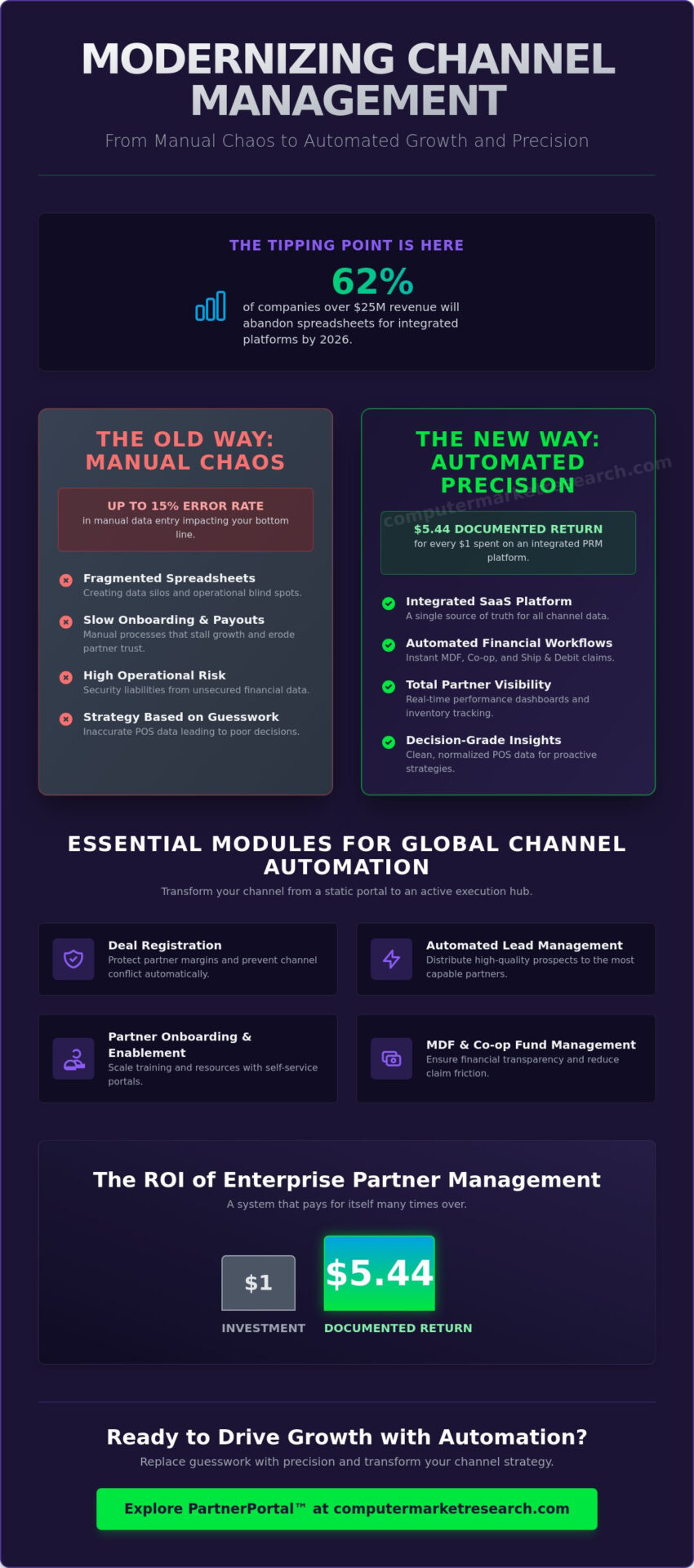
Manual data entry in channel management leads to error rates as high as 15%. For a scaling organization, these inaccuracies in MDF claims and rebate calculations aren’t just administrative headaches; they are direct hits to your bottom line. Transitioning to a robust strategy for enterprise partner relationship management is no longer a luxury for the few. As of 2026, 62% of companies with over $25 million in revenue have already moved away from fragmented spreadsheets in favor of integrated platforms that offer total visibility.
You likely feel the frustration of blind spots in your partner inventory and the friction of slow onboarding processes that stall your growth. It’s time to replace those manual bottlenecks with automated incentive payouts and centralized communication. This guide reveals how to secure decision-grade insights from clean POS data, ensuring your channel strategy is backed by precision rather than guesswork. We’ll examine the technical path from operational bottlenecks to a streamlined system that delivers a documented return of $5.44 for every dollar spent.
Key Takeaways
- Transform your channel from a static communication portal into an active execution hub that drives indirect sales.
- Utilize enterprise partner relationship management to automate high-friction financial workflows like MDF and co-op fund claims.
- Gain total visibility into global partner performance by normalizing fragmented POS, inventory, and ship & debit data.
- Evaluate the strategic advantages of specialized SaaS platforms compared to limited, generic CRM extensions for channel management.
- Learn how managed data services ensure your channel information remains clean, accurate, and ready for high-level decision-making.
What is Enterprise Partner Relationship Management?
Enterprise partner relationship management represents a fundamental shift in how global organizations manage indirect sales. Rather than acting as a simple directory, modern PRM serves as a cloud-based execution layer that coordinates complex interactions between manufacturers, distributors, and resellers. For leaders managing thousands of global touchpoints, this technology replaces the “black box” of the channel with transparent, actionable workflows.
By 2026, the transition from legacy, on-premise silos to cloud-native channel partner management software is a requirement for growth. Legacy systems often functioned as static repositories for documents, but today’s platforms act as active automation hubs. They don’t just store information; they execute processes like ship and debit claims and inventory adjustments automatically. This evolution ensures that decision-grade data is available at every stage of the partner lifecycle.
To better understand how these systems function in a modern enterprise environment, watch this helpful video:
The Evolution of Channel Technology
Historically, channel technology focused on basic lead distribution. Today, the focus has shifted to managing a complex financial ecosystem involving multi-layered incentives. 2026 requires real-time API integrations because slow batch uploads can’t keep pace with modern retail compliance or rapid inventory turns. Advanced systems now leverage AI to provide predictive partner performance scoring, allowing operations teams to identify which partners need support before revenue targets are missed. This shift ensures your enterprise partner relationship management strategy remains proactive rather than reactive.
Why Spreadsheets Are Your Biggest Operational Risk
Managing Global 2000 partner data in Excel is no longer a viable strategy. Manual reporting and data entry in channel management lead to error rates between 10% and 15%. These inaccuracies directly impact profitability through overpaid rebates or missed co-op opportunities. Fragmented data creates significant channel conflict and partner friction. When incentives are delayed or POS data is inaccurate, partner trust erodes quickly. Beyond efficiency, the security risks of passing sensitive financial files through unsecured spreadsheets create a massive liability that modern cloud infrastructure is designed to eliminate.
Essential Modules for Global Channel Automation
Achieving scale in a global channel requires more than a simple login page. It demands a suite of integrated modules designed to handle the friction of high-volume transactions. A robust enterprise partner relationship management platform serves as the foundational interface where every partner interaction is recorded and optimized. By centralizing these functions, organizations move away from siloed data and toward a unified execution strategy.
Deal registration is a critical component for protecting partner margins and preventing internal channel conflict. When a partner registers a deal, the system must automatically validate the opportunity and lock in the incentive. Similarly, automated lead management ensures that high-quality prospects are distributed to the most capable partners based on performance data rather than manual guesswork. This automation increases the speed to lead, which is vital in competitive B2B environments.
Streamlining Onboarding and Partner Enablement
Effective onboarding sets the tone for the entire relationship. Automating the journey from initial sign-up to the first sale reduces the administrative burden on your channel managers. Through PartnerPortal™, you can provide self-service resource centers and training modules that scale across global time zones. This allows for a customized experience tailored to specific partner tiers, ensuring that gold-level distributors receive the high-touch resources they require without manual intervention.
Managing MDF and Co-op Funds for Maximum ROI
Financial transparency is often the biggest point of friction in partner relationships. Legacy methods for managing market development funds often result in a 10% to 15% error rate due to manual data entry. By streamlining the approval process and utilizing automated audit trails, companies ensure strict compliance while significantly reducing payout delays. Research indicates that automated channel data systems can deliver a return of $5.44 for every dollar spent. This level of precision allows you to measure the direct ROI of marketing spend per partner, turning a cost center into a predictable growth engine. To understand how these modules integrate with your existing workflow, you can explore the benefits of a fully automated partner portal.
Mastering Channel Data: POS, Inventory, and Ship & Debit
Effective channel management relies on the quality of the information entering your system. While many platforms focus solely on the front-end portal experience, true channel data management focuses on the granular details of every transaction. In a robust enterprise partner relationship management environment, you aren’t just looking at which partners logged in; you’re looking at exactly what was sold, where it was sold, and how much inventory remains in the global pipeline.
Gaining real-time visibility into multi-tier inventory levels is essential for preventing both stockouts and supply chain oversupply. Without this data, your manufacturing and distribution strategies remain reactive and prone to error. By integrating POS and inventory data directly into your execution layer, you create a single source of truth that informs every level of the organization. This level of transparency is what separates high-performing networks from those struggling with fragmented information.
Normalizing Messy POS Data from Global Resellers
Global resellers rarely provide sales data in a uniform format. This “dirty data” is a significant operational hurdle for companies managing thousands of global partners. SaaS solutions address this by cleansing, validating, and enriching partner sales reports automatically. This process transforms raw, inconsistent POS files into decision-grade market intelligence. Instead of spending hundreds of hours manually correcting spreadsheets, your operations team can focus on identifying regional sales trends and optimizing partner performance based on accurate, normalized information.
Automating Complex Ship & Debit Claims Processes
Ship and debit programs are notoriously difficult to manage manually due to the complex financial calculations and volume of claims. Errors in these processes often lead to significant overpayments and strained partner relationships. Implementing specialized ship and debit management software within your PRM framework eliminates these risks. Automation allows you to track stock levels accurately and validate every claim against actual POS data in real time, ensuring that incentives are only paid on verified sales.
This systematic approach reduces claim processing time from weeks to just a few hours. It ensures that partners are compensated fairly and quickly while protecting your margins from fraudulent or inaccurate claims. By moving these processes into a modernized infrastructure, you replace chronic operational bottlenecks with a reliable, high-performance workflow that builds trust across your entire partner network.
Selecting the Right SaaS for Your Channel Strategy
Choosing a platform requires a clear distinction between a simple communication tool and a comprehensive execution engine. For a Global 2000 firm, enterprise partner relationship management must handle high-volume financial transactions that generic CRM add-ons often overlook. While basic portals manage lead distribution, they frequently lack the technical architecture to process complex ship and debit management or multi-tier co-op claims. Selecting a “nice-to-have” feature list is easy, but identifying “must-have” functional modules like automated rebate processing is what secures long-term ROI.
Evaluating a vendor’s capacity for data administration is just as critical as the software features themselves. Many providers offer a “software-only” model that leaves your team responsible for the arduous task of normalizing inconsistent partner data. A superior solution includes managed services that cleanse and validate POS reports before they enter your system. This reduces the Total Cost of Ownership (TCO) by eliminating the need for internal data analysts to fix manual errors. You should prioritize vendors who understand the “dirty work” of data normalization rather than those who only offer a polished front-end interface.
Integration with Enterprise CRM and ERP Systems
Deep integration with your existing CRM or ERP platforms is non-negotiable for maintaining operational consistency. Your PRM should not exist as a data island. Instead, it must facilitate a bidirectional flow of information, ensuring that deal registrations and sales credits are synchronized in real time across the global enterprise. This creates a single source of truth that allows finance and sales departments to work from the same decision-grade datasets. Without this synchronization, you risk creating duplicate records and channel conflict that erodes partner trust.
Scalability and Security for Global 2000 Firms
International operations demand multi-currency and multi-language support to ensure partner adoption remains high across diverse regions. As your channel grows, the system must handle increasingly high volumes of transactions and complex data points without performance degradation. Security compliance is equally vital for protecting intellectual property and financial records. Ensure any SaaS partner adheres to rigorous standards like GDPR and SOC2. If you’re ready to move beyond the limitations of manual tracking, you can start your 90-day free trial to see how specialized automation transforms channel performance.
Drive Growth with CMR PartnerPortal™ Automation
CMR combines four decades of specialized experience with cloud-native infrastructure to solve the most persistent channel challenges. While generalist CRM providers focus on sales rep activity, CMR prioritizes the back-end data administration that actually drives profitability. By centralizing all partner relationship management functions into a single portal, Fortune 500 companies can eliminate the friction of fragmented systems. This integration ensures that every module, from deal registration to ship and debit, works in concert to provide a unified view of your indirect sales.
A core differentiator is CMR’s Managed Data Services. We don’t just provide the infrastructure; we manage the data within it. This approach ensures that messy POS reports are cleansed and validated before they impact your financial reporting. It’s a custom implementation strategy designed to alleviate the administrative burden on your internal teams. By offloading these technical tasks, your channel managers can focus on strategic growth rather than manual data entry. This specialized focus on enterprise partner relationship management creates a stable foundation for long-term scalability.
The CMR Difference: Decision-Grade Data Integrity
Simple metrics tell you what happened, but decision-grade insights tell you why. By offloading the “dirty work” of data cleansing to CMR, you gain a level of transparency that generic platforms can’t match. This leads to improved partner ROI because your automated incentive management is based on verified, accurate sales data rather than unvalidated claims. When your rebate and MDF payouts are precise, you build deeper trust with your partners. This reliability is essential for maintaining a high-performance global network in a competitive market.
Transforming Your Channel Operations in 2026
Modernizing your infrastructure doesn’t have to mean business disruption. CMR uses a structured implementation timeline for the PartnerPortal™ platform to ensure a smooth transition from legacy processes. Our team understands the nuances of global distribution and the technical requirements of the Global 2000. You can claim your 90-day free trial to start your transformation and experience the shift from manual bottlenecks to automated precision. It is the logical step for organizations ready to secure their channel data and drive predictable growth.
Future-Proof Your Global Channel Strategy
Modernizing your infrastructure is the only logical way to eliminate the high error rates inherent in manual tracking methods. By shifting to a comprehensive framework for enterprise partner relationship management, you replace chronic operational bottlenecks with a scalable execution engine. We’ve explored how clean POS data and automated financial workflows protect your margins while simultaneously building partner trust. These systems ensure that your indirect sales strategy is driven by precision rather than guesswork.
Since 1984, CMR has provided the technical depth required by Global 2000 enterprises to navigate complex channel relationships. Our 40 years of expertise ensures that your data isn’t just collected; it’s normalized and validated through our full-service managed data cleansing. It’s time to move beyond fragmented spreadsheets and secure the decision-grade insights your organization demands for sustained growth. You’ve built a strong network; now give it the infrastructure it deserves to thrive in a competitive market.
Claim your 90-day free trial of PartnerPortal™ now to begin your transition to a modernized, automated channel. We look forward to helping you achieve total visibility and control over your global partner ecosystem.
Frequently Asked Questions
Difference Between CRM and Enterprise PRM
CRM platforms focus on managing direct relationships with customers and tracking internal sales rep activity. Enterprise partner relationship management manages the indirect channel and the entire partner lifecycle. While a CRM tracks leads, a PRM handles complex financial workflows like rebates, deal registration, and co-op fund management that standard systems aren’t built to execute.
How Does PRM Software Handle Data Cleansing?
Modern platforms use managed data services to normalize inconsistent POS reports from global resellers. This process validates every transaction against specific business rules to ensure absolute accuracy. It removes duplicates and corrects formatting errors before the information enters your financial records. This ensures your team works with decision-grade insights rather than messy, unverified spreadsheets.
Does Channel Software Integrate With My CRM?
Yes, deep integration with your primary enterprise CRM is a standard requirement for maintaining a single source of truth across your organization. The system facilitates a bidirectional flow of partner and sales data. This ensures that deal registrations and sales credits stay synchronized across your global enterprise. It eliminates the need for manual data syncing and reduces the risk of duplicate records.
Benefits of Automating MDF and Co-op Programs
Automation reduces manual data entry errors which often reach high levels in legacy environments. It speeds up the approval process and ensures strict compliance through automated audit trails and documentation. This transparency improves partner satisfaction by providing faster payouts. It also allows you to measure the direct ROI of your marketing spend per partner or region accurately.
Typical Costs for Enterprise Partner Management
Pricing varies based on the number of partner accounts and the specific functional modules your organization requires. While large-scale platforms often involve significant annual investments, it’s vital to evaluate the Total Cost of Ownership. This includes implementation fees and the long-term value of managed data services that reduce internal labor costs and prevent expensive overpayment errors.
What Is Ship & Debit in Channel Software?
Ship & Debit is a financial incentive where a manufacturer compensates a distributor for selling products at a discounted price to remain competitive. Channel software automates the complex calculations and validation of these claims against actual POS data. This prevents overpayments and reduces claim processing time from several weeks to just a few hours.
How SaaS Prevents Conflict Between Partners
Systems use deal registration modules to protect partner margins and clearly define territory ownership. When a partner registers an opportunity, the software locks it to prevent other resellers or internal teams from competing for the same deal. This transparency builds trust and encourages partners to be more open about their sales pipeline, knowing their efforts are protected.
Essential Features for a 2026 Partner Portal
Look for AI-powered onboarding automation and real-time inventory visibility across all channel tiers. A modern enterprise partner relationship management portal must also offer multi-currency support and robust security compliance like SOC2. Self-service resource centers and automated incentive payouts are standard requirements for any organization looking to scale globally without increasing administrative headcount.

Article by
Del Heles
Del Heles is the founder and CEO of Computer Market Research (CMR), a channel management software company he launched in 1984. With more than 40 years of experience, he’s known for helping manufacturers and distributors simplify complex partner programs through practical, customer-focused technology solutions.