

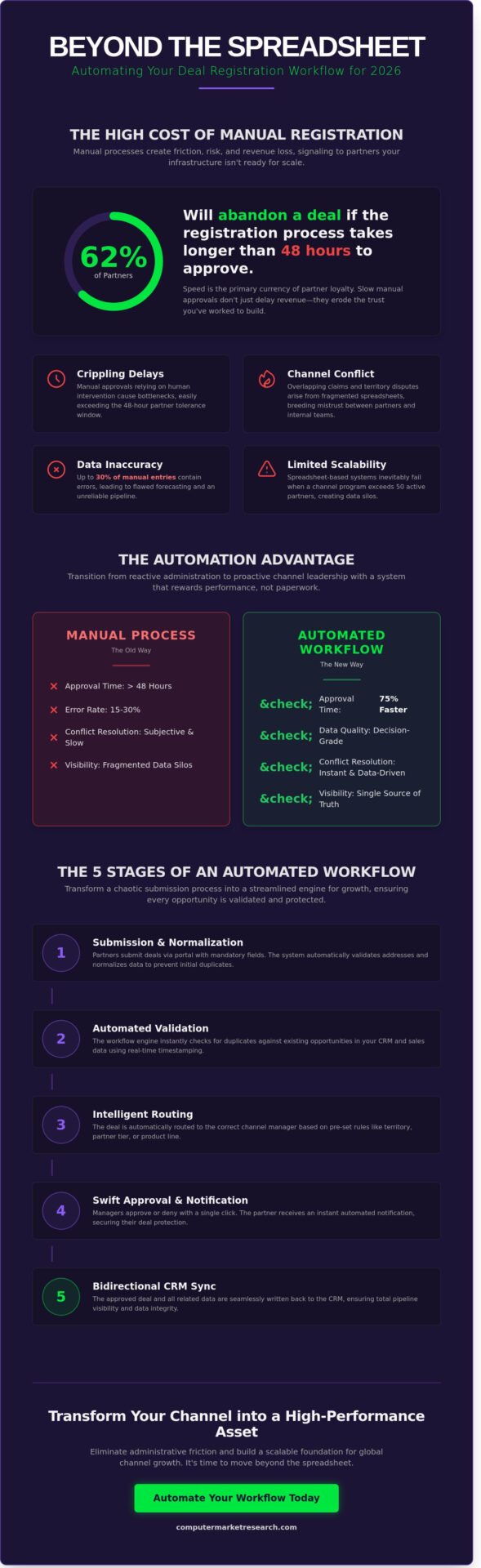
According to recent industry benchmarks, 62% of channel partners will abandon a potential deal if the registration process takes longer than 48 hours to approve. You’ve likely felt the friction when manual data entry in fragmented spreadsheets leads to overlapping claims and frustrated partners. It’s a common reality where channel conflict between internal teams and external partners erodes the trust you’ve worked hard to build. When your approval cycle relies on human intervention for every line item, your growth is limited by the speed of your inbox.
By automating deal registration workflow processes, you can eliminate these administrative headaches and transform your channel into a high performance strategic asset. We’ve seen that organizations utilizing automated validation reduce approval times by 75% while ensuring data accuracy. This 2026 guide provides a technical roadmap to achieving a single source of truth for every opportunity in your pipeline. We’ll explore how to replace outdated manual systems with a cloud-ready infrastructure that ensures data integrity and operational stability for your entire network. It’s time to move beyond the spreadsheet and embrace a system that rewards performance rather than paperwork.
Key Takeaways
- Identify the operational risks of manual tracking and how to transition from fragmented spreadsheets to a unified, automated strategic asset.
- Discover the five essential stages of automating deal registration workflow to eliminate duplicates and ensure only “decision-grade” data enters your pipeline.
- Learn to establish bidirectional synchronization between your partner portal and CRM to maintain absolute pipeline visibility and data integrity.
- Implement tiered access and incentive structures that reward partners for providing high-quality data while reducing administrative friction.
- Scale your global channel operations with a cloud-based infrastructure that supports multi-national logic and complex currency requirements.
The Operational Cost of Manual Deal Registration: Moving Beyond Spreadsheets
In the 2026 channel ecosystem, automating deal registration workflow is a fundamental requirement for maintaining channel integrity. It functions as a real-time validation engine that integrates directly with CRM and Point of Sale data. Manual systems rely on human memory and fragmented emails, which are prone to failure. Automation ensures that every opportunity is captured, validated, and protected instantly, removing the guesswork from partner management.
To better understand how this technology transforms partner interactions, watch this helpful video:
The spreadsheet headache is a common symptom of a program that’s outgrown its tools. Excel wasn’t built for high-velocity channel sales. When a program exceeds 50 active partners, manual tracking inevitably fails. Data silos emerge where sales teams and channel managers operate from different versions of the same file. This lack of visibility creates a breeding ground for errors. Inaccurate forecasting follows, as 30% of manual entries often contain formatting errors or outdated information that skews revenue projections.
Speed is the primary currency of partner loyalty. If a vendor takes more than 24 hours to approve a deal, they risk losing that partner to a more agile competitor. Slow manual approvals don’t just delay revenue; they signal to the partner that the vendor’s infrastructure isn’t ready for scale. By automating deal registration workflow, companies transition from reactive administration to proactive channel leadership.
The Death of the Spreadsheet in Channel Sales
Manual data entry is the primary obstacle to growth. Duplicate deals, missed expiration dates, and overlapping territories are common symptoms of an overloaded spreadsheet. Clean data is impossible to maintain when information is siloed across various departments. Transitioning to a cloud-based system turns deal registration from a tedious administrative task into a strategic asset. It provides the visibility needed to identify which partners are truly driving value and which are merely “squatting” on leads.
Solving the Channel Conflict Headache
Automation provides the quiet confidence required to manage partner trust. By using real-time timestamping and automated duplicate detection, vendors offer objective deal protection. Understanding Channel Conflict is essential for any manufacturer. It represents the friction that occurs when different sales paths compete for the same customer. Automation replaces subjective disputes with data-driven clarity, ensuring exclusivity for the partner who registered the lead first. This move toward objectivity is the only logical step for a growing business seeking to maintain long-term channel stability.
The 5 Stages of an Automated Deal Registration Workflow
Transitioning from manual spreadsheets to a structured, digital process is the only way to maintain channel integrity. By automating deal registration workflow, manufacturers eliminate the 15% to 20% margin of error typical in manual data entry. This systematic approach ensures every opportunity is tracked, validated, and protected without the administrative burden of constant email follow-ups. It transforms a chaotic submission process into a streamlined engine for growth.
Submission and Initial Data Normalization
The foundation of a reliable system is “decision-grade” data. Partners often provide incomplete information when using generic forms. To fix this, implement mandatory fields for end-customer contact details and project timelines while keeping secondary data like competitive landscape optional. Using real-time address validation and company name normalization prevents the creation of duplicate records. These Benefits of Supply Chain Automation extend directly to the channel, reducing partner friction through intuitive, web-based portals that pre-populate known information based on historical records.
If-Then Logic in Approval Workflows
Dynamic routing removes the bottleneck of manual review. If a deal exceeds a specific dollar threshold or originates from a Tier-1 partner, the system routes it to a regional manager instantly. Conversely, “auto-reject” criteria can be set for deals that don’t meet minimum margin requirements or involve blacklisted accounts. This logic saves approximately 10 hours of administrative work per week for every 50 registrations processed. Automated notifications keep partners updated, ensuring they don’t lose momentum while waiting for a response.
Exclusivity management represents the fourth stage of a mature automating deal registration workflow. Automated systems track the clock, sending alerts 14 days before a registration expires. This forces a proactive extension request or allows the deal to lapse, opening the opportunity to other partners. Finally, the process concludes with a data sync. Registered deals aren’t just entries in a log; they become actionable pipeline data in your CRM. This visibility allows for more accurate forecasting and ensures that clean channel data remains the central driver of your sales strategy. When these five stages work in harmony, the manufacturer-distributor relationship moves from reactive conflict to collaborative growth.
CRM Integration: The Foundation of Automated Pipeline Visibility
For a deal registration system to function effectively, it cannot exist as a siloed add-on. It must operate as a peer to your CRM. When manufacturers treat their partner portal as a secondary storage bin rather than a live extension of their primary sales engine, they invite data fragmentation. Automating deal registration workflow requires a bidirectional synchronization that keeps the partner portal and Salesforce or ERP systems in perfect alignment. This connection ensures that when a partner registers a lead, it doesn’t just sit in a queue; it populates the CRM immediately, allowing for instant conflict check and credit assignment.
Centralizing all indirect sales activity is the only way to eliminate “shadow pipelines.” These are the deals tracked in disparate spreadsheets that never make it into official forecasts. Industry data suggests that without a centralized system, up to 42% of channel activity remains invisible to sales leadership until the final invoice. By implementing robust channel data management (CDM), organizations establish a single source of truth. This technical competence allows managers to move away from manual data cleanup and toward strategic growth. Incorporating Effective Channel Management Strategies involves bridging the gap between partner input and corporate oversight, ensuring that every registered deal is verified and actionable.
The “Make-or-Break” Factor: Real-Time Sync
Batch processing is a relic of legacy systems that no longer serves the speed of 2026 commerce. A 24-hour lag in data synchronization can lead to “deal jumping” or duplicate registrations that frustrate partners and internal teams alike. Real-time sync prevents partner-submitted data from polluting the core CRM with duplicates through automated matching logic. For Global 2000 leaders, this level of precision is mandatory for accurate sales forecasting. If the data isn’t live, the forecast isn’t reliable. Precise integration ensures that 100% of channel opportunities are reflected in the pipeline the moment they are approved.
Visibility and Actionable Insights
Transitioning from “what happened” to “what will happen” requires predictive channel analytics. By automating deal registration workflow, companies can collect granular data points that reveal market trends before they become obvious in quarterly reports. This visibility allows for specific, data-driven decisions:
- Partner Performance: Identify the top 15% of partners driving 80% of your indirect revenue.
- Market Trends: Spot regional demand shifts by monitoring registration volume in specific territories.
- Predictive Accuracy: Use historical conversion rates to project future revenue with 95% accuracy.
Transparency also benefits the partners. When they can view their own performance metrics and deal statuses directly through the portal, it builds trust. It removes the “black hole” sensation of manual registration and replaces it with a clear, disciplined path toward closing deals.
Best Practices for Optimizing Your Automated Deal Workflow
Implementing a software solution is only the first step toward channel integrity. To truly eliminate the “spreadsheet headache,” manufacturers must establish clear, concise guidelines that leave no room for partner interpretation. Ambiguity is the primary driver of channel conflict. When rules are hardcoded into the system, you reduce the 15% of deal disputes typically caused by misunderstood program boundaries. Clear documentation ensures that partners know exactly what constitutes a valid lead from day one.
Efficiency thrives on high-quality data. By implementing tiered access, you can reward partners who consistently provide clean, actionable insights. For example, partners who maintain a 98% data accuracy rate over six months could be granted “Fast-Track” status, where their registrations are auto-approved. This creates a self-policing ecosystem where partners are incentivized to maintain data hygiene. Automating deal registration workflow allows you to set these parameters once and let the system manage the enforcement, ensuring your team only spends time on high-value exceptions.
Regular auditing remains essential, even in a hands-off environment. Use your automation tools to flag anomalies, such as a single partner registering ten deals at the same end-user location within 60 seconds. These automated red flags prevent “land-grabbing” and ensure that deal protection is granted to those actually doing the work. Coupling these audits with quarterly partner surveys creates a feedback loop that identifies where the workflow might be lagging behind market shifts.
Designing for the Partner Experience
The 3-minute rule is the benchmark for modern channel portals. If a partner cannot complete a deal submission in 180 seconds, the workflow is too complex. Reducing clicks and form fields is the fastest way to increase participation. Additionally, eliminate the “Under Review” black hole. Partners need instant feedback. If a deal is pending, the system should specify exactly which piece of data is missing, turning a potential frustration into a clear task. Effective onboarding ensures the portal becomes the partner’s natural home rather than a technical hurdle.
Measuring Success with KPIs
Visibility into the pipeline is the ultimate goal of automating deal registration workflow. You must track the Registration-to-Close ratio to understand the true quality of the leads entering your system. A healthy ratio typically sits between 25% and 30% for top-tier performers. Use partner relationship management systems to monitor the Average Approval Time. If approvals take longer than 24 hours, you’re losing momentum. Finally, analyze “abandoned registrations” to find where partners drop off. If 40% of users quit on the “Upload Invoice” page, that specific step requires simplification.
Ready to replace manual errors with automated precision? Contact Computer Market Research to see how our tools streamline your channel operations.
Scaling Global Operations with CMR PartnerPortal™
Scaling a global channel requires more than a standard web portal; it demands a system that respects regional nuances while maintaining a single source of truth. CMR PartnerPortal™ provides this through a cloud-based infrastructure designed for manufacturers operating across 50 or more countries. By centralizing global operations, you eliminate the fragmentation that occurs when regional offices rely on disparate spreadsheets. The platform manages complex currency variations and localized approval logic automatically, ensuring that a deal registered in Tokyo follows the same rigorous standards as one in New York.
The modular architecture of the CMR system allows firms to integrate market development funds and other financial incentives directly into the deal cycle. This integration ensures every registration is tied to a specific growth strategy, driving higher partner engagement. Industry leaders trust CMR because the platform prioritizes clean data. By automating deal registration workflow processes, organizations reduce the 12% margin of error typically found in manual entry systems. This systematic approach transforms raw channel data into actionable insights for the executive suite.
Enterprise-Grade Security and Compliance
Security isn’t a secondary feature in 2026; it’s the foundation of partner trust. CMR ensures compliance with GDPR and CCPA through rigorous data encryption and localized hosting protocols. Role-based access control ensures that a partner in Singapore only sees their specific pipeline, preventing internal conflict and protecting sensitive pricing data. Every action within the portal creates an immutable audit trail. If a deal is ever contested, you have the historical data to defend your decision with absolute accuracy. This transparency eliminates the “he-said, she-said” dynamic that often plagues distributor relationships.
The Path to 2026: Future-Proofing Your Channel
Closing the loop is the final step in the journey. Connecting your registration data to broader channel management practices provides total visibility from the initial lead to the final point-of-sale report. This end-to-end connectivity ensures that your channel remains a predictable, scalable engine for revenue. When your data is clean and your processes are automated, the path to global expansion becomes clear and manageable.
Securing Your Channel’s Competitive Advantage
Manual deal management isn’t just slow; it’s a structural risk to your 2026 growth targets. Transitioning to a structured, 5-stage automated process eliminates the data silos that cause channel conflict and lost revenue. By integrating your CRM directly into your partner ecosystem, you gain the pipeline visibility necessary to make informed, data-driven decisions. It’s time to move past the limitations of static spreadsheets and adopt a system built for the complexities of modern distribution.
Automating deal registration workflow allows your team to focus on high-value partner relationships rather than administrative recovery. Computer Market Research has been the trusted partner for Fortune 500 and Global 2000 companies since 1984, providing the technical foundation for global channel integrity. Our cloud-based PartnerPortal™ offers a modular, scalable architecture that ensures your operations remain agile as you enter new markets. You’ll gain real-time visibility that transforms raw point-of-sale data into actionable growth strategies.
Automate your deal registration and end the spreadsheet headache with CMR
Take the final step toward operational excellence and give your partners the professional experience they expect.
Frequently Asked Questions
What is the primary benefit of automating a deal registration workflow?
The primary benefit is the elimination of manual errors and the drastic reduction in approval cycle times. By automating deal registration workflow, manufacturers replace error-prone spreadsheets with real-time validation. This shift reduces administrative overhead by 30% according to 2024 industry benchmarks. It ensures that partners receive immediate feedback, which maintains momentum in the sales cycle and prevents lead stagnation.
How does deal registration automation prevent channel conflict?
Automation prevents channel conflict by enforcing standardized rules that prioritize the first partner to submit a qualified lead. The software uses timestamping and geographic tagging to ensure absolute transparency. In a 2023 study of channel ecosystems, automated rules reduced “double-dipping” disputes by 45%. This creates a fair environment where partners trust that their investments in a prospect are protected by data, not subjective decisions.
Can deal registration software integrate with my existing CRM like Salesforce?
Yes, modern deal registration software integrates directly with Salesforce and other Tier 1 CRM platforms via REST APIs. This bi-directional sync ensures that lead data flows between systems without any manual intervention. Data stays clean and consistent across both platforms. This integration typically resolves the 20% data discrepancy often found in disconnected manual systems, ensuring your sales operations team has a single source of truth.
What are the most important KPIs for measuring deal registration success?
The most important KPIs include the lead-to-deal conversion rate and the average time to approval. Successful programs aim for an approval window of less than 24 hours. You should also track the partner participation rate. A 10% increase in active partners often signals that the automated system has lowered the barrier to entry. Monitoring these metrics provides a clear view of your program’s health and ROI.
How long does it typically take to implement an automated deal registration system?
Implementation of an automated system typically takes between 4 and 8 weeks. This timeline includes the initial configuration of business rules, CRM integration, and partner portal setup. A structured 6-week rollout plan allows for thorough testing of the workflow. This ensures that the system is fully optimized before the official launch to your partner network, avoiding the technical debt associated with rushed deployments.
How do I encourage partners to actually use the deal registration portal?
You encourage partner adoption by providing a frictionless user experience and guaranteed margin protection. Partners are 60% more likely to use a portal if the registration process takes under three minutes. Offering a “fast-track” approval for recurring deal types also incentivizes consistent use. When partners see that the system protects their commissions and speeds up their sales cycle, they naturally gravitate toward the portal.
What happens if two partners try to register the same deal simultaneously?
The system uses millisecond-precise timestamping to identify which partner submitted the registration first. If two partners submit for the same end-user, the software flags the conflict for immediate review based on your specific program rules. This automated logic eliminates the ambiguity that leads to 25% of channel disputes. It provides a clear, data-backed audit trail for every submission, which maintains integrity across the entire channel.
Is an automated workflow secure for sensitive customer data?
Automated workflows are highly secure, utilizing SOC2 Type II compliance standards and end-to-end encryption for all data in transit. Role-based access control ensures that only authorized personnel can view sensitive customer information. By automating deal registration workflow, you move away from insecure email threads and shared spreadsheets. This centralized approach reduces the risk of data breaches by 40% compared to manual file sharing methods.

Article by
Del Heles
Del Heles is the founder and CEO of Computer Market Research (CMR), a channel management software company he launched in 1984. With more than 40 years of experience, he’s known for helping manufacturers and distributors simplify complex partner programs through practical, customer-focused technology solutions.