

The spreadsheet your team spent six hours cleansing this morning is already obsolete. When manufacturers rely on data that’s seven days old, they’re essentially making 2026 production decisions based on 2025’s rearview mirror. Achieving real-time channel inventory visibility isn’t just a technical upgrade; it’s the difference between a 12% margin growth and a warehouse full of costly overstock. We understand that the manual grind of normalizing disparate distributor files is a primary obstacle to your scaling efforts. It’s a frustrating, resource-heavy process that often results in stockouts or missed revenue opportunities.
In this guide, you’ll learn how to eliminate the blind spots in your indirect sales channel by moving toward automated, decision-grade data. We’ll show you how to replace those manual headaches with a streamlined system that provides actionable insights into your channel stock. From improving your ROI through precise allocation to mastering data normalization, we’re outlining the exact framework you need to maintain control over your distribution network through 2026 and beyond.
Key Takeaways
- Identify the critical risks of relying on “good enough” data and why manual spreadsheets create a dangerous blind spot in volatile markets.
- Master the mechanics of 2026 data standards by bridging the gap between partner Point of Sale systems and your central management dashboard.
- Scale your operations effectively by transitioning from error-prone manual entry to automated real-time channel inventory visibility.
- Follow a strategic implementation roadmap to audit partner capabilities and establish standardized data-sharing agreements for decision-grade accuracy.
- Leverage managed data services to offload administrative burdens and regain total control over your indirect sales channel.
The Channel Visibility Blind Spot: Why “Good Enough” Data Fails in 2026
Real-time channel inventory visibility represents the continuous, automated stream of stock data flowing directly from indirect partners into a manufacturer’s decision-making engine. It’s no longer a luxury for the elite. By 2026, the threshold for market agility has shifted. Relying on weekly or monthly reports is a recipe for obsolescence because market volatility now moves faster than a static PDF or an emailed CSV. When you wait seven days to see what’s on a distributor’s shelf, you’re essentially driving a high-performance business while looking through a rearview mirror.
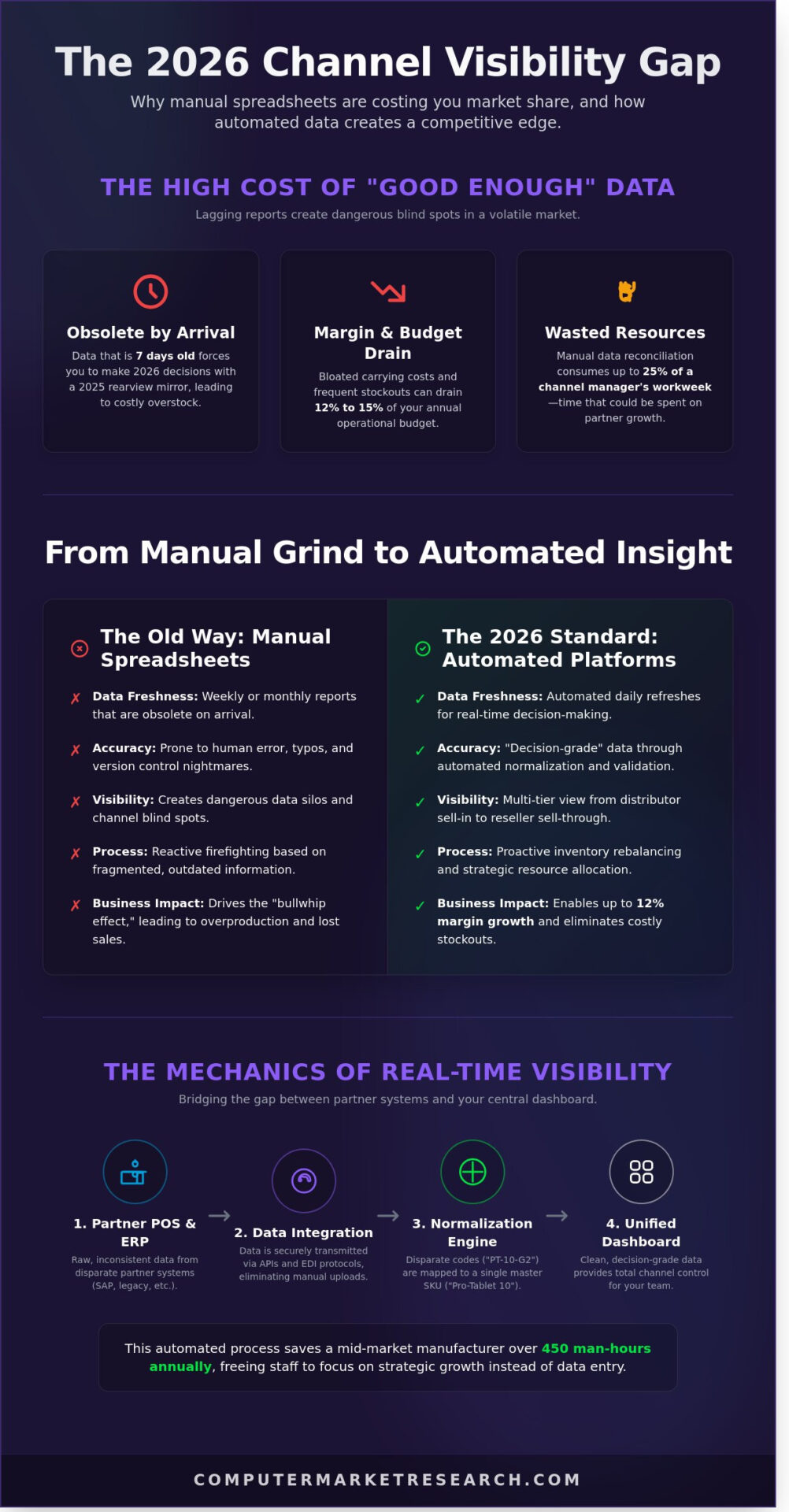
The primary cause of the visibility blind spot is a combination of disparate ERP systems and entrenched manual reporting habits. Most manufacturers struggle with a fragmented landscape where Partner A runs a modern SAP instance while Partner B relies on a legacy system built in 2005. This technical friction leads to tangible losses. Without a unified view, companies face the recurring headaches of phantom inventory, frequent stockouts, and bloated carrying costs that can drain 12% to 15% of annual operational budgets.
The High Cost of Lagging Inventory Reports
A 48-hour delay in data might seem negligible, but it can devastate a modern product launch. If your marketing team spends $50,000 on a localized digital campaign for a product that’s actually out of stock at the nearest distributor, that ROI drops to zero instantly. This lag also fuels the destructive bullwhip effect. The bullwhip effect is a phenomenon where minor shifts in consumer demand create increasingly large inventory swings up the supply chain as a direct consequence of poor visibility. Without clean, instant data, manufacturers often overproduce in response to noise, leading to excess stock that must be liquidated at a loss.
Identifying the Data Silo Epidemic
Data silos persist because many distributors still view their inventory levels as a proprietary secret or a bargaining chip. This cultural barrier is compounded by the “spreadsheet-by-email” workflow, a process that is prone to human error and version control nightmares. Achieving true real-time channel inventory visibility requires moving beyond these manual habits. When one partner uses a cloud-based ERP and another uses an obscure on-premise database, the manufacturer is left to piece together a broken puzzle. This fragmentation prevents sales operations from seeing the “big picture,” resulting in missed opportunities and inefficient allocation of MDF and Co-op funds across the channel.
The Mechanics of Real-Time Channel Inventory Visibility
By 2026, the technical standard for data flow has shifted from manual uploads to a continuous bridge between Partner POS systems and the Manufacturer Dashboard. This architecture relies on APIs and EDI protocols to eliminate the latency that previously plagued channel operations. While “real-time” often suggests millisecond updates, true real-time channel inventory visibility in a B2B context typically refers to automated daily refreshes. This frequency provides the necessary balance between speed and data integrity, ensuring that stakeholders act on verified information rather than fluctuating noise.
Reliability hinges on decision-grade data. Raw numbers from a distributor’s warehouse are rarely ready for executive analysis. A 2024 study by VDC Research found that manual data reconciliation consumes up to 25% of a channel manager’s workweek. By automating the data bridge, manufacturers transition from reactive firefighting to proactive inventory rebalancing. This shift is only possible when the underlying technology treats data as a strategic asset rather than a clerical byproduct.
POS Data Integration and Normalization
Raw Point of Sale (POS) data is notoriously inconsistent. One partner might list a product as “Pro-Tablet 10,” while another uses “PT-10-G2.” Cloud-based platforms automate the normalization process by mapping these disparate partner codes to a single master SKU. This automated cleansing eliminates the “death by spreadsheet” that occurs when teams try to reconcile thousands of lines manually. Implementing an automated channel data management solution can save a mid-market manufacturer over 450 man-hours annually, allowing staff to focus on partner growth instead of data entry.
Multi-Tier Visibility: From Distributor to Reseller
Tracking stock becomes exponentially harder when it moves from a distributor to a sub-tier reseller. Visibility platforms solve this by tracking both “sell-in” (what you sold to the distributor) and “sell-through” (what the reseller sold to the end user). Understanding this delta is critical. If a manufacturer only sees sell-in data, they risk overproducing goods that are currently sitting idle in a tier-two warehouse. Precise tracking across the entire ecosystem ensures that production cycles align with actual market demand, reducing carrying costs by as much as 18% based on recent industry benchmarks.
Automated Platforms vs. Manual Spreadsheets: A Comparative Analysis
The choice between automated SaaS platforms and manual spreadsheets is the difference between operational agility and stagnation. Excel was never designed to handle the velocity of modern global trade, where even a single delay at a critical transit point—managed by agencies like Adimar Shipping, Inc. at the Panama Canal—can disrupt an entire supply chain. For manufacturers, emailing sensitive inventory files across the web creates massive security vulnerabilities. It exposes trade secrets and partner pricing to potential interception. The “death of the spreadsheet” is a prerequisite for any enterprise seeking growth in 2026. Transitioning to a specialized automated platform provides a secure, cloud-ready infrastructure. This move replaces the headache of fragmented data with a single source of truth, establishing a foundation for real-time channel inventory visibility.
The Hidden Risks of Manual Data Entry
Human error is a constant threat in manual environments. A simple typo in a spreadsheet can lead to a $100,000 over-ordering mistake or a critical stockout during a peak sales cycle. Beyond simple typos, version control is a recurring nightmare for sales operations. Research indicates that 88% of spreadsheets contain significant errors. When different departments use different versions of the same report, the resulting confusion halts progress. Manual processes prevent real-time channel inventory visibility because the data is already obsolete by the time it’s consolidated. If it takes your team five days to aggregate partner reports, you’re making decisions based on the past, not the present. This lag makes it impossible to respond to sudden market shifts or competitor actions effectively.
Scalability and ROI of Automated CDM
Automation allows a single channel manager to oversee 10x more partners than manual methods allow. This efficiency is vital for scaling beyond 100 global partners without ballooning headcount. Implementing a robust Channel Data Management (CDM): The Definitive Guide strategy provides decision-grade insights that spreadsheets cannot match. Companies utilizing automated CDM typically see a 22% improvement in inventory turnover and a drastic reduction in dead stock. These systems provide the technical competence to validate Point of Sale data automatically. The ROI manifests as reduced carrying costs and improved partner relationships. Reliable data ensures that incentives and MDF are paid out accurately and on time. Achieving this level of control isn’t just a technical upgrade; it’s a fundamental shift toward a more profitable, data-driven distribution model.
Implementation Roadmap: Transitioning to Decision-Grade Visibility
Moving from manual spreadsheets to real-time channel inventory visibility requires a shift in both technology and partner culture. It’s not just about installing software; it’s about building a reliable data pipeline that replaces guesswork with precision. Research indicates that 78% of manufacturers still struggle with data silos that delay decision-making by weeks. This roadmap provides a structured path to eliminate those delays.
- Step 1: Audit partner data capabilities. Evaluate the ERP formats used by your top 20% of distributors. Most will use legacy systems that require specific mapping to ensure compatibility with your central hub.
- Step 2: Establish standardized data-sharing agreements. Define exactly what data is required and the frequency of transmission. Clear expectations prevent friction later in the process.
- Step 3: Deploy a centralized CDM platform. Use a dedicated Channel Data Management system to act as the single source of truth. This platform should aggregate data from disparate sources without manual intervention.
- Step 4: Automate the normalization engine. Raw data is often messy. Implement automated rules to clean SKU numbers, standardize location names, and reconcile unit-of-measure discrepancies.
- Step 5: Integrate visibility into financial workflows. Connect your inventory data directly to your incentive and rebate systems to ensure payouts are based on actual stock movement.
Establishing Data Standards with Partners
Partners often hesitate to share granular data because they fear it might be used against them. You must frame this exchange as a mutual win. When you have accurate stock levels, you can optimize lead distribution to partners who actually have the product in stock. This increases their conversion rates by an average of 22%. At a minimum, your data standard must include the SKU, Quantity on Hand, Location ID, and a Date Timestamp. To ensure 98% compliance, consider offering small “data cleanliness” bonuses or preferential shipping terms to partners who meet your 24-hour reporting windows.
Integrating Inventory Data with Ship & Debit Claims
Inventory visibility is the most effective tool for preventing claim inflation and fraudulent ship and debit requests. By creating a closed-loop system, you can verify every claim against the partner’s existing stock levels. If a distributor claims a discount for 500 units but your data shows they only had 300 in stock, the system flags the discrepancy immediately. This level of control can reduce overpayments by 15% annually. Understanding what is channel management provides the context for why this integration is vital. It’s the foundation of a scalable strategy that protects your margins while rewarding honest performance.
Ready to eliminate manual data entry and reclaim your time? Schedule a demo to see how our CDM platform automates your channel visibility.
Leveraging CMR PartnerPortal™ for Total Channel Control
The inventory headache isn’t just about missing units; it’s about the invisible costs of fragmented data. Computer Market Research (CMR) developed the PartnerPortal™ to solve this specific disconnect by providing real-time channel inventory visibility. This platform eliminates the manual data entry that typically drains sales operations teams of 20 hours or more per week. Our Managed Data Services take this a step further by offloading the administrative burden of data collection and normalization. Instead of your team chasing distributors for inconsistent spreadsheets, our experts ensure your data is clean, accurate, and ready for immediate use.
The system’s modular design allows you to scale at your own pace. Most manufacturers begin by addressing the inventory crisis to stabilize their supply chain. Once that foundation is solid, they easily expand into Market Development Funds (MDF) and Incentive Management within the same interface. This phased approach has been shown to increase implementation speed by 30% compared to monolithic ERP overhauls. It transforms the channel into a frictionless environment where data drives every dollar spent.
This focus on creating a frictionless, data-driven environment is a priority across many industries; for example, Trialport offers clinical trial navigation services to help communities seamlessly connect and manage their own specialized research ecosystems.
Centralizing Inventory and POS Data
The CMR dashboard serves as the single source of truth for your entire channel ecosystem. Users can view global stock levels at a glance or drill down into specific partner locations to identify localized stockouts before they impact revenue. “Visibility without centralization is just more noise; CMR turns that noise into strategy.” By consolidating disparate Point of Sale (POS) files into one web-based interface, we’ve helped clients reduce reporting errors by over 95%. This level of detail ensures you aren’t just seeing numbers; you’re seeing the health of your partnerships.
Turning Visibility into Actionable Strategy
True control means using real-time channel inventory visibility to move the needle on performance. When you identify inventory piling up in a specific region, you can adjust MDF allocations on the fly to stimulate demand. This prevents the 15% margin erosion typically caused by desperate, end-of-quarter fire sales. Analyzing these inventory trends allows your team to predict partner needs three to six months in advance, ensuring the right product is always in the right place. To see how these automated tools can streamline your operations, request a demo of CMR’s PartnerPortal™ today.
Mastering Your Channel Data Strategy for 2026
Computer Market Research has led this discipline since 1984. With over 40 years of specialized expertise, we’re trusted by Fortune 500 and Global 2000 enterprises to deliver total channel control. Our proprietary PartnerPortal™ platform offers modular scalability that grows alongside your business, ensuring your data remains clean and actionable. Don’t let outdated systems stall your growth in the coming year.
Schedule a demo to see how CMR automates your channel inventory visibility
Building a more transparent, efficient channel is within your reach, and the right tools make all the difference.
Frequently Asked Questions
What is the difference between inventory visibility and inventory management?
Inventory visibility provides the data foundation while inventory management involves the execution of supply chain decisions. Visibility shows a manufacturer that a distributor has 450 units of a specific SKU in stock at a specific warehouse location. Management is the subsequent process of deciding to reorder 200 more units or redistribute stock based on that data. You can’t manage what you can’t see; visibility is the technical prerequisite for effective control.
How often should channel inventory data be updated for it to be considered “real-time”?
To achieve real-time channel inventory visibility in 2026, data updates must occur at least once every 24 hours. While some advanced systems offer hourly API pings, daily synchronization ensures that 98% of stock levels remain accurate for sales planning. Relying on weekly reports leads to a 15% increase in stock-outs because the data is already obsolete by the time managers review it.
Can real-time visibility work if my partners use different ERP systems?
Real-time visibility works across disparate ERP systems by using a centralized data management platform to bridge the technical gap. Whether one partner uses SAP and another uses Oracle, cloud-based tools ingest these various formats and translate them into a single source of truth. This eliminates the need for partners to change their internal software, allowing for 100% participation across the channel network without manual data entry.
What is the biggest challenge in achieving channel inventory visibility?
The primary obstacle to achieving visibility is the lack of standardized data formats among different channel partners. In a typical 50-partner network, you’ll encounter 12 or more different file types ranging from CSVs to EDI 852. Without automated ingestion tools, sales operations teams spend 40% of their work week manually correcting these formatting errors in spreadsheets rather than analyzing the actual inventory levels.
How does real-time visibility improve the ROI of channel incentive programs?
Visibility improves ROI by ensuring that incentive payments like MDF or rebates are tied to actual sell-through data rather than estimated stock levels. Manufacturers using real-time channel inventory visibility can reduce overpayments by 12% on average. When you know exactly which SKUs are sitting in a warehouse, you can launch targeted promotions to move that specific inventory rather than wasting budget on products that are already selling well.
Does a manufacturer need a full PRM to see channel inventory?
A manufacturer doesn’t need a full Partner Relationship Management (PRM) suite to gain inventory insights. Dedicated Channel Data Management (CDM) modules provide more granular control over inventory levels without the high cost of a complete PRM implementation. These specialized tools focus specifically on the “death of the spreadsheet” by automating data collection. It’s often more efficient for sales ops teams than a bulky, generalist PRM.
What is POS data normalization and why is it required for visibility?
POS data normalization is the process of converting disparate data points from various partners into a standardized format. For instance, one distributor might list a product as “Model-A” while another lists it as “MDL-A123.” Normalization maps these entries to a single SKU, ensuring 100% accuracy in reporting. Without this process, manufacturers face fragmented reports that make it impossible to get a clear view of total channel stock.

Article by
Del Heles
Del Heles is the founder and CEO of Computer Market Research (CMR), a channel management software company he launched in 1984. With more than 40 years of experience, he’s known for helping manufacturers and distributors simplify complex partner programs through practical, customer-focused technology solutions.