

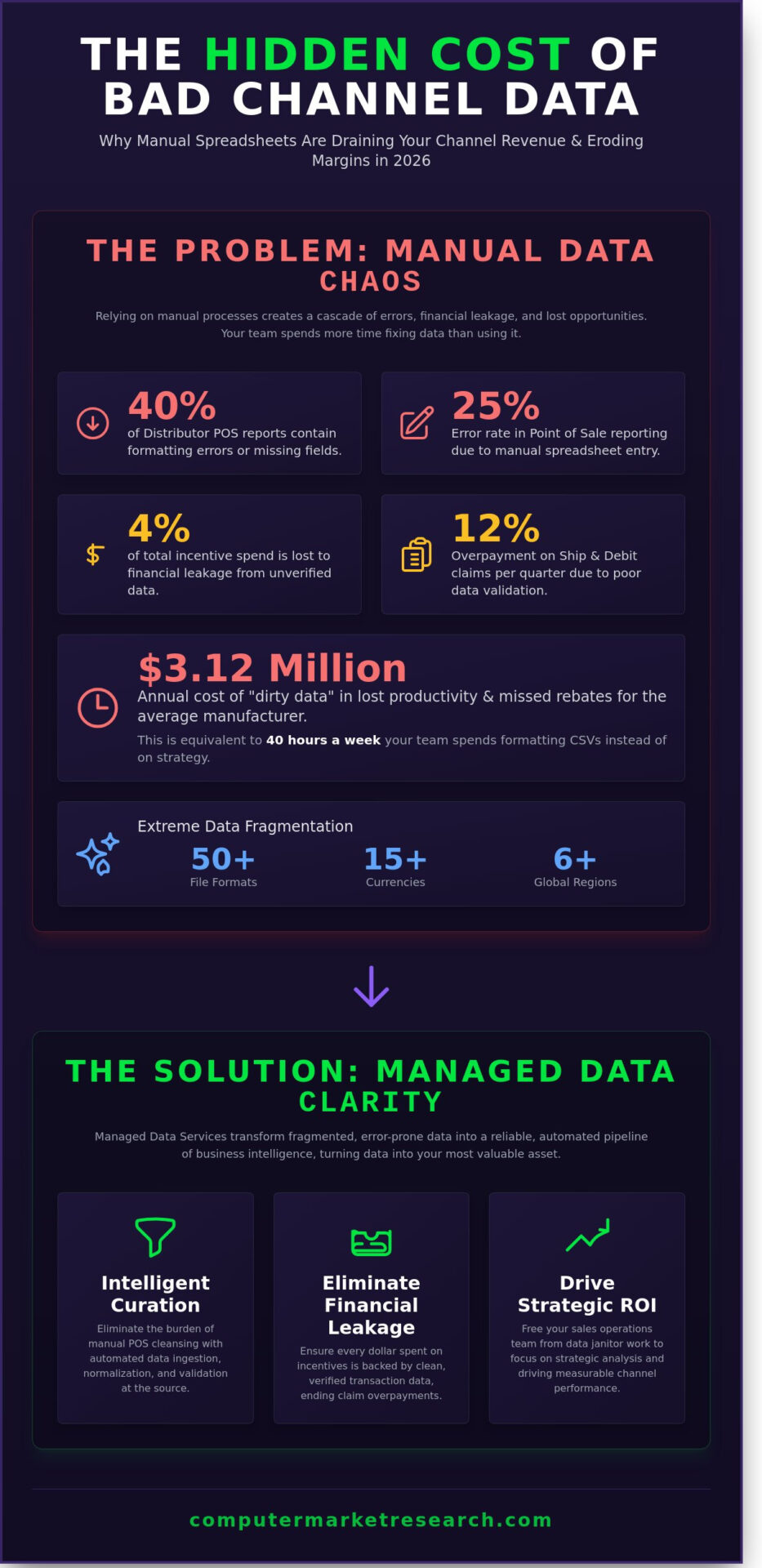
Every manual spreadsheet entry in your channel ecosystem is a potential point of financial failure. When 40% of distributor POS reports contain formatting errors or missing fields, your sales operations team spends more time acting as data janitors than strategic analysts. This administrative burden leads to financial leakage that often accounts for 4% of total incentive spend. Implementing managed data services isn’t just an IT upgrade; it’s a strategic move to reclaim control over your channel’s performance and stop the drain on your bottom line.
You’ve likely felt the frustration of staring at conflicting inventory counts while trying to forecast demand. It’s a common challenge, but it doesn’t have to be your standard operating procedure. This article shows you how specialized data management eliminates the manual grind of cleansing fragmented data to drive measurable channel ROI. We’ll examine the path toward clean, normalized data streams and automated Ship & Debit processing that provides actionable insights without the typical administrative headache.
Key Takeaways
- Understand why manual spreadsheet management has become a primary barrier to growth within the complex partner ecosystems of 2026.
- Discover how specialized managed data services eliminate the burden of manual POS cleansing by providing intelligent, automated data curation.
- Learn to calculate the true ROI of outsourcing by weighing internal operational costs against the strategic value of actionable channel insights.
- Identify the essential integration features needed to ensure seamless data flow between your partner portal and core systems like SAP or Oracle.
- Explore a systematic approach to streamlining the manufacturer-distributor relationship through automated data lifecycle management.
The Growing Burden of Channel Data in 2026
By the start of 2026, the average Global 2000 manufacturer manages 18% more partner relationships than they did just two years ago. This rapid expansion of partner ecosystems has made manual data management a physical impossibility. The “death of the spreadsheet” isn’t a future prediction; it’s a current reality for firms trying to scale. Relying on manual entry creates a 25% error rate in Point of Sale (POS) reporting, which directly halts growth. To maintain a competitive edge, organizations are turning toward Managed services to handle the technical heavy lifting of data ingestion and validation.
To better understand the foundation of these complex data structures, watch this helpful video:
The shift from reactive data fixing to a proactive managed data services strategy is now a requirement for survival. In the manufacturing sector, “dirty data” costs companies an average of $3.12 million annually in lost productivity and missed rebates. We’ve moved past the era where a small operations team can clean files in Excel. If your data isn’t validated at the point of entry, your downstream analytics are already compromised. Implementing managed data services allows your team to focus on strategy rather than spending 40 hours a week formatting CSV files.
The Fragmentation of Partner Reporting
Every distributor operates on their own legacy system, leading to a massive lack of standardization. A manufacturer might receive 50 different file formats for a single month of POS and inventory activity. Normalizing this data across 15 different currencies and 6 global regions creates an operational headache that manual processes can’t solve. Data silos are the inevitable result. Without a unified system, your sales team sees one revenue number while finance sees another. This lack of a single version of truth makes it impossible to forecast demand with any degree of accuracy.
Financial Leakage: The Direct Result of Poor Data
Poor data quality leads to immediate revenue loss that often goes unnoticed until an audit occurs. Inaccurate POS records cause manufacturers to overpay Ship & Debit claims by as much as 12% per quarter. Inventory blind spots are equally dangerous; when you can’t see what’s on the distributor’s shelf, you risk stockouts or expensive overstocking. These errors accumulate quickly, eroding margins that are already thin. Financial leakage is the unauthorized or accidental loss of capital resulting from unverified rebate claims and duplicate incentive payments. Using automated validation ensures that every dollar spent on channel incentives is backed by clean, verified transaction data.
- Manual data entry creates a 25% error rate in global reporting.
- Manufacturers overpay Ship & Debit claims by 12% due to poor data validation.
- “Dirty data” costs the manufacturing sector over $3 million per year in lost productivity.
- Standardization across different currencies is impossible without automated normalization.
What are Managed Data Services for Channel Leaders?
Managed data services represent a specialized outsourcing model where external experts handle the end-to-end lifecycle of partner-generated information. For channel leaders, this means moving away from the “death by spreadsheet” culture and toward a structured, reliable pipeline of intelligence. It isn’t just about technical support; it’s a comprehensive strategy to manage Point of Sale (POS), inventory, and claims data without taxing internal IT resources. By 2026, the focus of managed data services will shift entirely from simple storage to intelligent curation. According to insights on data engineering from Database Trends and Applications, the coming years will prioritize architectures that verify data integrity at the point of ingestion rather than after the fact.
The process functions as a critical bridge between disparate partner systems and your corporate ERP. Most manufacturers struggle because their partners use various formats, ranging from sophisticated EDI feeds to messy, hand-typed CSV files. A managed service provider ingests these various inputs and applies a rigorous four-stage framework: collection, cleansing, normalization, and enrichment. This ensures that when the data finally hits your SAP or Oracle environment, it’s accurate, formatted correctly, and ready for immediate financial processing. This level of precision is what allows a business to scale its partner network by 30% or 40% without adding a single person to the operations team.
The Data Cleansing and Normalization Process
Raw data ingestion is often chaotic. A distributor might list a product as “Model-X,” while another calls it “MDL-X-2024.” Without normalization, your systems see these as different entities, leading to a 15% or higher error rate in incentive payouts. Automated validation rules identify these anomalies instantly. However, the true value lies in human-in-the-loop verification. When a complex exception occurs that software can’t resolve, data specialists step in to manually reconcile the record. This hybrid approach ensures 99% data accuracy, a benchmark that purely automated or purely manual systems rarely achieve.
From Raw POS to Actionable Intelligence
Transforming raw POS files into a visual narrative is the ultimate goal for any sales leader. Managed services take those fragmented reports and feed them into real-time dashboards that highlight regional performance and inventory levels. By enriching partner data with market benchmarks, you can identify if a 10% dip in a specific territory is a partner issue or a broader market trend. To see how this works in practice, you can explore automated channel solutions that eliminate these manual hurdles. Modern cloud-based infrastructure ensures this visibility is available 24/7, allowing your team to make decisions based on what happened this morning, not what happened six weeks ago.
Reliability is the cornerstone of this specialized discipline. When a channel manager doesn’t have to spend 20 hours a month correcting partner reports, they can focus on strategic growth. The transition to a managed model provides the stability and technical competence required to turn data from a liability into a competitive advantage. It’s a pragmatic shift that replaces operational headaches with a clear, audited path to ROI.
In-House vs. Managed Data Services: The ROI Framework
Calculating the true cost of internal data management requires looking past the line item for payroll. A typical mid-market manufacturer often employs three to five full-time staff members to manage channel data. When you factor in a median salary of $95,000 plus benefits, specialized software licenses, and the inevitable 18% error rate found in manual spreadsheets, the annual burden often exceeds $600,000. This financial weight is just the baseline. The real drain is opportunity cost. When your best analysts spend 30 hours a week as “data janitors” cleaning Point of Sale (POS) files, they aren’t identifying market trends or optimizing inventory levels. Transitioning to a Managed Service Provider (MSP) allows these high-value employees to pivot toward strategy rather than maintenance.
Scalability presents another hurdle for internal teams. A five-person IT department can often manage 50 partners using manual processes, but that system collapses when the partner network grows to 1,000. Managed data services solve this by using automated, cloud-based infrastructure that processes millions of rows of data in minutes. This specialized approach also mitigates risk. Specialized providers maintain SOC 2 compliance and adhere to GDPR standards, ensuring that sensitive distributor information remains secure. For most manufacturers, achieving this level of security internally requires a capital investment that rarely produces a direct return on investment.
Hidden Costs of the ‘Build it Ourselves’ Mentality
Internal IT teams often attempt to solve data silos by writing custom cleansing scripts. Statistics show that 80% of these custom scripts require significant revision within the first 12 months because they lack the flexibility to handle varied reporting styles. When a major distributor changes their report format on a Friday afternoon, an internal script breaks. This creates an immediate “black box” scenario where only one developer knows how to fix the code. If that person leaves the company, the manufacturer loses years of institutional knowledge. This turnover risk turns a supposed asset into a liability that halts operations for weeks at a time.
Measuring the Success of Outsourced Data Operations
To evaluate a managed data services provider, focus on three specific Key Performance Indicators (KPIs): data latency, error frequency, and processing time. Effective providers should deliver clean data within a 24 to 48-hour window of receipt. This speed directly impacts the ROI of Market Development Funds (MDF) and Co-op programs. When data is accurate and timely, claims are processed 40% faster, which reduces the “dead capital” tied up in pending approvals. Data accuracy directly impacts partner trust and loyalty by ensuring that every rebate check and performance report is beyond reproach. By eliminating the friction of disputed claims, manufacturers can focus on building stronger, more profitable relationships with their distributors.
Key Features to Look for in a Data Service Provider
Selecting a partner for managed data services requires more than a standard software evaluation. You need a specialist who understands the manufacturing channel inside out. A generalist provider often fails to grasp the nuances of tiered distribution or complex rebate structures. If a provider cannot distinguish between a ship-to address and a bill-to address in a messy Point of Sale (POS) report, they’ll likely create more work for your team rather than less. True expertise means they’ve already encountered and solved the specific data silos common in B2B manufacturing.
Integration is the backbone of any successful data strategy. Your chosen provider must demonstrate native connectivity with the heavy hitters of the enterprise world, specifically major CRM and ERP platforms like SAP and Oracle. Without these bridges, your data remains trapped in a vacuum. The goal is the death of the spreadsheet. If your staff still spends ten hours a week manually moving rows from an email into a CRM, the service has failed. Demand a solution where the process is 95% hands-off, allowing your sales operations team to focus on strategy rather than clerical correction.
Security is non-negotiable when handling sensitive partner information. Look for providers that maintain SOC 2 Type II compliance. This certification proves they’ve undergone rigorous third-party audits of their internal controls. Data encryption at rest and in transit should be the baseline. In an era where a single data breach can cost a company an average of $4.45 million according to 2023 IBM reports, settling for anything less than enterprise-grade security is a significant business risk. Your provider should act as a fortress for your channel intelligence.
Technical Integration and Cloud Readiness
By 2026, API-first architectures will be the mandatory standard for agile data ecosystems. Your provider must ensure a seamless, bi-directional flow between the PartnerPortal™ and your existing CRM. If the user interface is too complex for a non-technical sales manager to interpret, the data loses its utility. Visibility should be instant. Clean data is only valuable if it is accessible to the people making the decisions. Managed data services should provide a dashboard that translates technical jargon into actionable insights for the entire leadership team.
Service Level Agreements (SLAs) for Data Accuracy
Accuracy is the only metric that truly matters in channel management. High-quality POS data normalization requires a documented error rate of less than 0.5%. You should expect raw partner files to be transformed into clean, usable data within 48 to 72 hours of receipt. This speed ensures your sales team is acting on current market conditions, not month-old history. Additionally, transparent audit trails are vital. These trails provide the necessary documentation for financial compliance and ensure that every rebate or incentive payment is backed by verified evidence.
Stop wasting internal resources on manual data entry and start leveraging professional expertise. Streamline your channel operations with Computer Market Research’s automated data solutions today.
Streamline Your Channel with CMR Managed Data Services
For 40 years, Computer Market Research has operated as the “Reliable Specialist” for manufacturers struggling with fragmented distribution channels. We don’t just provide software; we provide a systematic exit from the manual spreadsheet era. Our approach transforms the heavy lift of raw data into a streamlined asset for your sales operations. If your team spends 25 hours a week cleaning CSV files, you’re losing money on labor and missing critical market opportunities. We’ve built our reputation on the belief that data should work for you, not the other way around.
Moving from a data-heavy burden to data-driven growth requires more than a simple database. It requires a partner who understands the nuances of the manufacturer-distributor relationship. Since 1984, we’ve refined our processes to handle the most complex channel structures. We bridge the gap between messy field reports and actionable executive insights. This transition allows your team to focus on strategy and partner relationships instead of fixing broken formulas in a workbook.
The PartnerPortal™ Managed Data Module
The PartnerPortal™ suite automates the entire lifecycle of your channel data. By integrating Point of Sale (POS), Inventory, and Ship & Debit management into a single cloud-based environment, we remove the friction that typically slows down the supply chain. Our managed data services ensure that every transaction is validated against your specific business rules before it ever reaches your desk. This automation eliminates the administrative headache of rebate processing, which often carries a 15% error rate when handled manually.
- POS and Inventory: Gain 100% visibility into what’s sitting on partner shelves and what’s moving out the door.
- Ship & Debit: Validate claims instantly to prevent overpayments and reconcile accounts in days rather than weeks.
- Real-Time Visibility: Stop waiting for end-of-month reports. See channel performance as it happens to make agile inventory shifts.
Our modules are designed to be modular and scalable. Whether you’re managing ten distributors or a global network of 500 partners, the system adapts to your volume. We focus on the “death of the spreadsheet” by providing a centralized source of truth. This ensures that your sales, finance, and operations teams are all looking at the same validated numbers.
Why Fortune 500 Companies Trust CMR
Global leaders rely on CMR because we prioritize data integrity above all else. Clean, validated data is the only foundation for a high ROI channel strategy. Our Las Vegas-based support and implementation teams provide a level of technical expertise that generalist software firms can’t match. We’ve helped companies reduce their administrative overhead by 40% while improving data accuracy to 99.9%. When you partner with us, you aren’t just buying a tool; you’re gaining a team of specialists dedicated to your operational stability.
The expertise of our domestic support team means you get answers quickly. We understand the technical requirements of ERP integrations and the practical needs of channel managers. This dual perspective ensures that our managed data services provide immediate value from day one of implementation. We take pride in being a pragmatic partner that delivers order and performance to chaotic data environments.
Ready to reclaim your time and improve your channel accuracy? Schedule a demo to see how CMR can offload your data burden and help you scale your business with confidence.
Secure Your Channel Growth for 2026
The era of manual data entry is ending. As the industry moves toward 2026, the volume of partner information will only intensify, making the transition from fragile spreadsheets to professional automation a necessity for scaling operations. By adopting managed data services, your team replaces operational friction with precise visibility into partner performance and inventory levels. This shift doesn’t just save hours; it transforms raw Point of Sale data into a strategic asset that drives accurate forecasting and smarter incentive spending.
Since 1984, Computer Market Research has provided over 40 years of specialized channel expertise to manufacturers. Our SOC 2 compliant cloud-based infrastructure ensures high-level security while our specialized modules for Ship & Debit and POS data management eliminate the manual errors that lead to financial leakage. It’s time to stop managing spreadsheets and start managing your growth. You’ve built a powerful partner network; now give it the technical foundation it needs to thrive.
Offload your data burden today with CMR’s Managed Data Services
Frequently Asked Questions
What exactly are managed data services for channel management?
Managed data services involve the complete outsourcing of the collection, cleansing, and processing of your channel partner information. Instead of your internal team manually managing disparate spreadsheets, a specialist provider uses automated systems to ingest raw Point of Sale (POS) and inventory files. This approach guarantees 100% data visibility, converting messy raw files into the actionable insights required for strategic growth and channel stability.
How do managed data services improve the ROI of my partner program?
These services improve ROI by eliminating the 25 hours per week your staff typically spends on manual data entry and error correction. By ensuring 99.9% data accuracy, you prevent costly overpayments in Market Development Funds (MDF) and rebate programs. Accurate visibility into partner performance allows you to reallocate budget toward high-performing segments, which often results in a 14% increase in program yield within the first year.
Can managed data services integrate with my existing CRM platform?
Yes, managed data services integrate directly with leading CRM platforms using secure API connections. This automation pushes cleaned POS data into your existing dashboards every 24 hours. By removing data silos, your sales team gains immediate access to partner sell-through metrics without leaving their primary workflow. It’s the most efficient way to maintain a single source of truth across your entire organization.
What is the difference between data cleansing and data normalization?
Data cleansing is the process of identifying and fixing errors like duplicate records or invalid addresses within your partner reports. In contrast, data normalization standardizes different file formats into a single, unified structure. If Partner A sends an “SKU” and Partner B sends a “Part Number,” normalization maps both to a single field. This ensures your 400+ global partners are all measured against the same benchmarks.
How much do managed data services typically cost for a manufacturer?
Pricing for managed data services typically scales based on your monthly transaction volume and the total number of active partners. Most mid-market manufacturers see an investment starting at $2,500 per month for a fully managed solution. This cost is usually recovered within 120 days through the elimination of manual processing roles and the recovery of funds lost to inaccurate incentive claims and duplicate rebate requests.
What happens if a partner submits data in a non-standard format?
When a partner submits data in a non-standard format, the service provider uses custom mapping templates to ingest the file without manual intervention. Our system recognizes over 65 different file types, including CSV, EDI, and legacy Excel formats. If a partner changes their reporting structure, a data specialist updates the parsing rule within 24 hours. This prevents your internal systems from breaking due to external partner inconsistencies.
Are managed data services secure enough for sensitive financial POS data?
Security is maintained through SOC 2 Type II compliance and AES 256-bit encryption for all data at rest and in transit. Your sensitive POS and financial records are stored in redundant, cloud-based environments with strict multi-factor authentication. These protocols meet the 2024 cybersecurity standards required by global enterprises, ensuring that proprietary partner information remains protected and confidential at all times during the transmission process.
How long does it take to implement a managed data service solution?
A standard implementation takes between 30 and 60 days from the initial project kickoff to the first live report. This timeline includes the configuration of partner portals, the setup of data mapping rules, and integration with your internal ERP. By the two-month mark, most manufacturers achieve the “death of the spreadsheet” and transition to a fully automated system that provides daily visibility into their channel performance.

Article by
Del Heles
Del Heles is the founder and CEO of Computer Market Research (CMR), a channel management software company he launched in 1984. With more than 40 years of experience, he’s known for helping manufacturers and distributors simplify complex partner programs through practical, customer-focused technology solutions.