

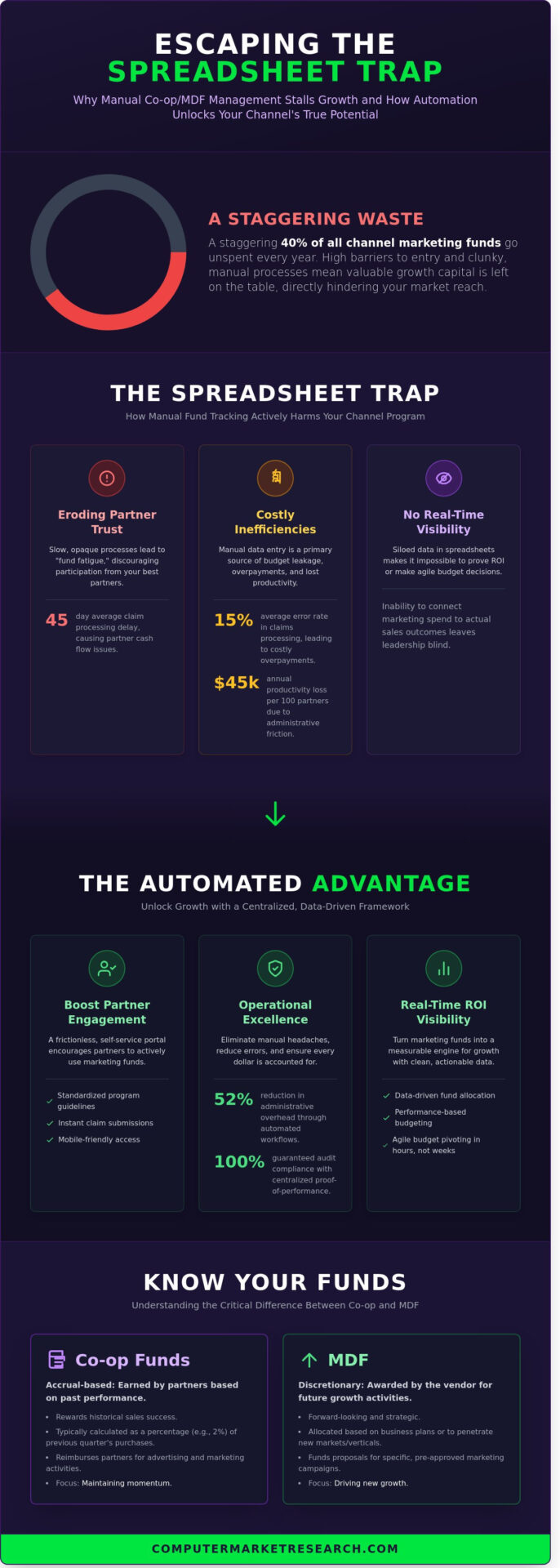
A staggering 40% of channel marketing funds go unspent every year because the barrier to entry for partners is simply too high. When your team relies on fragmented spreadsheets for co-op/mdf management, you aren’t just losing time; you’re actively eroding partner trust through 45-day claim processing delays and 15% error rates. You likely already know that manual data entry is the primary obstacle to scaling your channel program. It’s a source of constant operational headaches that makes proving ROI to executive leadership nearly impossible.
This principle of replacing administrative friction with specialized software extends beyond channel marketing. In other complex sectors like UK healthcare, for example, dedicated platforms are essential for managing everything from patient records to regulatory compliance. To see how automation is applied in that field, you can find out more about Care Management Software.
This guide offers a clear path out of the spreadsheet trap. You’ll learn how to implement an automated system that reduces administrative overhead by 52% and guarantees 100% audit compliance. By moving to a centralized, cloud-ready infrastructure, you can provide the real-time visibility your distributors demand. We’ll outline the specific steps to transition from manual tracking to a streamlined, data-driven framework that increases partner participation and turns your marketing funds into a measurable engine for growth.
Key Takeaways
- Identify the critical distinctions between discretionary MDF and accrual-based funding to align your financial strategy with partner performance.
- Recognize how manual spreadsheet tracking leads to “fund leakage” and costly overpayments that stall your channel growth and waste budget.
- Streamline partner engagement by standardizing program guidelines and implementing a self-service portal for frictionless claim submissions.
- Transition to automated co-op/mdf management to eliminate operational headaches and gain real-time visibility into marketing ROI.
- Adopt a modular, cloud-based approach to ensure your channel data remains clean, accurate, and actionable for a 2026 “channel-first” strategy.
What is Co-op/MDF Management in 2026?
In the current B2B environment, Market Development Funds (MDF) and co-op programs represent more than just line items on a balance sheet. Effective co-op/mdf management is the systematic control and optimization of marketing capital allocated to downstream channel partners. By 2026, 73% of B2B organizations have adopted a channel-first go-to-market strategy. This shift transforms these funds from simple discretionary grants into high-precision instruments for driving partner-led growth.
To better understand how these programs function in a modern enterprise environment, watch this helpful video:
The era of “check-the-box” spending has ended. Historically, manufacturers saw a 22% leakage in fund utilization because of opaque, paper-heavy processes. Today, performance-based allocation ensures that capital flows to partners who demonstrate measurable ROI. Modern SaaS platforms have replaced the fragmented email chains of the past. These systems centralize fund requests, automate approval workflows, and accelerate the reimbursement cycle. This level of automation turns a once-clunky administrative burden into a competitive advantage by providing real-time visibility into every dollar spent.
The Core Components of a Modern Fund Program
Success in co-op/mdf management relies on three pillars. First, fund allocation must be data-driven. Brands determine budgets based on 12-month trailing sales or specific strategic growth goals rather than gut feeling. Second, activity management defines sanctioned tactics. This includes webinars, SEO campaigns, or localized events that align with the brand’s identity. To help partners execute these high-impact digital initiatives, you can learn more about Content Masters Marketing Management. Finally, the claim and reimbursement workflow ensures partners submit proof-of-performance for verification before payment is issued. This structure maintains compliance while protecting the manufacturer’s margins.
Why Traditional “Manual” Management is Failing
Administrative friction costs the average manufacturer $45,000 annually per 100 partners in lost productivity. We’re witnessing the death of the spreadsheet in channel operations. Manual data entry is the primary obstacle to growth because it’s slow and prone to human error. If a supply chain disruption occurs, managers need to pivot budgets in 24 hours, not three weeks. Spreadsheets cannot provide that agility. Manual systems also create a disconnect between marketing spend and actual sales outcomes, leaving leadership blind to which incentives actually move the needle. When data stays in silos, manufacturers can’t see the full picture of their partner’s performance.
Relying on outdated methods leads to “fund fatigue” where partners stop participating because the process is too difficult. By 2026, partners expect a seamless digital experience. They want to see their available balance, submit a claim via a mobile device, and receive reimbursement through automated clearing house transfers. If you don’t provide this level of efficiency, your best partners will likely shift their focus to competitors who do. Clean data and automated workflows are no longer optional features; they’re the foundation of any scalable channel strategy.
Co-op vs. MDF: Understanding the Key Differences
Channel leaders often conflate Market Development Funds (MDF) and Co-operative Advertising. While both provide financial support to partners, they operate on opposite ends of the sales cycle. Effective co-op/mdf management requires a technical grasp of these distinctions to prevent budget leakage and ensure every dollar drives measurable growth. The fundamental difference lies in how funds are generated: MDF is discretionary and forward-looking, while Co-op is accrual-based and rewards historical performance.
If a manufacturer allocates funds based on a partner’s projected ability to penetrate a new vertical, they’re using an MDF model. If they provide a credit based on 2% of the partner’s total purchases from the previous quarter, they’re using a Co-op model. Mixing these up leads to operational headaches, as the compliance requirements and ROI expectations for each are vastly different. Modern co-op/mdf management platforms solve this by segmenting these funds into distinct workflows, ensuring that sales operations teams maintain full visibility into where capital is deployed.
MDF: The Discretionary Growth Engine
MDF functions as a strategic bet on a partner’s future. Manufacturers grant these funds to select partners to stimulate demand before a sale ever occurs. This model is highly discretionary; the manufacturer decides who receives the investment based on strategic alignment rather than a fixed formula. It’s particularly effective when a brand needs to pivot. For instance, if a company aims to increase its footprint in the healthcare sector by 15% in 2025, it might grant MDF to partners with established medical client bases for specialized webinars or lead-generation campaigns.
- Focus on future sales: Allocating funds based on potential and strategic alignment.
- Best used for: Launching new products or entering new geographic territories where historical data doesn’t yet exist.
MDF is a proactive investment in partner-led market expansion.
Co-op Funds: The Reward for Performance
Co-op funds are earned, not granted. These funds accumulate as a percentage of a partner’s product purchases, creating a predictable budget for ongoing marketing efforts. This model rewards high-volume distributors and rewards loyalty by subsidizing the costs of maintaining brand presence. A standard Co-Op Advertising program typically requires partners to provide proof of performance, such as digital invoices or media placements, before receiving reimbursement.
The primary challenge with Co-op funds is “breakage.” Industry data from 2023 shows that nearly 40% of accrued co-op funds go unspent because partners find the claim process too cumbersome. This “use it or lose it” nature can create friction if the manufacturer doesn’t provide a clear, automated path for fund utilization. When funds expire, the brand loses out on local market visibility that could have sustained its competitive edge.
The Hybrid Strategy for Maximum ROI
Relying on a single funding model often leaves gaps in a channel strategy. Established distributors benefit from the stability of Co-op accruals, but new, high-growth partners might lack the historical volume to earn significant funds. A hybrid approach allows a manufacturer to reward its “steady earners” while simultaneously funding “rising stars” through discretionary MDF.
By integrating automated incentive tracking, businesses can transition away from manual spreadsheets that obscure fund status. This level of control ensures that if a partner isn’t utilizing their Co-op balance, those funds can be strategically reallocated as MDF to a more active partner. This shift from static budgeting to dynamic fund management is the only logical step for brands looking to optimize their channel spend and eliminate wasted marketing capital.
The Spreadsheet Trap: Why Manual Fund Tracking Stalls Growth
Many channel managers argue that their current Excel systems have served them well for over a decade. This reliance creates a false sense of security. While a spreadsheet might track a single transaction, it cannot scale alongside a growing network of 50 or more distributors. As volume increases, the visibility into how capital is actually deployed vanishes. Relying on legacy tools for co-op/mdf management ensures that marketing spend data never communicates with the CRM or ERP, leaving leadership with a fragmented view of performance.
Manual data entry carries a high price. Industry benchmarks suggest that manual co-op/mdf management often results in a 4% to 6% error rate due to duplicate claims or miscalculated accruals. For a manufacturer with a $5 million channel budget, this equates to $300,000 in annual capital waste. This “fund leakage” isn’t just a rounding error; it’s a direct hit to the bottom line that remains invisible until a formal audit occurs. Most of these losses stem from simple human oversights:
- Accidental double-payments on a single invoice.
- Approving claims that don’t meet brand guidelines.
- Applying incorrect percentage splits for shared marketing costs.
Speed is the currency of partner loyalty. When distributors wait 90 days for reimbursement due to manual verification, their cash flow suffers. This friction causes top-tier partners to prioritize competitors who offer faster, more transparent payment cycles. Automation reduces this cycle to under 14 days, strengthening the manufacturer-distributor bond. If the process is painful, partners simply won’t use the funds, leading to underutilized budgets and stagnant regional growth.
Operational Headaches of Manual Auditing
Gathering Proof of Performance (PoP) through fragmented email threads is a logistical nightmare. Staff members often spend 15 hours per week chasing down screenshots or invoices to justify a single month of claims. During a corporate financial audit, these manual records frequently lack the necessary “paper trail” to satisfy compliance standards. Reconciling claims against three different versions of a master spreadsheet leads to version conflict; this makes it impossible to determine which document represents the truth. It’s an administrative burden that pulls high-value employees away from strategic planning.
The Opportunity Cost of Poor Visibility
If you can’t see fund requests in real-time, you’ll miss critical market shifts. For instance, if 40% of partners suddenly request funds for a specific regional trade show, manual trackers won’t flag this trend until the quarter is over. This lack of agility prevents you from pivoting budgets to counter a sudden competitive threat or capitalize on a localized surge in demand. Without centralized data, it’s impossible to calculate true Channel ROI because the connection between spend and point-of-sale results is severed. You end up spending money based on historical habits rather than current performance data.
Best Practices for Automating Your Co-op/MDF Program
Manual co-op/mdf management is a primary obstacle to channel growth. Industry data indicates that up to 22% of allocated funds go unspent each year because of administrative friction and complex manual processes. Transitioning from fragmented spreadsheets to a structured, automated system is the only way to reclaim this lost opportunity. It requires a systematic approach to eliminate the data silos that typically plague manufacturer-distributor relationships.
Standardizing your program guidelines is the first essential step. Ambiguity is the enemy of partner participation. If a partner isn’t 100% certain that a specific digital marketing campaign or trade show booth qualifies for reimbursement, they won’t commit their own capital. You must define eligible activities, required documentation, and expiration timelines with absolute clarity. Clear, standardized rules can reduce program-related support tickets by 90%.
Automation succeeds when you implement a self-service Partner Portal for all requests and claims. This centralizes communication and removes the “black hole” effect of email-based submissions. Once the portal is active, you can automate the approval workflow based on pre-defined business rules. For instance, claims under $500 that meet all documentation requirements can be auto-approved, while larger requests are routed to specific managers. This ensures that your team focuses on high-impact strategic decisions rather than repetitive data entry.
Integrating your fund management with Point of Sale (POS) and inventory data provides a level of precision that manual systems can’t match. When accruals are tied directly to actual sales data, you eliminate the risk of over-allocating funds based on inaccurate forecasts. This integration allows for a 75% reduction in manual data reconciliation tasks. Finally, use real-time dashboards to monitor fund utilization. If a specific region is only using 40% of its allocated co-op funds by mid-quarter, you can reallocate those resources to higher-performing partners before the budget expires.
Creating an Audit-Ready Environment
Automated systems protect your budget by ensuring 100% digital storage of all Proof of Performance documents. This creates an instant retrieval system for internal or external audits. By using automated validation, the system checks every claim against your program rules before a single dollar is paid. This rigorous process typically reduces fraudulent or non-compliant claims by 15%. You maintain a transparent paper trail for every transaction, ensuring total accountability across the channel.
Driving Partner Adoption
Partner loyalty is built on reliability and speed. You should aim to reduce your “Time-to-Payment” from the industry average of 45 days to under 10 days. Automated notifications are also vital; they remind partners of expiring funds 30 days in advance, which drives higher utilization. When partners have real-time visibility into their available balances through a portal, they are 30% more likely to initiate new marketing activities. Speed and transparency make you the preferred manufacturer to do business with.
How CMR PartnerPortal™ Streamlines Co-op/MDF Management
Computer Market Research delivers a modular, cloud-based framework that redefines the standards of co-op/mdf management. We recognize that manufacturers often struggle with fragmented data and decentralized processes. Our approach replaces the “spreadsheet headache” with automated workflows that ensure every marketing dollar is accounted for. This isn’t just about moving data to the cloud; it’s about creating a centralized ecosystem where fund allocation and reimbursement happen in a fraction of the traditional time. Industry data suggests that 65% of channel managers still rely on manual tracking, which leads to a typical 12% error rate in data entry. Our platform eliminates these inaccuracies through systematic automation.
The core of our solution focuses on three critical areas of channel operations. First, we provide automated accrual tracking that calculates fund availability based on real-time sales volume. Second, our digital Proof of Performance (PoP) submission process reduces audit cycles by as much as 40%. Partners upload documentation directly to the portal, which triggers an automated validation sequence. Finally, the platform offers deep CRM integration. This ensures that your sales and marketing teams operate from a single source of truth, rather than working within isolated data silos that hinder decision-making.
The “CMR Advantage” goes beyond basic administration. We provide 360-degree visibility by linking marketing funds directly to Ship & Debit claims and Point of Sale (POS) data. This level of granularity is rare. It allows you to verify that funds were used for their intended purpose and that the resulting sales actually occurred. You get a clear, data-backed view of your entire channel ecosystem. This transparency builds trust between manufacturers and distributors while protecting your margins from fraudulent or duplicate claims. We turn administrative burdens into strategic advantages.
Real-Time ROI Tracking
Effective co-op/mdf management requires a shift from tracking spend to measuring outcomes. Our custom reporting tools show you exactly which partners and activities drive the highest revenue. You can analyze performance by region, product line, or specific campaign type. This data allows you to reallocate funds to high-performing areas instantly, ensuring your marketing budget isn’t wasted on stagnant programs. Learn more about our POS Data Management to see how we validate these performance metrics through clean, actionable data.
Seamless Integration with Your Tech Stack
We act as a “Reliable Specialist” that complements your existing infrastructure. Our module integrates directly with major ERP and CRM systems like Oracle and SAP. We handle the heavy lifting of data cleansing and normalization, ensuring that 100% of the information entering your system is accurate. This removes the burden from your internal IT teams and allows your channel managers to focus on strategy rather than data repair. Request a demo of the CMR Co-op/MDF Management Module today and take the first step toward operational excellence.
Future-Proof Your Channel Strategy
The era of managing complex marketing funds through manual spreadsheets has ended. If your team still relies on disconnected data silos, you’re likely facing the operational headaches that stall partner growth. Modern co-op/mdf management requires a shift toward 100% cloud-based, audit-ready infrastructure to maintain a competitive edge in 2026. By prioritizing automation, you eliminate the risk of manual errors and gain the visibility needed to drive higher ROI from your manufacturer-distributor relationships.
Since 1984, Fortune 500 companies have trusted Computer Market Research to solve their most difficult data challenges. Our CMR PartnerPortal™ reduces claim processing time by up to 75%, allowing your team to focus on high-level strategy rather than administrative bottlenecks. It’s time to replace outdated workflows with a systematic approach that ensures stability and accuracy across your entire channel. This transition isn’t just about software; it’s about building a reliable foundation for scalable growth.
Automate your fund management with a CMR PartnerPortal™ Demo
Building a more efficient, data-driven partnership starts with the right tools. We’re ready to help you navigate this transition with confidence.
Frequently Asked Questions
What is the difference between MDF and Co-op funds?
MDF is discretionary and forward-looking, while Co-op funds are earned based on past sales performance. Manufacturers use MDF to stimulate future growth through specific, strategic partners. Co-op funds accrue as a fixed percentage of total purchases, typically ranging from 1% to 5% of gross sales. This distinction is vital for effective co-op/mdf management because it dictates how budgets are allocated and audited.
How do companies typically calculate Co-op fund accruals?
Companies calculate Co-op fund accruals by applying a fixed percentage to a partner’s net purchase volume over a set fiscal period. For instance, a hardware manufacturer might allocate 2% of every $100,000 in wholesale orders to a partner’s marketing bank. These funds usually expire within 6 to 12 months if they aren’t utilized for approved advertising activities. This systematic approach ensures that high-performing distributors receive proportional marketing support.
What are common examples of activities covered by Market Development Funds?
Market Development Funds typically cover strategic initiatives like webinars, trade show booth rentals, or localized digital ad campaigns. A partner might request $5,000 to host a lunch-and-learn event for 25 prospective leads. Other common uses include hiring temporary sales staff for a product launch or funding technical certifications for engineers. These activities focus on expanding market share rather than just maintaining brand presence.
Why is Proof of Performance (PoP) critical in MDF management?
Proof of Performance is critical because it validates that marketing dollars were spent according to the agreed-upon terms. Without documentation like invoices, tear sheets, or 100% of lead lists, manufacturers risk non-compliance and financial waste. Robust co-op/mdf management requires these artifacts to clear audits and justify future budget requests. It bridges the gap between a partner’s claim and the actual execution of the campaign.
How does automation reduce the risk of channel fund fraud?
Automation reduces fraud by enforcing standardized workflows and flagging duplicate or suspicious claims instantly. Manual spreadsheet tracking allows up to 15% of claims to contain errors or fraudulent data. An automated system cross-references invoices against pre-approved activities and historical spending patterns. This transparency eliminates “double-dipping” and ensures that 100% of distributed funds are tied to legitimate, verified marketing efforts.
Can Co-op/MDF management software integrate with my existing CRM?
Yes, modern fund management platforms integrate with CRMs like Salesforce or Microsoft Dynamics using standard API protocols. These integrations allow for the seamless transfer of partner data and sales performance metrics. By syncing these systems, channel managers can see exactly how a $10,000 MDF investment correlates with new opportunities in the sales pipeline. This connectivity eliminates data silos that often plague manual reporting processes.
What is the average ROI of an automated fund management platform?
Organizations using automated platforms typically see a 20% increase in fund utilization and a 30% reduction in administrative overhead. By replacing manual entry, companies save approximately 40 hours of labor per month for every 50 partners managed. These efficiency gains allow channel teams to focus on strategy rather than clerical tasks. The software pays for itself by capturing “lost” funds and preventing overpayments.
How do I encourage my partners to actually use their allocated marketing funds?
You can encourage utilization by simplifying the claims process and providing pre-approved marketing “menus.” When partners see that reimbursement takes 10 days instead of 45, they’re more likely to participate. Providing ready-to-use templates for email campaigns or social media ads reduces the barrier to entry. Clear visibility into expiring balances also prompts partners to act before their earned credits disappear.

Article by
Del Heles
Del Heles is the founder and CEO of Computer Market Research (CMR), a channel management software company he launched in 1984. With more than 40 years of experience, he’s known for helping manufacturers and distributors simplify complex partner programs through practical, customer-focused technology solutions.